Firm Quote
A firm quote is an actionable, legally binding two-sided price quotation offered by a market maker or dealer that guarantees immediate order execution at the quoted rate for a specified transaction volume.
What Is a Firm Quote?
A firm quote (or executable quote) is a definitive, legally binding price quotation provided by a financial dealer, market maker, or electronic exchange. Unlike an informational or indicative price, a firm quote represents an unconditional commitment: if a trader or institution accepts the quoted price within the permitted time window, the dealer is contractually and legally obligated to execute the transaction at that exact price for the stated order size.
In interbank foreign exchange (FX) trading and institutional electronic communications networks (such as EBS Market or Currenex), firm quotes form the core of continuous order matching. When a Tier-1 bank posts a firm quote into the central limit order book, any market participant can match against it immediately without fear of the dealer rejecting the trade, altering the spread, or issuing a re-quote.
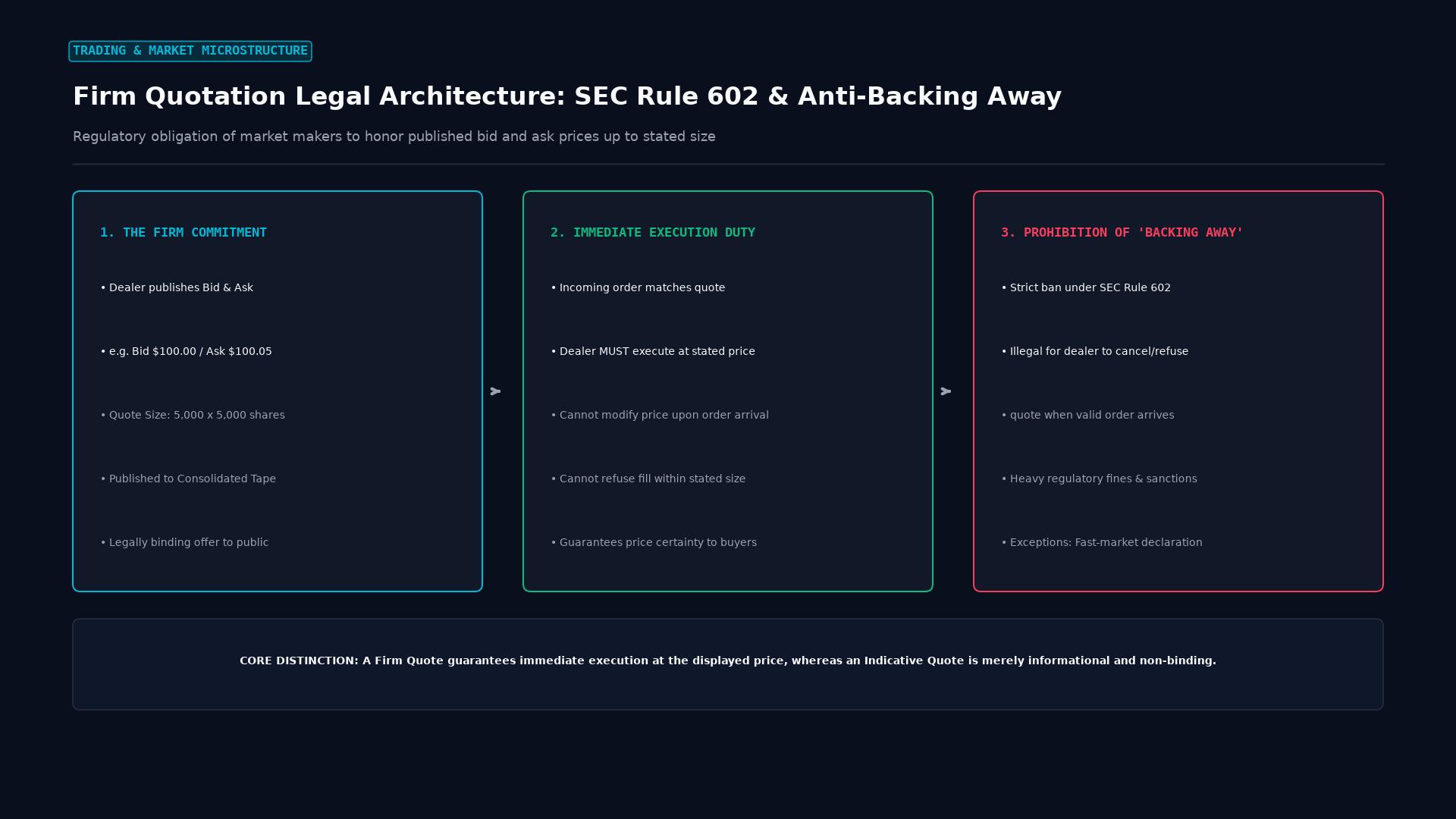 Figure: Market maker legal obligations: publishing actionable two-way quotes with mandatory execution duty up to stated size, strictly prohibiting backing away under SEC Rule 602.
Key Takeaways
- Legally Binding Obligation: A firm quote cannot be rescinded or altered once the counterparty hits the bid or lifts the offer within the valid quoting timeframe.
- Fixed Size Constraint: Firm quotes are always tied to a maximum transaction size (e.g., “Firm for 5 million USD”); orders exceeding that amount may sweep deeper liquidity tiers.
- Firm vs. Indicative: Indicative quotes are mere estimates for price reference; firm quotes are actionable prices ready for immediate execution.
- The FX Global Code Standard: Under principle 17 of the FX Global Code, market makers providing firm liquidity are prohibited from utilizing “Last Look” delays to unfairly reject winning trades.
Firm Quote vs. Indicative Quote Comparison
| Feature | Firm Quote (Executable) | Indicative Quote (Informational) |
|---|---|---|
| Legal Status | Legally binding contract upon acceptance | Non-binding reference estimate |
| Re-quote Risk | Zero; dealer cannot change price | High; dealer can reject or re-quote |
| Execution Speed | Instantaneous (sub-millisecond electronic fill) | Slower; requires dealer re-confirmation |
| Primary Trading Venue | Central Limit Order Books (CLOBs), ECNs, MT5 | Indicative news feeds (Bloomberg/Reuters TV), weekend screens |
| Suitability for Algorithms | Essential for high-frequency and automated models | Unusable for automated algorithmic trading |
The “Last Look” Controversy in Foreign Exchange
In Over-the-Counter (OTC) foreign exchange, the concept of a firm quote was historically complicated by a practice known as “Last Look”:
How "Last Look" Undermined Firm Liquidity:
1. Dealer streams an apparent firm quote to a client terminal.
2. Client clicks to execute at 1.0820.
3. LAST LOOK WINDOW (100–300 ms delay): Dealer holds the order while watching
   the broader interbank market.
4. If market moves in client's favor: Dealer rejects the trade ("Price moved").
5. If market moves against client: Dealer accepts and fills the order.
Because Last Look allowed dealers to treat supposedly firm quotes as optional, global regulatory bodies intervened. The Bank for International Settlements (BIS) and the Foreign Exchange Working Group developed the FX Global Code, requiring liquidity providers to eliminate unfair last-look latency buffers and provide genuine, non-discriminatory firm liquidity feeds.
Streaming Executable Prices (ESP) vs. Request for Quote (RFQ)
Institutional currency platforms deliver firm quotes through two primary technical channels:
1. Executable Streaming Prices (ESP)
Liquidity providers stream continuous, live, two-sided firm prices into the trading platform. The trader can click directly on the streaming Bid or Ask to execute instantaneously without prior communication. ESP is standard for liquid G10 currency pairs and retail forex trading.
2. Request for Quote (RFQ)
For illiquid exotic currencies or large multi-million-dollar block trades, continuous streaming is impractical. A corporate treasurer submits an RFQ to multiple banks. The banks respond with custom, two-sided firm quotes valid for a brief window (e.g., 5 seconds), during which the treasurer can execute with a single click.
Frequently Asked Questions
Can a firm quote expire?
Yes. A firm quote is binding only while it remains active on the order book. In high-frequency electronic markets, firm quotes are updated or replaced thousands of times per second. If an order reaches the server after the quote was legally refreshed by a new tick, the original quote is no longer active.
Why do news websites display indicative quotes instead of firm quotes?
Public financial websites and television networks display indicative quotes because market making firm quotes require expensive, high-bandwidth dedicated exchange data feeds. Furthermore, indicative quotes provide a sufficient general benchmark for retail observers without incurring institutional exchange licensing costs.
What is a “stale quote”?
A stale quote is a price that remains displayed on a screen or terminal due to network latency, software lag, or an inactive market maker after the true market price has moved. Under exchange rules, trading against an obvious stale quote is classified as latency arbitrage and may result in cancelled trades.
Ready to trade forex?
Open a free demo account with a regulated broker. Practice with virtual funds before risking real money.