First In First Out (FIFO)
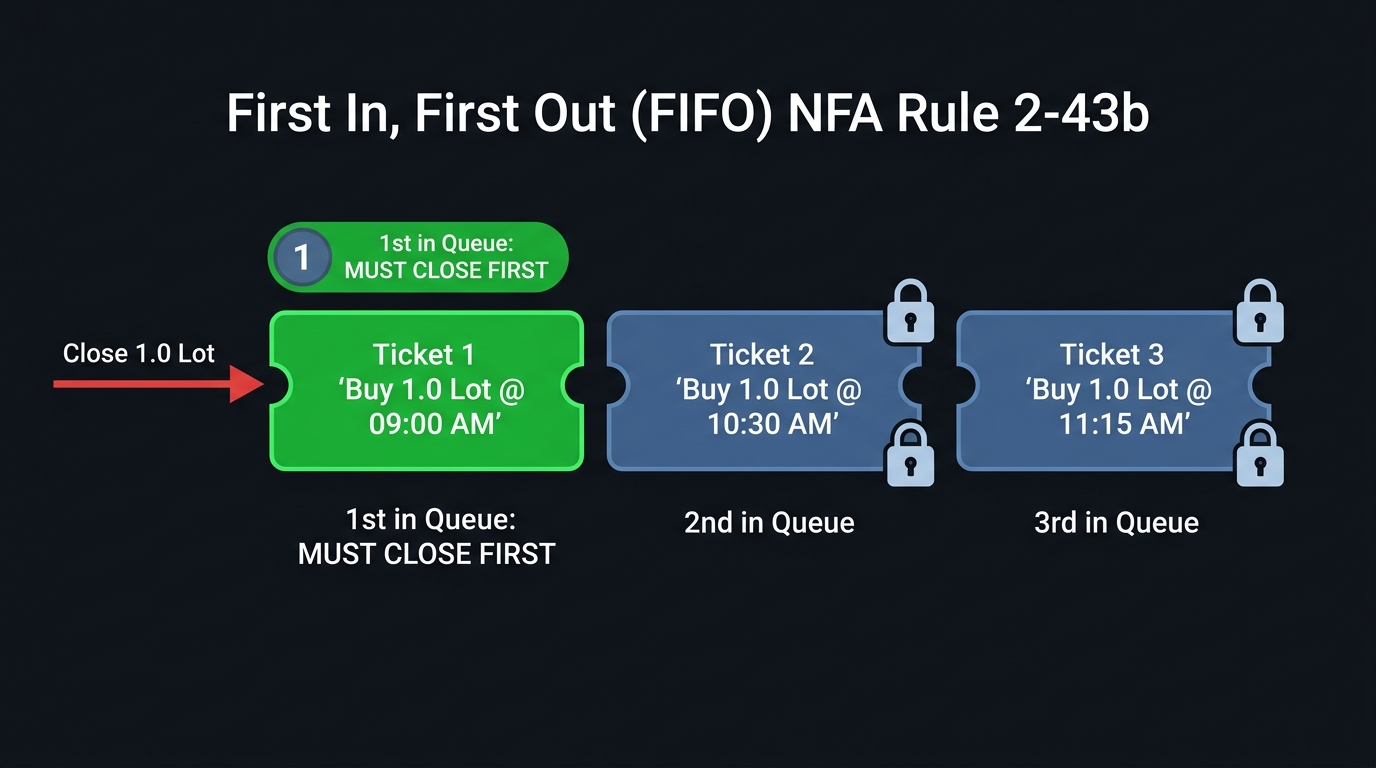
First In, First Out (FIFO) is a trading rule mandating that if a trader opens multiple positions of the same currency pair and lot size, the oldest position must be closed before newer positions can be liquidated.
What Is the FIFO Rule in Forex?
First In, First Out (FIFO) is a regulatory trading execution mandate enforced in specific financial jurisdictions—most notably the United States. Under the FIFO rule, if a trader holds multiple open positions of the identical currency pair and lot size, the broker’s trading platform must liquidate the earliest opened trade first when an exit order is executed.
Traders subject to FIFO cannot selectively close their second or third trade while keeping their first trade running. For example, if a trader buys 1 standard lot of EUR/USD on Monday, another lot on Tuesday, and a third lot on Wednesday, any closing order for 1 lot must automatically close Monday’s position first.
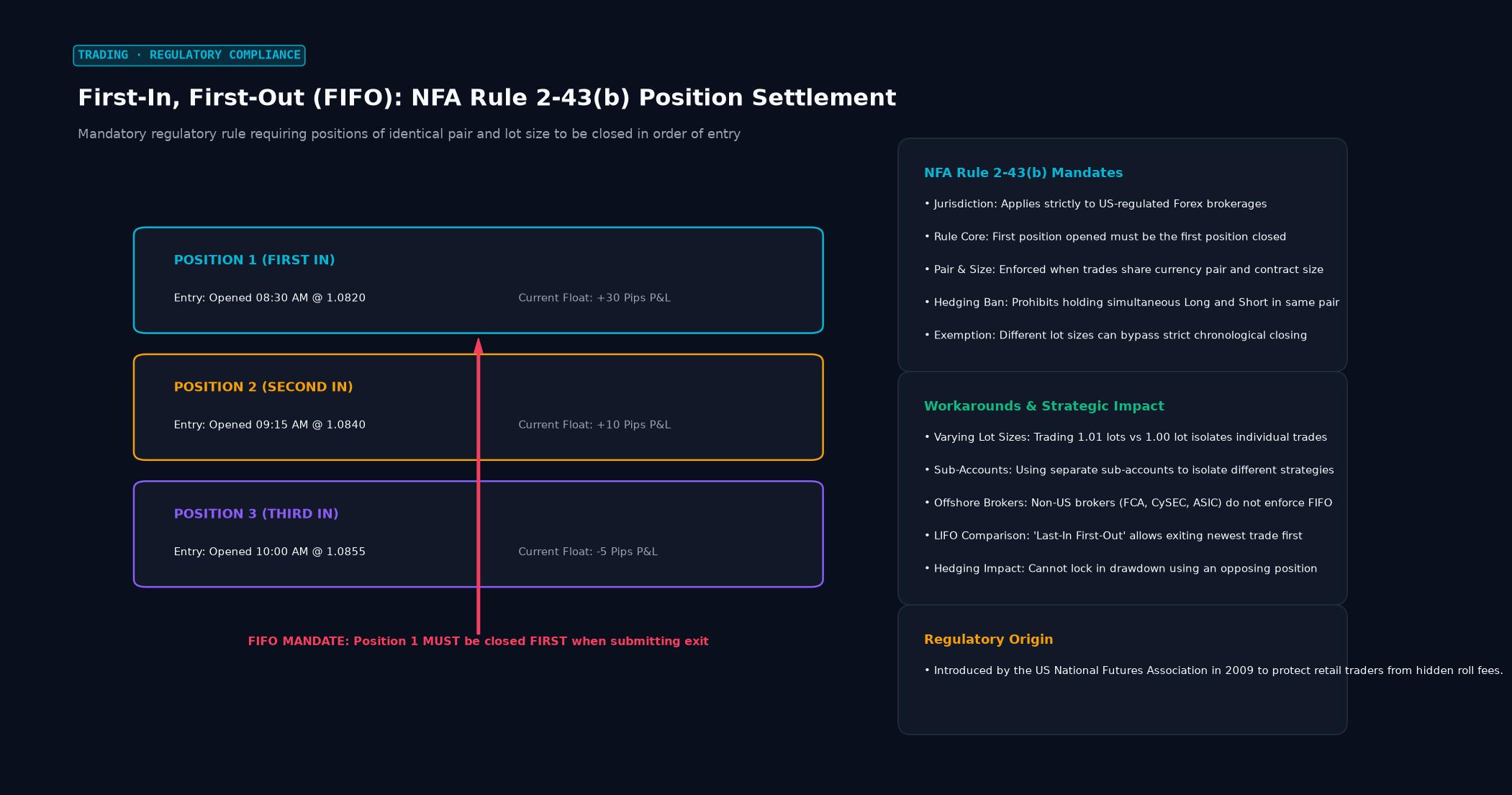 Figure: Mandatory regulatory rule requiring positions of identical pair and lot size to be closed in order of entry
Regulatory Origin: NFA Compliance Rule 2-43(b)
The FIFO requirement was introduced into retail foreign exchange trading by the National Futures Association (NFA) under Compliance Rule 2-43(b), which took effect across the United States on May 15, 2009, with endorsement from the Commodity Futures Trading Commission (CFTC).
The NFA instituted the rule alongside a ban on same-account currency hedging to accomplish two primary regulatory objectives:
- Preventing Deceptive Trading Practices: Regulators observed that some retail traders opened opposing long and short positions on the same currency pair simultaneously, paying double spreads and overnight financing fees while operating under the false psychological impression that their capital was hedged.
- Transparent Margin Accounting: Enforcing a chronological liquidation queue standardizes how margin utilization, realized profit/loss, and taxation are calculated across retail brokerage accounts.
How FIFO Operates: Practical Examples
To understand how FIFO governs daily order execution, consider the following two scenarios:
Scenario A: Identical Lot Sizes (Strict FIFO Applied)
A trader opens three consecutive long positions on GBP/USD:
- Order 1 (09:00 AM): Buy 1.0 Lot GBP/USD at 1.2700
- Order 2 (10:30 AM): Buy 1.0 Lot GBP/USD at 1.2730
- Order 3 (11:15 AM): Buy 1.0 Lot GBP/USD at 1.2750
At 1:00 PM, GBP/USD trades at 1.2740. The trader wants to close Order 3 to lock in a small loss or take a quick profit on Order 2.
- Under FIFO: The trading platform will reject an order specifically targeting Order 2 or Order 3. When the trader submits an order to sell 1.0 lot, the broker must close Order 1, realizing a gain of +40 pips ($400 USD).
- Order 2 and Order 3 remain open, with Order 2 becoming the next in line for liquidation.
Scenario B: Different Lot Sizes (FIFO Exemption)
The NFA rule specifically applies to multiple positions of the same size. If positions are opened with varying lot sizes, they are treated as distinct contracts:
- Order A: Buy 1.0 Lot USD/JPY at 155.00
- Order B: Buy 1.5 Lots USD/JPY at 155.40
- Order C: Buy 0.5 Lots USD/JPY at 155.70
Because none of the three orders share identical volume, the trader can close Order B or Order C at will without touching Order A.
Impact on Trading Strategies and Automated EAs
The introduction of FIFO fundamentally reshaped how retail strategies and Expert Advisors (EAs) operate:
- Elimination of Same-Account Hedging: Under NFA rules, a trader cannot hold a Long 1 Lot EUR/USD position and a Short 1 Lot EUR/USD position simultaneously in the same account. Submitting a sell order simply closes the long position rather than creating a hedge.
- Disruption of Grid and Martingale Strategies: Many automated algorithms open a series of positions at regular pip intervals and close individual tranches as prices retrace. On FIFO-compliant accounts, these EAs frequently fail unless recoded to open unequal lot sizes.
- Stop-Loss and Take-Profit Complexity: If a trader places distinct stop-loss orders on three identical positions, the execution of the earliest stop-loss automatically closes the oldest trade, even if the price action touched the price level associated with the newest trade.
Comparison: US vs. International Broker Regulations
| Feature | US Brokers (NFA / CFTC) | UK & Europe (FCA / CySEC) | Australia & Global (ASIC / Off-shore) |
|---|---|---|---|
| FIFO Mandatory? | Yes (Rule 2-43b) | No | No |
| Direct Hedging Allowed? | No | Yes | Yes |
| Selective Trade Exit? | No (for same lot sizes) | Yes (close any ticket at will) | Yes |
| Maximum Retail Leverage | 50:1 on majors | 30:1 on majors | 30:1 (ASIC) / up to 500:1 (Off-shore) |
Workarounds for Traders on FIFO Accounts
US retail traders navigating FIFO employ three common operational strategies to maintain flexibility:
- Varying Position Sizes: Opening positions using micro-lot variations (e.g., 1.01 lots, 1.02 lots, 1.03 lots) bypasses the same-size FIFO constraint, allowing selective ticket closure.
- Multiple Sub-Accounts: Opening two distinct trading accounts with the same broker enables long positions in Account A and short positions in Account B, legally mimicking hedging strategies.
- Proprietary Trading Firms or Futures: Trading through regulated futures exchanges (CME currency futures) or simulated prop accounts governed by different institutional frameworks.
Key Takeaways
- FIFO requires traders holding multiple positions of the same currency pair and size to close the oldest position first.
- The rule is strictly enforced by the NFA and CFTC for retail forex accounts registered in the United States.
- European (FCA, CySEC) and Australian (ASIC) brokers do not enforce FIFO, allowing traders to close any position ticket selectively.
- FIFO prevents simultaneous long and short hedging in the same trading account.
- Traders can bypass FIFO limitations by varying lot sizes or utilizing multiple sub-accounts.
Frequently Asked Questions
Does FIFO apply to limit and stop-loss orders?
Yes. If multiple positions of identical size have individual stop-loss orders, the broker will trigger liquidation in chronological order (oldest first), regardless of which specific ticket’s stop level was hit.
Why do European and Australian brokers not enforce FIFO?
Regulatory bodies like the UK Financial Conduct Authority (FCA) and Australian Securities and Investments Commission (ASIC) concluded that selective ticket closing and direct hedging provide retail traders with greater risk management flexibility, choosing instead to focus restrictions on leverage caps and negative balance protection.
Can an automated trading bot (EA) run on a FIFO account?
Yes, but the Expert Advisor must be programmed with FIFO-compliant logic. Standard EAs built for MetaTrader that attempt to close specific order tickets out of chronological order will trigger error codes (“Order Close Failed”) on US brokerage servers.
Ready to trade forex?
Open a free demo account with a regulated broker. Practice with virtual funds before risking real money.