Hedge / Hedging
Hedging in forex is the practice of opening one or more positions specifically designed to offset the risk of an existing position. A hedge reduces or eliminates exposure to adverse price movements. It is used by corporations to protect future cash flows, by investors to guard against currency risk, and by traders to protect profits during periods of uncertainty.
Why Hedging Exists
Every company that operates internationally faces currency risk. A US manufacturer that sells products in Europe receives euros but reports in dollars. If the euro falls 10% against the dollar between the time the sale is negotiated and when payment is received, that 10% currency loss directly hits the profit margin — even if everything else goes perfectly.
Hedging is the toolkit for managing this exposure. It’s not a trading strategy designed to profit; it’s an insurance policy designed to control uncertainty. The cost of a hedge is the premium you pay for that insurance.
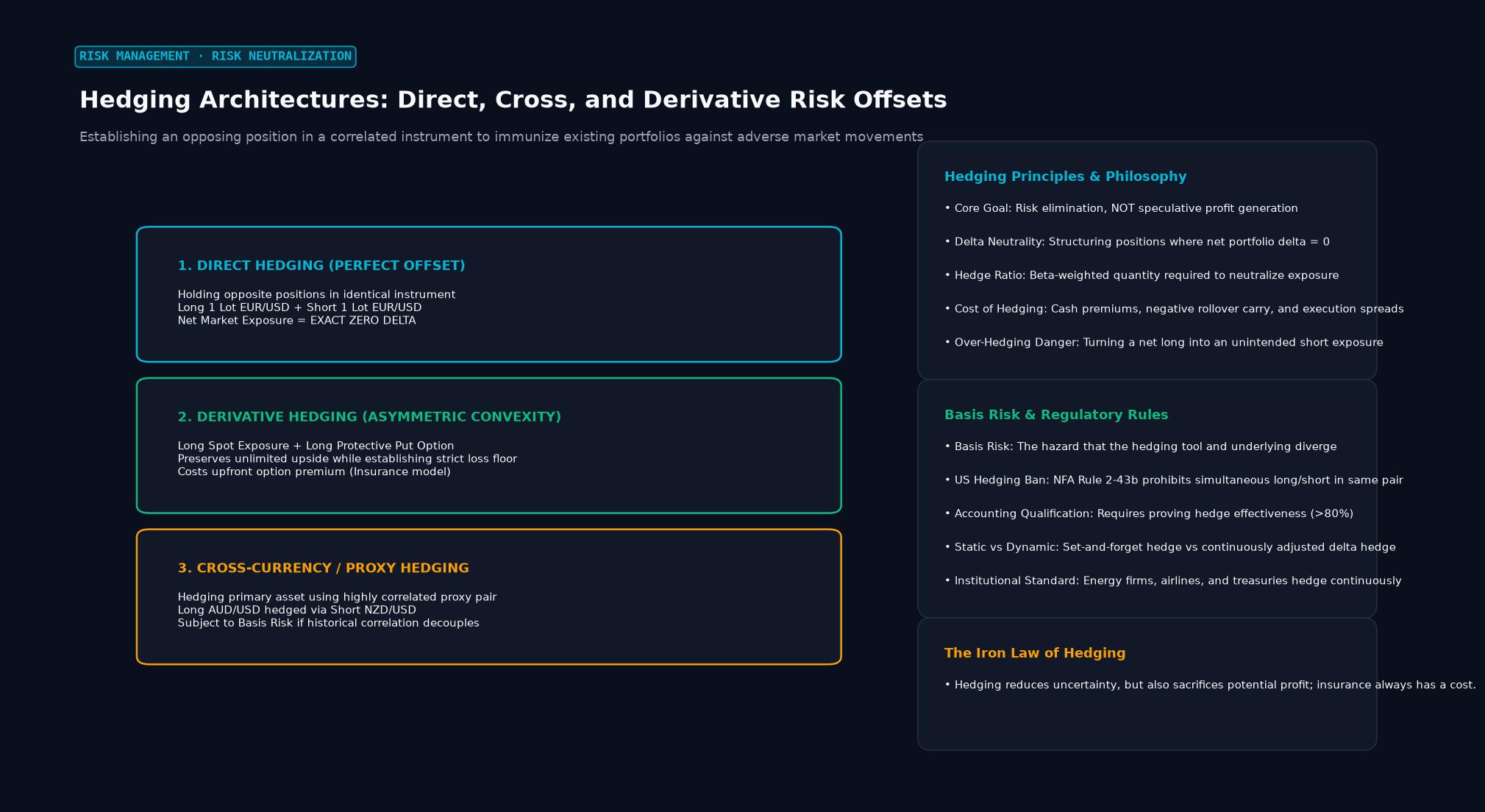 Figure: Establishing an opposing position in a correlated instrument to immunize existing portfolios against adverse market movements
Common Forex Hedging Instruments
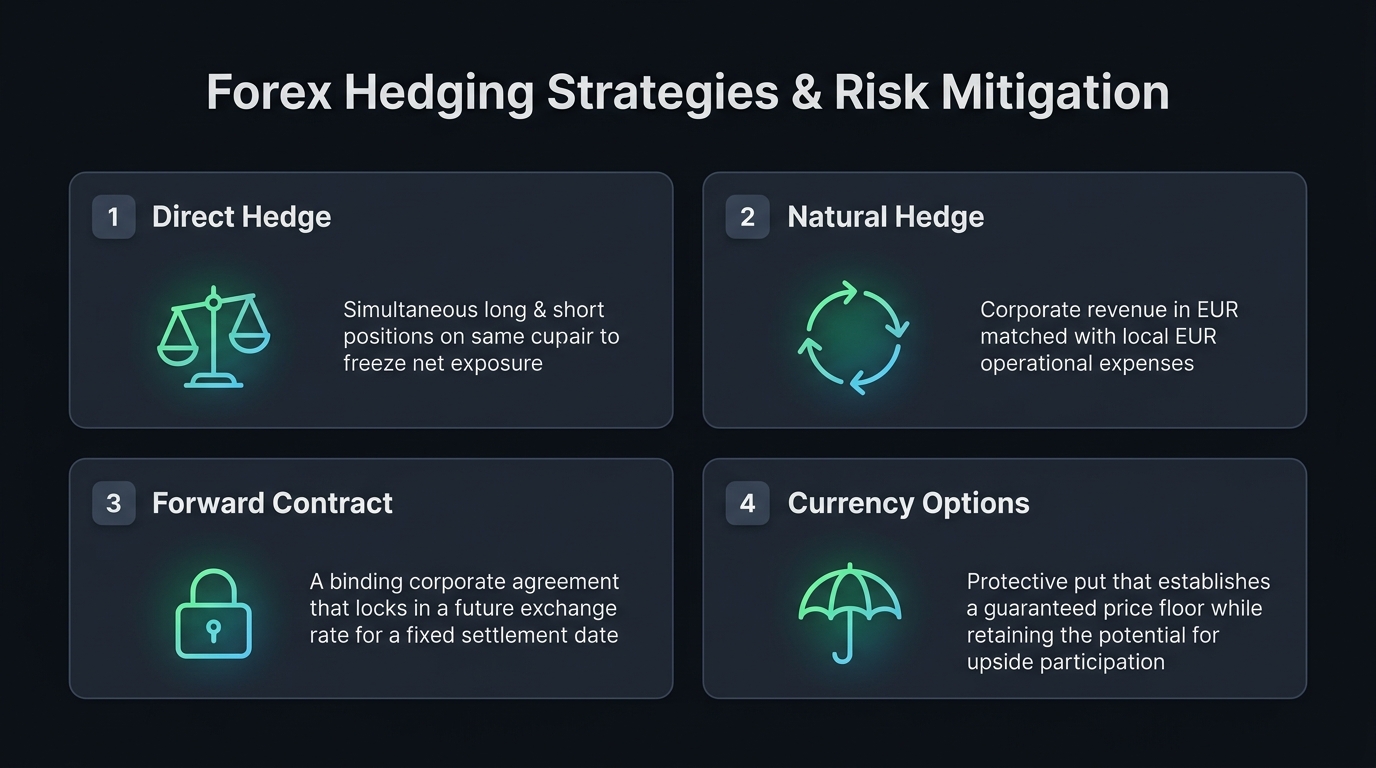
Forward contracts: An agreement to buy or sell a specified amount of currency at a predetermined rate on a future date. The corporate hedger’s primary tool. A UK exporter expecting to receive $1 million in three months can sell those dollars forward today at the current forward rate, locking in the sterling amount regardless of where USD/GBP goes in the interim. No money changes hands until settlement — only the rate is fixed.
Currency options: The right, but not the obligation, to exchange currency at a specified rate before a set expiration date. Options let hedgers set a “floor” on their worst-case exchange rate while still benefiting if rates move in their favor. This flexibility comes at a cost — the option premium. A company that buys a put option on EUR/USD is protected if EUR falls but benefits fully if EUR rises, unlike a forward that locks in both sides.
Currency swaps: An agreement to exchange a series of cash flows in different currencies. Used primarily by corporations to convert debt obligations from one currency to another and by central banks to provide liquidity in foreign currencies during crises.
Natural hedging: Matching currency exposure without financial derivatives. A German company that manufactures in Germany but also has significant US dollar costs (raw materials, US-based subsidiaries) has a natural hedge — dollar revenue and dollar costs offset each other. Structuring operations to create natural hedges is the most fundamental form of corporate FX risk management.
Retail Trader Hedging: The Direct Hedge
In retail forex, “hedging” often refers to opening an equal and opposite position on the same pair — simultaneously long and short EUR/USD, for example. This eliminates all market exposure (the positions cancel each other out) but is essentially pointless unless one of the positions has a stop or take-profit that the other doesn’t.
Some traders use direct hedges as a short-term pause mechanism: instead of closing a losing position, they open an offsetting position to freeze the loss while reassessing. This can be legitimate if it provides time to analyze without further exposure, but it doubles the spread cost paid and provides no actual risk reduction beyond simply closing the losing trade.
Most regulated brokers in the US (under CFTC/NFA rules) prohibit same-currency-pair hedging. In Europe and elsewhere, it’s allowed.
Imperfect Hedges and Basis Risk
A perfect hedge eliminates risk entirely. Perfect hedges are rare and expensive. Most practical hedges are imperfect — they reduce risk but not to zero. The remaining exposure is called basis risk — the risk that the hedge doesn’t move exactly in line with the underlying exposure.
A US company with Korean Won (KRW) receivables might hedge with USD/JPY because liquid JPY derivatives are more available and less expensive than KRW derivatives. JPY and KRW are both Asian currencies with some correlation — but not perfect correlation. If KRW weakens 5% and JPY only weakens 2%, the hedge under-performs by 3%. That 3% is basis risk.
The Cost-Benefit of Hedging
Hedging is never free. Every hedge has a cost:
- Forward contracts embed the interest rate differential in the forward rate
- Options require an upfront premium
- Currency swaps involve bank intermediation fees
- Increased spread and transaction costs in retail hedges
The decision to hedge is a business decision: is the cost of the hedge worth the certainty it provides? Large corporations with thin margins often determine that the certainty of cash flows justifies hedging costs. Highly capitalized investors with long time horizons may decide that currency volatility averages out over time and hedging costs erode returns unnecessarily.
Key Takeaways
- Hedging reduces or eliminates currency exposure by taking an offsetting position
- Primary instruments: forward contracts (corporate), options (flexible protection), currency swaps, natural hedges
- Retail “direct hedging” (long and short same pair) is mathematically equivalent to closing the position — the only reason to do it is for tactical flexibility
- Basis risk is the exposure that remains after an imperfect hedge
- Hedging has real costs; the decision requires weighing certainty against those costs
FAQ
Should retail traders hedge their positions? Generally no. For retail traders, hedging is almost always less efficient than simply reducing position size or placing a stop-loss. The direct hedge on the same pair pays spread twice without reducing risk. The only legitimate retail hedging use case is cross-pair hedging — for example, using a correlated pair to partially offset risk during a specific period.
How do multinationals manage FX hedging at scale? Large corporations employ dedicated FX risk management teams that continuously monitor currency exposures across all subsidiaries and business lines. They use a combination of natural hedges, rolling forward contracts, and options programs to keep exposure within board-approved limits. This is a sophisticated, continuous process — not a one-time trade.
Ready to trade forex?
Open a free demo account with a regulated broker. Practice with virtual funds before risking real money.