Position
A position in forex is an active trade — a commitment to buy or sell a currency pair that has not yet been closed. Long positions profit when price rises; short positions profit when price falls. Position size (measured in lots), direction (long or short), and duration (how long the position is held) are the three fundamental parameters of any trade.
What a Position Is — and Isn’t
A position exists from the moment you execute a trade to the moment you close it. Between those two points, your account equity fluctuates with every pip of price movement. The position is your exposure — how much you stand to gain or lose as the market moves.
It’s worth being precise: a position is not just an intention or an analysis. Many traders “paper trade” — track hypothetical positions without real money — but a live position involves real capital at risk, real emotions, and real consequences.
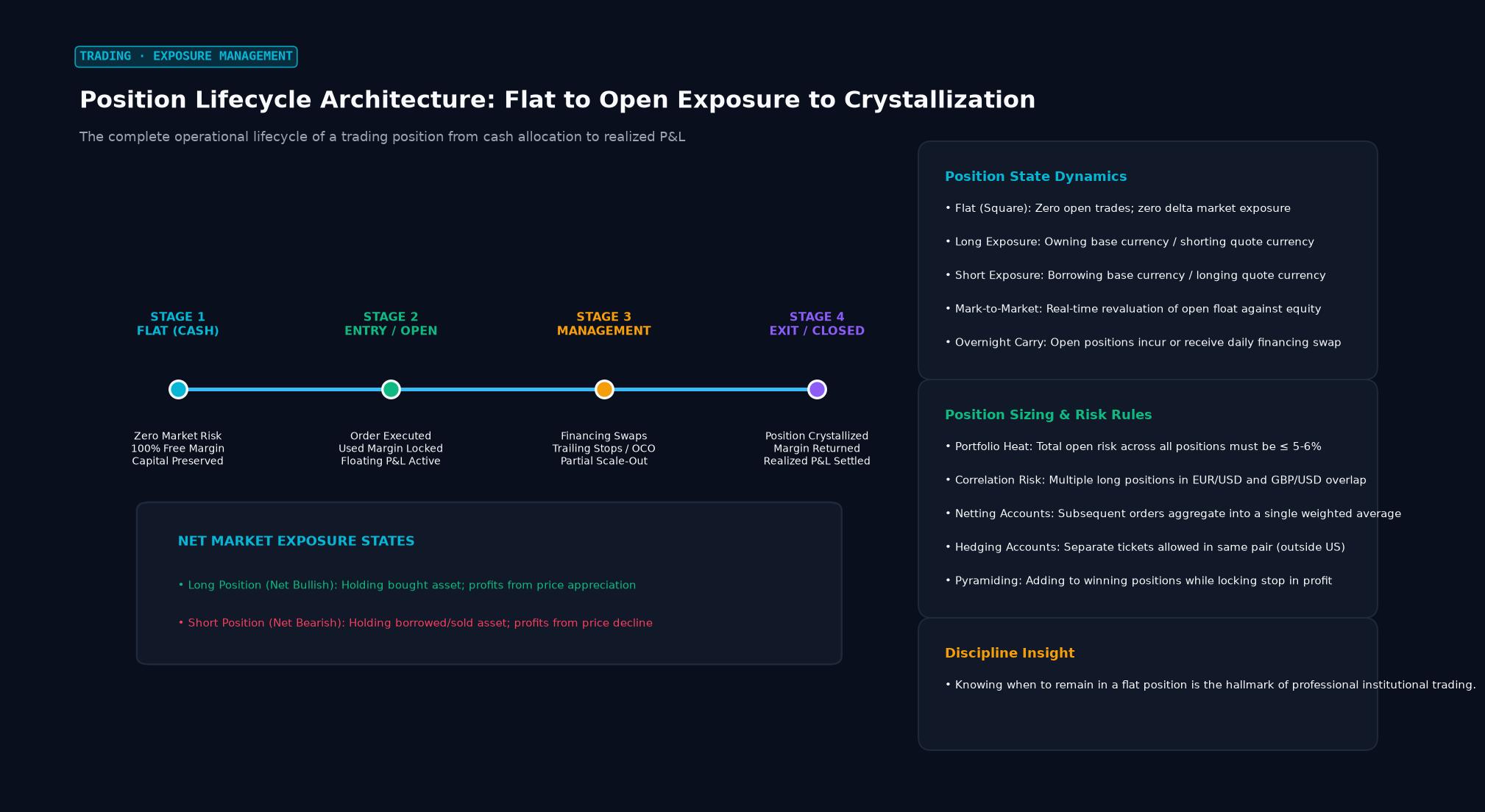 Figure: The complete operational lifecycle of a trading position from cash allocation to realized P&L
Long vs. Short
Long position: You bought the base currency expecting it to appreciate against the quote currency. If you’re long EUR/USD at 1.0850, you profit if EUR/USD rises — each pip move in your favor is a gain, each against is a loss.
Short position: You sold the base currency expecting it to depreciate. If you’re short GBP/USD at 1.2740, you profit if GBP/USD falls.
In forex, going short is exactly as easy as going long — there’s no concept of “borrowing shares” as in stock markets. You simply click sell on a pair and the position opens. This symmetry is one of forex’s structural advantages: the market can be traded in either direction with equal facility.
Position Size and Risk
Position size measured in lots determines the monetary value of each pip move:
| Lot Type | Units of Base Currency | Pip Value (EUR/USD approx.) |
|---|---|---|
| Standard lot | 100,000 | ~$10 |
| Mini lot | 10,000 | ~$1 |
| Micro lot | 1,000 | ~$0.10 |
| Nano lot | 100 | ~$0.01 |
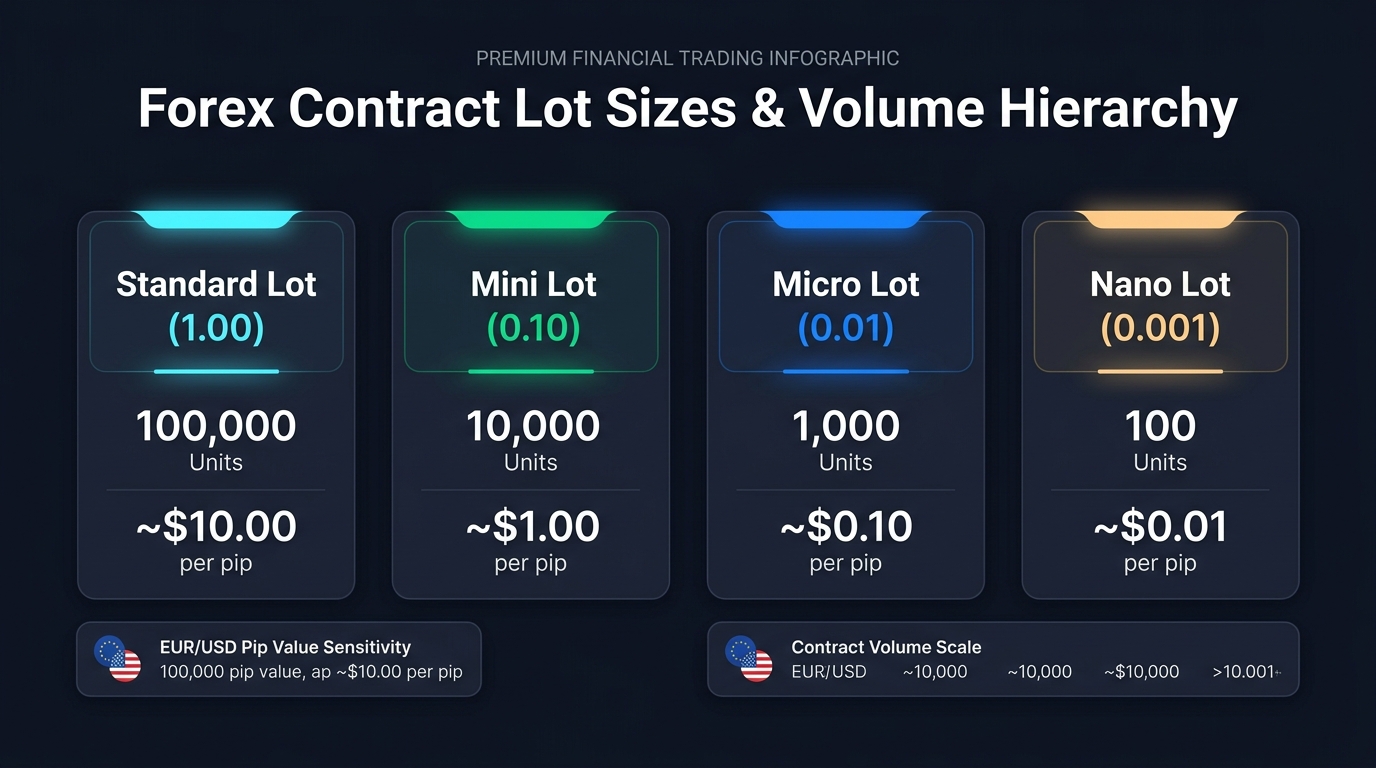
Position sizing is not a preference — it’s a risk management calculation. The correct position size is determined by your account balance, the percentage you’re willing to risk per trade, and the distance in pips to your stop-loss.
Formula:
Lots = (Account × Risk%) / (Stop distance in pips × Pip value per lot)
For a $10,000 account risking 1% ($100) with a 50-pip stop:
$100 / (50 × $10) = 0.2 standard lots = 2 mini lots
Position Management
Opening a position is just the beginning. Managing it correctly is where most of the skill lies.
Initial stop-loss: Set at a logical structural level before the position is opened. Moving the stop-loss after a position goes against you (widening it) is one of the most common and damaging trading mistakes.
Break-even adjustment: When a position moves a meaningful distance in your favor, moving the stop-loss to the entry price eliminates further monetary loss on the trade. A “free trade” can now only break even or profit.
Partial close: Closing a fraction of the position at an interim target while leaving the remainder to run is a professional technique for both locking in profit and maximizing participation in extended moves.
Trailing stop: Automatically moving the stop-loss behind the position as it profits, locking in gains incrementally.
Flat Position (Being “Flat”)
When all positions are closed, the account is “flat” — zero market exposure. Being flat is sometimes the best position: before major uncertainty events, at the end of a losing session, or when the market is in an unreadable condition.
Many retail traders feel uncomfortable being flat — as if they’re “missing out” on a move. Professional traders treat being flat as a legitimate and sometimes preferred state.
Key Takeaways
- A position is an active, open trade — it exists until closed and carries real risk at every moment
- Long positions profit from price increases; short positions profit from price decreases
- Position size (in lots) determines the dollar value of each pip — calculated from risk parameters, not chosen arbitrarily
- The critical management steps: initial stop, break-even adjustment, partial close options, and trailing stop
- Being “flat” (no open positions) is a valid and sometimes optimal trading state
FAQ
Can I have multiple positions open simultaneously? Yes. Most brokers allow multiple open positions, including multiple positions on the same pair in different directions (some brokers allow “hedging” — holding both a long and short on the same pair). Multiple correlated positions effectively multiply your exposure, which may be intentional or accidental.
What is an “underwater” position? A position where the current price has moved against you — your unrealized P&L is negative. An underwater position is not necessarily a mistake (the market may still reach your target before your stop), but it requires discipline to manage without moving the stop or adding to the position impulsively.
Ready to trade forex?
Open a free demo account with a regulated broker. Practice with virtual funds before risking real money.