Floor
In finance, a floor is an established lower price or rate threshold, most commonly referring to (1) an interest rate floor derivative that guarantees a minimum yield on floating-rate debt, or (2) an official central bank currency floor peg defending a minimum exchange rate.
What Is a Floor?
In economics, derivatives pricing, and foreign exchange, the term floor establishes an absolute lower boundary below which an interest rate, asset valuation, or currency exchange rate is prevented from falling. The concept operates across two critical domains in institutional finance:
- In Derivatives & Banking (Interest Rate Floor): An Over-the-Counter (OTC) contract composed of a series of European-style put options (called floorlets) written on a reference interest rate benchmark (such as SOFR or Euribor). It guarantees that a floating-rate lender receives a guaranteed minimum rate of interest, protecting their cash flows against falling central bank benchmark rates.
- In Foreign Exchange & Macroeconomics (Currency Floor): A statutory exchange rate peg enforced by a sovereign central bank. The central bank commits to buying unlimited amounts of foreign currency to prevent its domestic currency from appreciating past a specified limit against a target currency.
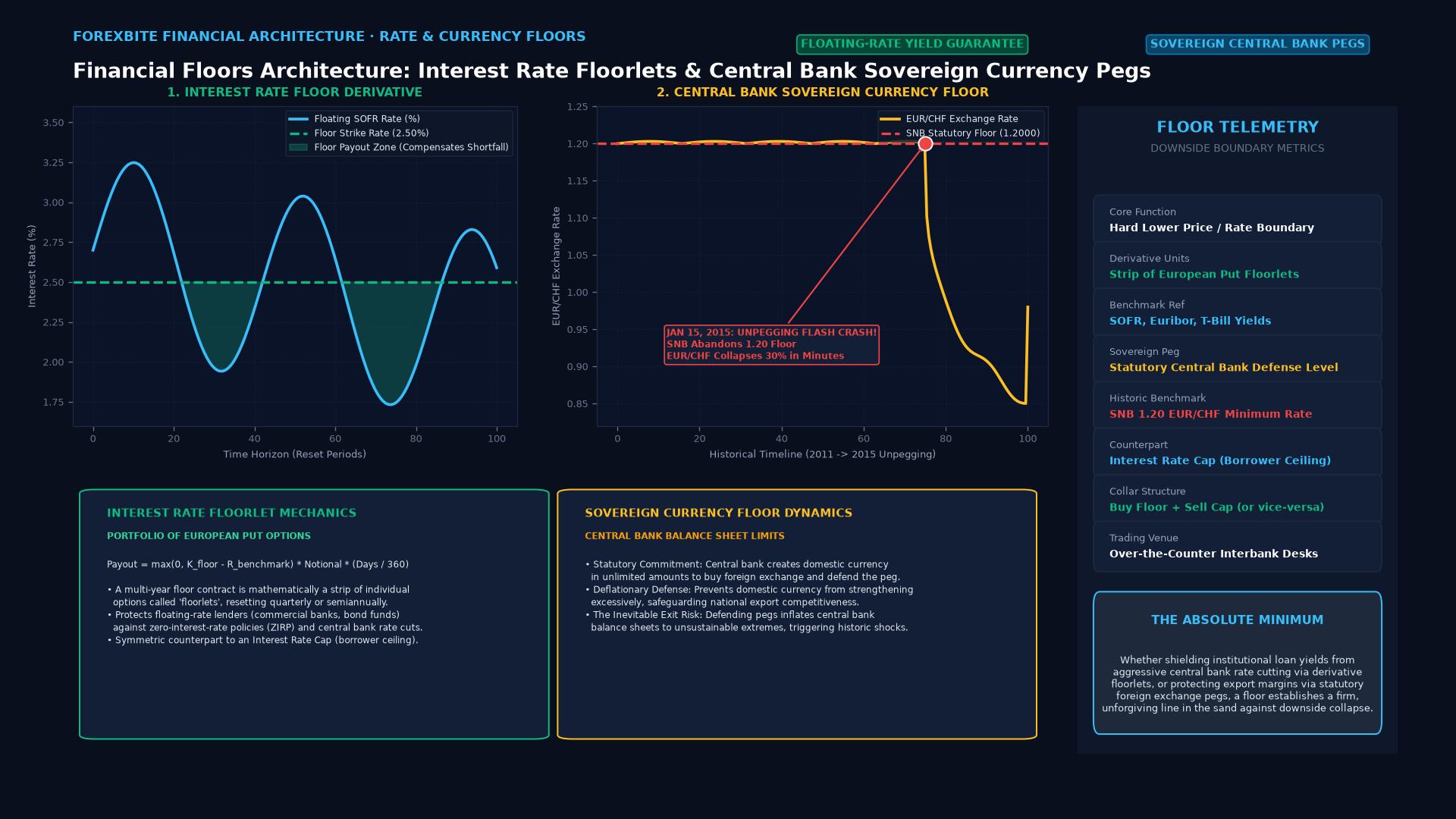 Figure: Financial floors architecture comparing interest rate derivative floorlet mechanics with sovereign central bank currency defense pegs.
Key Takeaways
- Lower Limit Mechanism: Whether established via a derivative contract or statutory central bank decree, a floor stops downside progression at a defined strike level.
- The Derivative Payoff: An interest rate floor pays the buyer a cash settlement whenever the floating benchmark falls below the contractual floor strike: $\text{Payoff} = \max(0, K_{\text{Floor}} - R_{\text{Benchmark}}) \times \text{Notional}$.
- Symmetric Opposite of a Cap: While an Interest Rate Cap protects borrowers from rising interest rates, an Interest Rate Floor protects investors and lenders from collapsing yields.
- The Historic Swiss Floor (2011–2015): The Swiss National Bank’s unilateral 1.20 EUR/CHF floor remains the most famous currency floor in history, whose sudden abandonment in January 2015 caused the largest single-day currency flash crash in modern financial history.
Derivatives: The Interest Rate Floor Structure
An interest rate floor is designed for institutions holding floating-rate assets (such as commercial banks issuing variable-rate credit or institutional funds holding Floating Rate Notes):
- Floorlets: An interest rate floor spanning five years with quarterly resets consists of 20 individual options called floorlets. Each floorlet monitors the benchmark on its specific reset date.
- Cash Flow Example: A lender holds a $10,000,000 floating loan tied to 3-month SOFR and buys a 2.50% Floor. If 3-month SOFR drops to 1.50%, the floor seller pays the lender: $$\text{Quarterly Payout} = $10,000,000 \times (0.025 - 0.015) \times \frac{90}{360} = $25,000$$
- This $25,000 payment compensates the lender for the yield shortfall, ensuring an effective minimum return of 2.50%.
Macroeconomics: Central Bank Currency Floors
A central bank imposes a currency floor when excessive capital inflows threaten to overvalue its national currency, destroying export competitiveness and causing deflation:
The Swiss National Bank (SNB) 1.20 EUR/CHF Floor Case Study
- The Catalyst (September 2011): Amid the Eurozone sovereign debt crisis, global capital flooded into the Swiss Franc as a safe haven. To prevent the export economy from collapsing, the SNB announced: “The SNB will no longer tolerate a EUR/CHF exchange rate below the minimum rate of 1.20. The SNB will enforce this minimum rate with the utmost determination and is prepared to buy foreign currency in unlimited quantities.”
- The Defense: For three and a half years, whenever EUR/CHF touched 1.2000, the SNB electronically printed Swiss Francs to buy hundreds of billions in Euros, amassing massive foreign exchange reserves.
- The Abandonment (January 15, 2015): Facing the European Central Bank’s launch of massive Quantitative Easing (which would force the SNB to buy untenable volumes of depreciating Euros), the SNB abruptly abandoned the floor.
- The Fallout: Within 15 minutes, EUR/CHF crashed by over 30% from 1.2000 to an intraday low of 0.8500. Major retail brokerages became insolvent, hedge funds collapsed, and liquidity evaporated globally.
Comparison: Interest Rate Floor vs. Currency Floor
| Dimension | Interest Rate Floor (Derivatives) | Currency Floor (Macroeconomic Policy) |
|---|---|---|
| Originating Entity | Private investment bank / OTC market | Sovereign Central Bank (e.g., SNB, Danmarks Nationalbank) |
| Enforcement Tool | Contractual cash settlement between parties | Unlimited open-market foreign exchange intervention |
| Counterparty Risk | Bilateral default risk under ISDA Master Agreement | Sovereign policy credibility; risk of abrupt unpegging |
| Cost to Implement | Upfront option premium paid by buyer | Expansion of central bank balance sheet & reserve accumulation |
| Duration | Fixed contractual maturity (e.g., 1 to 10 years) | Discretionary policy duration; can terminate without warning |
Frequently Asked Questions
What is an “embedded floor” in a retail mortgage?
An embedded floor is a contractual clause inside a commercial or residential variable-rate loan where the lending bank specifies that the borrower’s payable interest rate can never fall below a certain level (e.g., “SOFR $+ 1.5%$, subject to an absolute floor of 2.0%”). During eras of negative central bank policy rates, embedded floors prevent banks from having to pay interest to borrowers.
Can an investor combine a cap and a floor?
Yes. When an investor buys an interest rate cap and simultaneously sells an interest rate floor (or vice versa), the strategy is called an Interest Rate Collar. This locks floating borrowing or lending costs within a defined corridor while reducing or eliminating the net upfront option premium.
What is the difference between a floor and a support level in technical analysis?
In technical chart analysis, traders often colloquially refer to a strong support zone as a “floor.” However, a technical support floor is purely an observational chart level where historical buying pressure has concentrated, whereas a derivative or central bank floor is a legally or structurally binding financial constraint.
Ready to trade forex?
Open a free demo account with a regulated broker. Practice with virtual funds before risking real money.