Exercise
Exercise is the formal act whereby the holder of an option contract invokes their legal right to buy (via a call) or sell (via a put) the underlying currency or financial asset at the established strike price.
What Is Option Exercise?
In derivatives markets, exercise is the election by the owner (buyer) of an option to execute the terms of the underlying contract. When an investor exercises a Call Option, they demand delivery of the underlying asset at the agreed Strike Price. Conversely, when an investor exercises a Put Option, they require the option seller (writer) to purchase the underlying asset from them at the strike price.
Option contracts grant the buyer the right, but not the obligation, to exercise. Consequently, option holders will only exercise when doing so provides a financial benefit—specifically when the option is In-The-Money (ITM) and possesses positive intrinsic value. The option seller is legally bound to fulfill the transaction if the holder chooses to exercise.
Key Takeaways
- Buyer’s Discretion: Only the long option holder has the right to exercise; the option seller (writer) is passive and must fulfill the assignment if called upon.
- Three Exercise Styles: Contracts are classified as American-style (exercisable at any time prior to expiration), European-style (exercisable only on the exact expiration date), or Bermudan-style (exercisable on specific pre-agreed calendar dates).
- European Dominance in FX: The vast majority of institutional Over-the-Counter (OTC) currency options trade under European-style exercise terms.
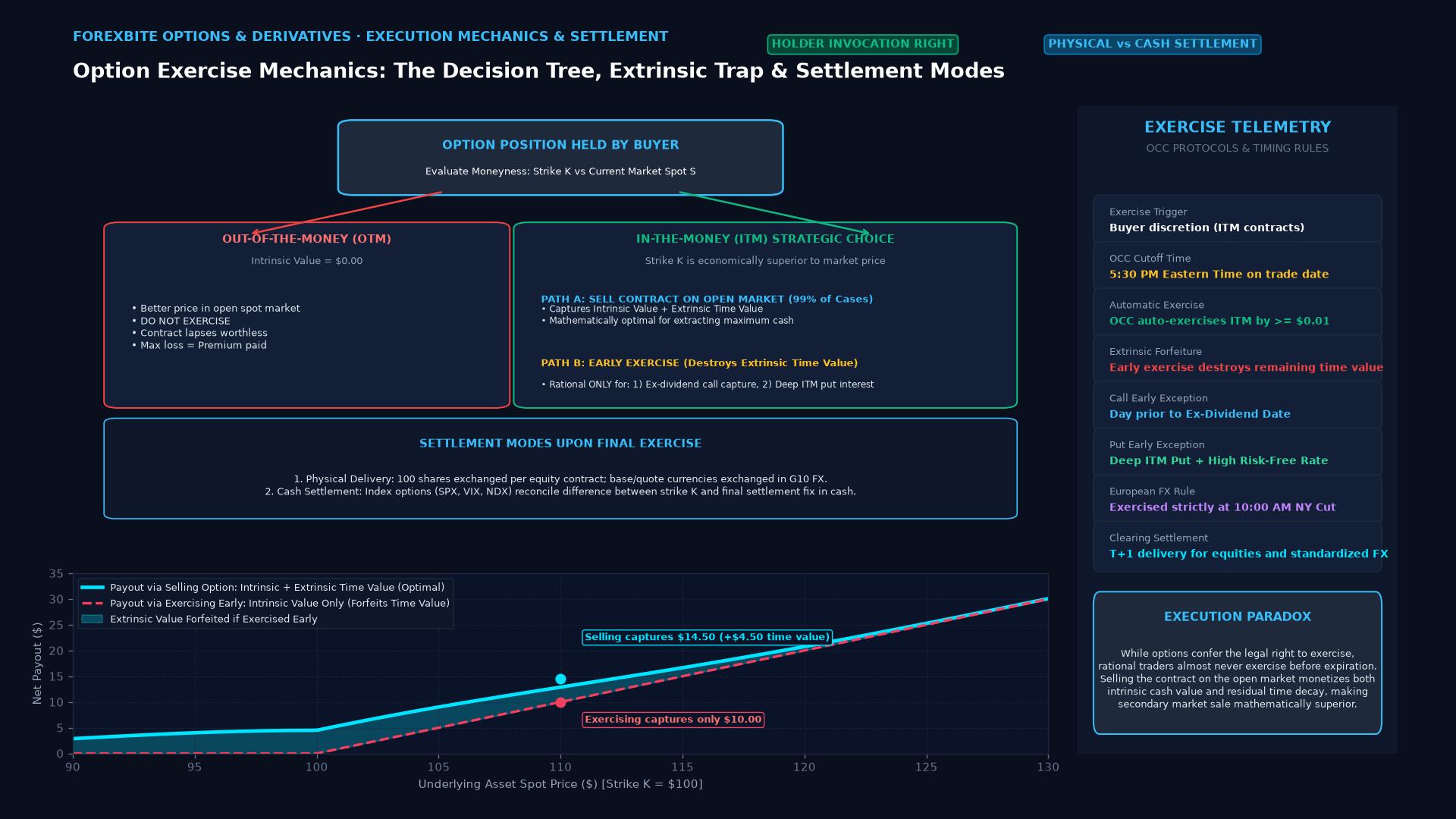
- The Extrinsic Value Trap: Exercising an option early forfeits any remaining extrinsic (time) value. In almost all circumstances, selling the option back to the market yields a higher net return than exercising it early.
Exercise Styles in Currency and Financial Markets
| Feature | European Style | American Style | Bermudan Style |
|---|---|---|---|
| Exercise Window | Expiration date only | Any business day up to expiration | Predetermined specific dates |
| Market Prevalence | Dominates OTC Forex & Index Options | Dominates Single-Stock & CME FX Futures Options | Common in interest rate swaptions |
| Pricing Model | Black-Scholes-Merton / Garman-Kohlhagen | Binomial Trees / Bjerksund-Stensland | Finite Difference / Lattice Models |
| Early Exercise Risk | Zero early assignment risk for sellers | High risk if deep in-the-money or before ex-dividend | Discrete dates only |
| Premium Cost | Lower premium (less flexibility for buyer) | Higher premium (valuable exercise flexibility) | Moderate premium |
Settlement Mechanisms Upon Exercise
When an option is exercised, the transaction settles via one of two primary methods:
1. Physical Delivery
The buyer pays the full strike price in cash and receives the underlying physical asset or currency:
- Example: Exercising a EUR/USD call option with a strike of 1.0800 for 100,000 EUR requires the buyer to deliver $108,000 in cash and receive €100,000 into their interbank settlement account.
- Futures Assignment: In exchange-traded currency options (such as CME EUR/USD options), exercising the option assigns an active long or short underlying futures contract to both parties at the strike price.
2. Cash Settlement
Rather than physically swapping currencies, the transaction settles through a single net cash transfer representing the option’s intrinsic value: $$\text{Cash Payout} = \text{Notional Amount} \times \left( S_{\text{Settlement}} - K \right)$$ This method is standard in Non-Deliverable Options (NDOs) on restricted emerging market currencies (e.g., Brazilian Real or Indian Rupee).
Why Early Exercise Is Usually a Costly Mistake
A foundational principle of derivatives pricing is that an option’s total market premium equals its intrinsic value plus its time value:
$$\text{Option Premium} = \text{Intrinsic Value} + \text{Extrinsic (Time) Value}$$
When a trader exercises an option early, they receive only the intrinsic value:
- If an American call option is trading at $6.00 with $4.00 of intrinsic value and $2.00 of time value, exercising it immediately yields $4.00.
- If the trader instead sells the option contract in the open secondary market, they collect the full $6.00 premium.
Early exercise is economically rational only in rare circumstances—such as when holding an equity call option immediately prior to an ex-dividend date where the cash dividend exceeds the remaining time value, or deep in-the-money put options during periods of exceptionally high interest rates.
Frequently Asked Questions
What is automatic exercise?
Most derivatives clearing houses (such as the Options Clearing Corporation - OCC, or CME Clearing) enforce automatic exercise protocols (e.g., OCC Rule 805). If an expiring option is in-the-money by as little as $0.01 or 1 pip at the closing fix, the clearing house automatically exercises the contract on behalf of the holder to prevent the loss of intrinsic value.
Can an out-of-the-money option be exercised?
Legally, yes, the holder of an American-style option can submit an exercise notice on an out-of-the-money contract. Economically, however, this would represent an irrational decision, as the holder would be deliberately buying an asset above current market price or selling it below market price.
What is the difference between “exercise” and “assignment”?
Exercise is the action taken by the long option buyer who chooses to activate the contract. Assignment is the corresponding notification sent by the broker or clearing house to the short option writer, obligating them to fulfill the trade.
Ready to trade forex?
Open a free demo account with a regulated broker. Practice with virtual funds before risking real money.