Floortion
A floortion is a compound interest rate derivative granting the holder the right, but not the obligation, to enter into or purchase a standard interest rate floor contract at a predetermined strike rate, maturity, and premium on or before an agreed exercise date.
What Is a Floortion?
A floortion (also termed a floorption or an option on an interest rate floor) is an exotic compound derivative instrument belonging to the family of “options on options.” A floortion grants its buyer the right, but not the legal obligation, to buy an Interest Rate Floor at a predetermined strike price, expiration schedule, and premium on or before a designated future expiration date.
In institutional banking and Asset-Liability Management (ALM), floortions provide corporate treasurers and bank portfolio managers with extreme hedging flexibility. Instead of committing large amounts of upfront capital today to purchase a long-term interest rate floor during uncertain economic environments, an institution can pay a much smaller initial premium for a floortion. If central bank interest rates drop as feared, the institution exercises the floortion to lock in floor protection; if interest rates rise or remain elevated, the floortion is allowed to expire worthless, saving the institution the bulk of the floor’s cost.
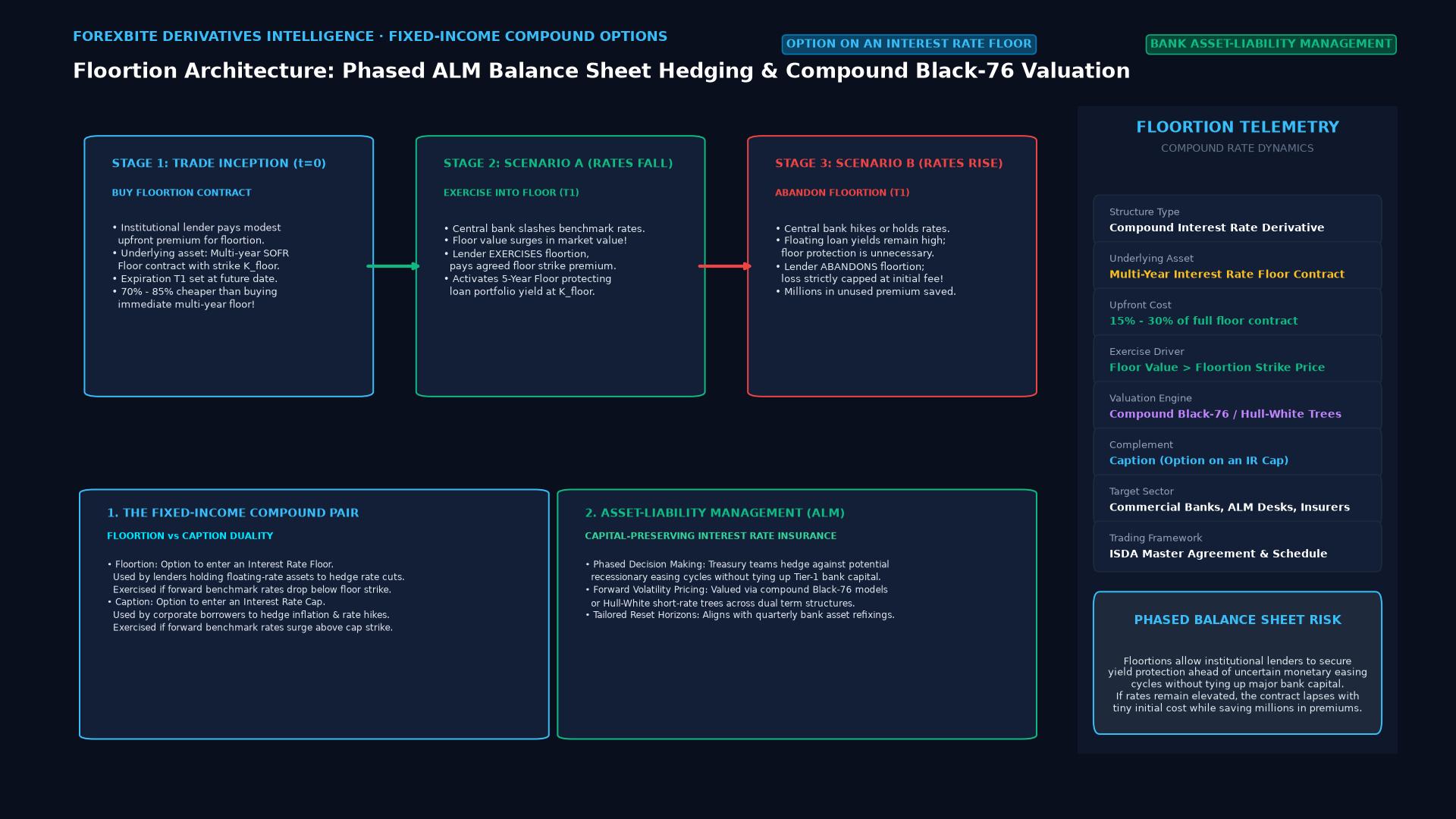 Figure: Floortion compound derivative architecture illustrating the phased decision tree between trade inception, interest rate shifts, and floor activation.
Key Takeaways
- Compound Derivative: A floortion is an option on an option; the underlying asset of the floortion is not an interest rate, but an entire interest rate floor contract.
- Asymmetrical Hedging Cost: Allows institutional lenders to purchase conditional protection against falling yields at a fraction of the cost of buying an immediate multi-year floor.
- Complement to the Caption: A caption (cap option) gives the right to purchase an interest rate cap to hedge rising borrowing costs; a floortion hedges against collapsing yields.
- Valuation Complexity: Valued using compound Black-76 models or Hull-White short-rate tree simulations that account for interest rate volatility surfaces over multiple time horizons.
The Compound Options Family in Fixed Income
Fixed-income derivatives desks utilize compound options to tailor balance sheet exposures:
| Compound Derivative | Underlying Financial Instrument | Primary Purpose | Optimal Economic Environment |
|---|---|---|---|
| Floortion | Interest Rate Floor | Right to buy yield protection for floating assets | Expecting a potential, but uncertain, future central bank easing cycle |
| Caption | Interest Rate Cap | Right to buy debt-cost ceiling protection | Expecting an emerging, but unconfirmed, inflationary rate hike cycle |
| Swaption (Payer) | Interest Rate Swap (Pay Fixed) | Right to enter an IRS paying a fixed coupon | Protecting against surges in corporate bond borrowing costs |
| Swaption (Receiver) | Interest Rate Swap (Receive Fixed) | Right to enter an IRS receiving fixed income | Locking in high yields ahead of anticipated monetary policy rate cuts |
Real-World Institutional Case Study: Bank ALM Desk
Consider a regional commercial bank holding $500,000,000 in commercial floating-rate loans indexed to 3-month SOFR (currently trading at 5.00%):
- The Dilemma: The bank fears that if a recession hits in 12 months, the Federal Reserve will slash benchmark rates down to 2.00%, devastating the bank’s net interest income. However, if the economy achieves a “soft landing,” rates may stay near 5.00% for years.
- Option A (Buy 5-Year 3.00% Floor Today): Premium cost is $8,000,000. If rates stay at 5.00%, this entire $8 million expenditure is wasted.
- Option B (Buy a 1-Year Floortion on a 4-Year 3.00% Floor): The floortion costs only $1,200,000 upfront.
- Outcome 1 (Rates Collapse to 2.00%): After 12 months, the bank exercises the floortion, pays the pre-agreed strike fee, and activates the 4-year floor, successfully ring-fencing its loan portfolio at a guaranteed 3.00% minimum yield.
- Outcome 2 (Rates Stay at 5.00%): The bank lets the floortion expire. It lost $1.2 million, but saved $6.8 million compared to buying the full floor outright.
Pricing Mechanics: The Black-76 Compound Model
Valuing a floortion requires modeling two distinct time horizons:
- $T_1$: The expiration date of the floortion (when the decision to buy the floor must be made).
- $T_2$: The maturity date of the underlying interest rate floor (spanning the future loan period).
Dealers employ extensions of the Black-76 model or two-factor Hull-White models. The price depends on the forward yield curve from $T_1$ to $T_2$, the volatility of forward interest rates, and the correlation between the forward curve at $T_1$ and the forward swap rates across the entire duration.
Frequently Asked Questions
What is the difference between a floortion and an interest rate swaption?
A floortion gives the right to purchase a multi-period interest rate floor, which provides asymmetric option protection (it pays out only when rates fall below the floor, leaving upside uncapped). A receiver swaption gives the right to enter an interest rate swap receiving a fixed rate and paying floating, which creates a linear, two-way commitment.
Are floortions traded on public exchanges?
No. Floortions are bespoke, Over-the-Counter (OTC) bilateral financial contracts traded exclusively between Tier-1 investment banks, multinational corporate treasuries, and sovereign debt management agencies under standard ISDA Master Agreements.
Why do market makers sell floortions?
Derivatives dealers sell floortions to harvest option premium (theta decay) and balance their internal exotic options books. Dealers hedge the exposure by dynamically trading interest rate futures (such as SOFR futures), short-dated swaptions, and forward rate agreements (FRAs).
Ready to trade forex?
Open a free demo account with a regulated broker. Practice with virtual funds before risking real money.