Currency Swap
A currency swap, or cross-currency interest rate swap, is a customized derivative contract between two parties to exchange principal and interest payments in one currency for equivalent cash flows in another currency over an agreed multi-year term, mitigating long-term foreign exchange and interest rate risks.
What Is a Currency Swap?
A currency swap—formally designated in institutional finance as a Cross-Currency Interest Rate Swap (CCIRS)—is an over-the-counter (OTC) derivative agreement between two institutional counterparties, such as multinational corporations, commercial banks, or sovereign treasuries. Under the contract, the parties exchange principal and periodic interest payments denominated in two different national currencies over a predetermined period, typically spanning between 1 and 30 years.
The landmark currency swap occurred in August 1981 between the World Bank and IBM, structured by Salomon Brothers. IBM had issued debt denominated in Swiss Francs and German Marks, but possessed surplus US Dollar revenues. The World Bank desired low-interest Swiss Franc and German Mark debt but could borrow more cost-effectively in US Dollars. By executing a cross-currency swap, both institutions achieved substantial interest savings while eliminating exchange rate risk, inaugurating the modern multi-trillion-dollar global swap market.
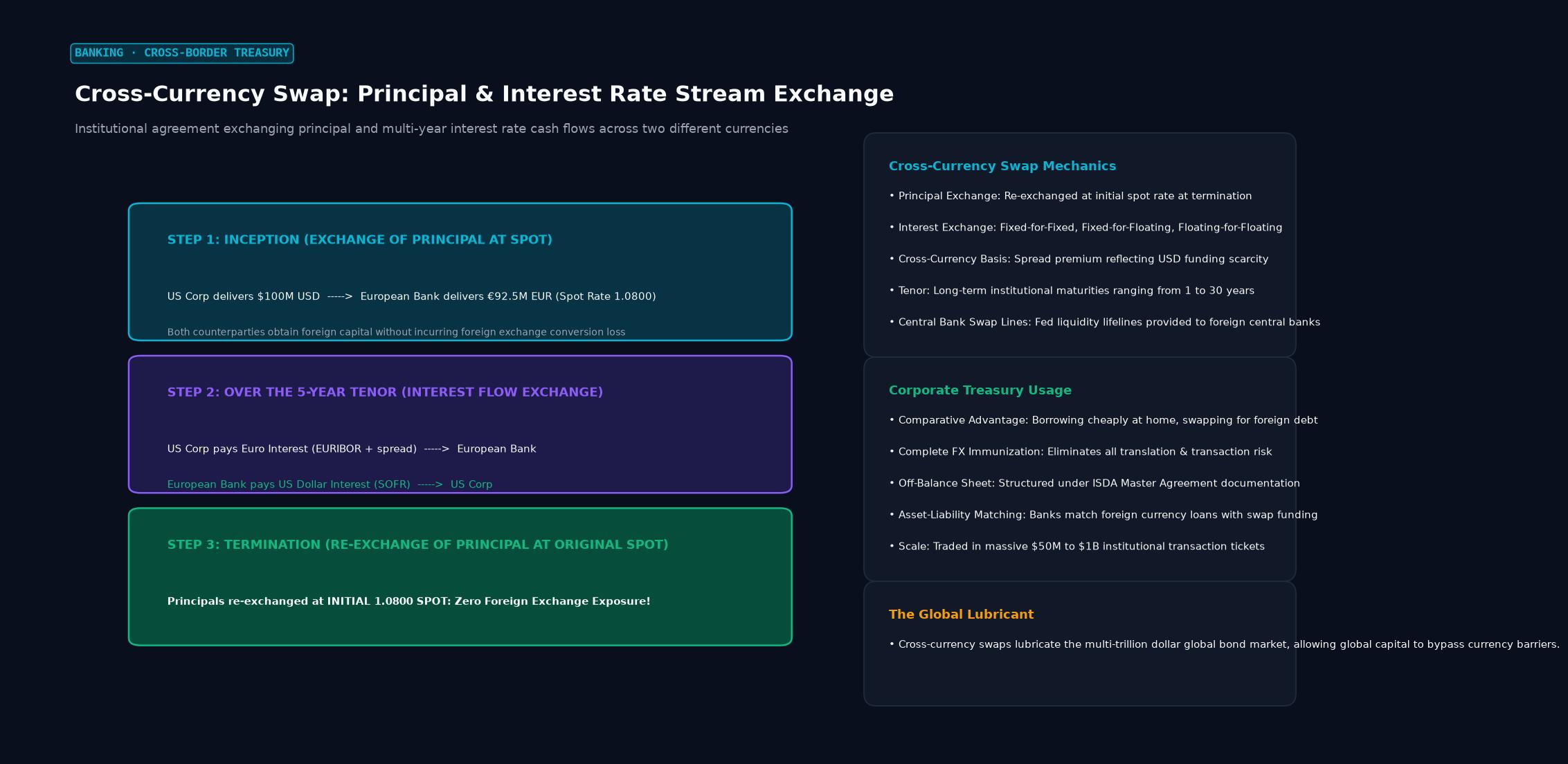 Figure: Institutional agreement exchanging principal and multi-year interest rate cash flows across two different currencies
FX Swaps vs. Currency Swaps: The Critical Distinction
Financial commentators frequently conflate two distinct market instruments: the FX Swap and the Currency Swap. Understanding the structural differences is essential:
1. The Foreign Exchange Swap (FX Swap)
An FX swap is a short-term liquidity management tool, usually expiring within days, weeks, or months (over 70% have a maturity under one month).
- Structure: It combines a spot foreign exchange transaction with a simultaneous, offsetting forward foreign exchange contract.
- Cash Flows: The parties exchange currencies at today’s spot rate and agree to reverse the trade at a forward rate on a future date.
- Interest: There are no intermediate periodic interest payments. The interest rate differential between the two currencies is embedded directly into the forward exchange rate (the forward points).
2. The Cross-Currency Interest Rate Swap (Currency Swap)
A currency swap is a long-term capital financing instrument designed to fund corporate operations over multi-year horizons.
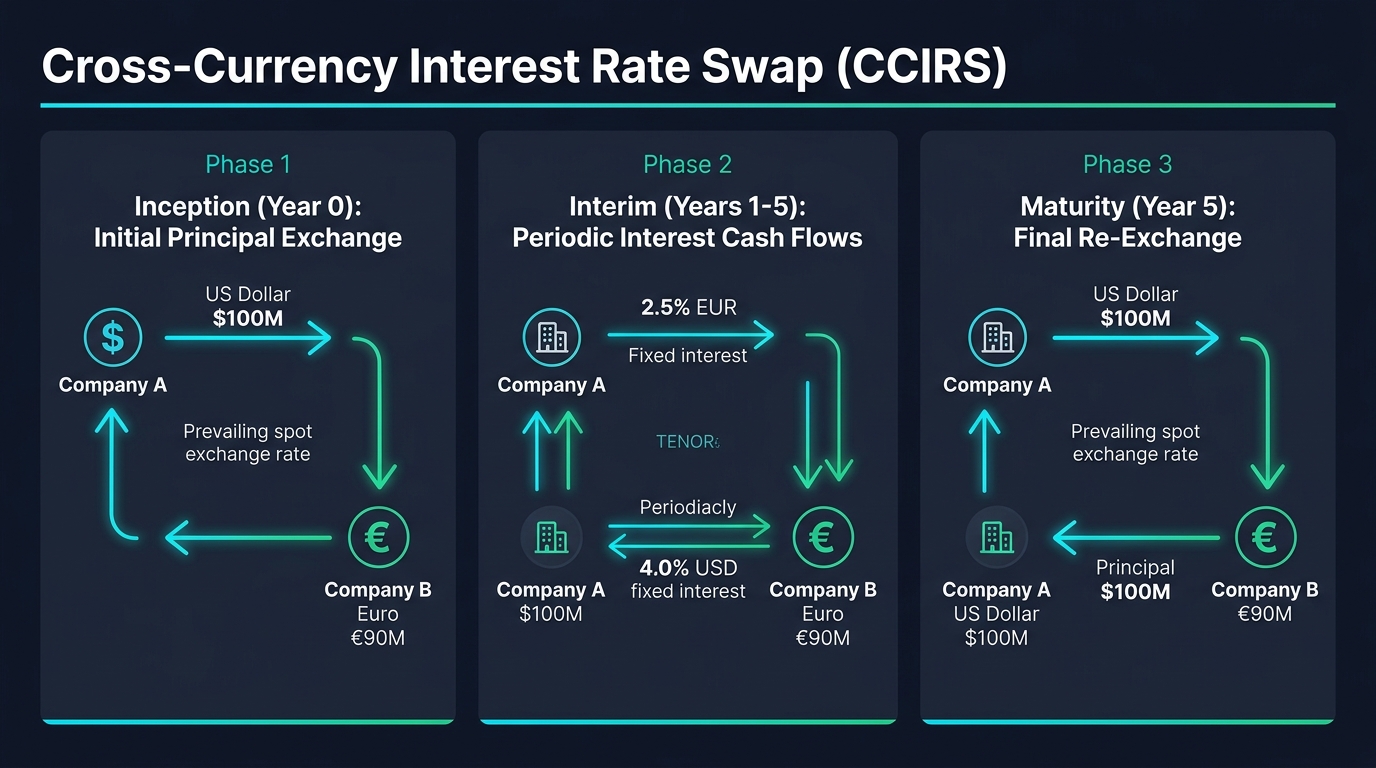
- Initial Exchange: Counterparties exchange initial principal amounts at the prevailing spot exchange rate.
- Intermediate Payments: Throughout the multi-year tenure of the contract, the parties exchange regular periodic interest payments (quarterly or semi-annually). One party pays a fixed or floating rate on the currency they received, while the other party does the same in the opposing currency.
- Final Re-Exchange: At maturity, the counterparties re-exchange the exact original principal amounts at the original spot exchange rate, completely insulating both parties from interim exchange rate fluctuations.
Why Institutions Execute Currency Swaps
Global entities deploy currency swaps to achieve two primary strategic objectives:
1. Exploiting Comparative Advantage in Foreign Debt Markets
Multinational corporations frequently possess a “home bias” advantage: a corporation can borrow significantly cheaper in its domestic credit market, where local institutional investors and bond funds are intimately familiar with its creditworthiness, than it can in a foreign debt market.
Suppose an American manufacturing conglomerate (Company A) needs to borrow €100,000,000 to construct a new assembly facility in Germany. Simultaneously, a German automotive group (Company B) requires $110,000,000 to expand operations in the United States.
- Company A can issue USD bonds at 4.0% in New York, but European investors demand 5.5% if Company A attempts to issue Euro bonds directly in Frankfurt.
- Company B can issue Euro bonds at 3.0% in Frankfurt, but Wall Street investors demand 5.0% for Company B to issue USD bonds.
By executing a currency swap:
- Company A borrows $110,000,000 in the US at its favorable 4.0% rate.
- Company B borrows €100,000,000 in Germany at its favorable 3.0% rate.
- They swap the borrowed principal funds at inception.
- Over the next ten years, Company A services the 3.0% interest on Company B’s Euro loan, and Company B services the 4.0% interest on Company A’s Dollar loan.
- Both companies obtain foreign currency financing at rates significantly lower than if they had entered foreign credit markets independently.
2. Central Bank Liquidity Swap Lines
During global financial crises, the cross-currency swap mechanism becomes a vital instrument of international monetary stability.
The US Federal Reserve maintains permanent bilateral liquidity swap arrangements with five major central banks: the European Central Bank (ECB), the Bank of England (BoE), the Bank of Japan (BoJ), the Bank of Canada (BoC), and the Swiss National Bank (SNB).
During severe dollar liquidity shortages (such as the 2008 Lehman Brothers collapse and the March 2020 pandemic shock), foreign commercial banks faced immense difficulty rolling over their US Dollar liabilities. Under the swap line agreements:
- The Fed provides physical US Dollars to the foreign central bank (e.g., the ECB) in exchange for equivalent Euro collateral.
- The foreign central bank auctions those US Dollars directly to its domestic commercial banks to stave off bank runs.
- At maturity, the central banks reverse the transaction at the identical exchange rate, ensuring the Fed bears zero currency risk while backstopping global banking liquidity.
Practical Example: Mechanics of a 5-Year EUR/USD Swap
Consider a 5-year fixed-for-fixed cross-currency swap between an American multinational and a European bank:
- Notional Principal: $100,000,000 USD and €90,000,000 EUR
- Spot Exchange Rate at Inception: EUR/USD = 1.1111 ($100M / €90M)
- Agreed Terms: The US firm pays 2.50% fixed annually on €90,000,000; the European bank pays 4.00% fixed annually on $100,000,000.
Step 1: Initial Exchange (Year 0)
- The US firm transfers $100,000,000 to the European bank.
- The European bank transfers €90,000,000 to the US firm.
Step 2: Annual Interest Exchanges (Years 1 through 5)
Every year for five years:
- The US firm pays €2,250,000 to the European bank ($90,000,000 \times 2.50%$).
- The European bank pays $4,000,000 to the US firm ($100,000,000 \times 4.00%$).
Step 3: Final Re-Exchange at Maturity (Year 5)
Regardless of whether the live EUR/USD market exchange rate has risen to 1.3000 or collapsed to 0.9000:
- The European bank returns the original $100,000,000 to the US firm.
- The US firm returns the original €90,000,000 to the European bank.
- The exchange risk on the $100M principal is completely neutralized.
Key Takeaways
- A currency swap is a long-term OTC contract to exchange principal and interest payments in two different currencies.
- It differs from an FX swap, which is short-term and features no intermediate interest cash flows.
- The market was pioneered in 1981 by the World Bank and IBM.
- Multinationals use currency swaps to exploit comparative borrowing advantages and lock in foreign exchange funding costs.
- Central bank standing swap lines provide emergency US Dollar liquidity to international banking systems during financial crises.
FAQ
Why are principal amounts re-exchanged at the original exchange rate? Re-exchanging principal at the historical inception rate is the core economic purpose of a currency swap. It guarantees that the borrower faces zero currency risk on the repayment of their debt principal, regardless of how market exchange rates fluctuate over the 5- or 10-year period.
What is the difference between a fixed-for-floating and floating-for-floating swap? In a fixed-for-floating swap, one counterparty pays a constant fixed percentage while the other pays a variable rate tied to an interbank benchmark (such as SOFR or EURIBOR). In a floating-for-floating swap (also known as a cross-currency basis swap), both counterparties pay variable benchmark interest rates.
What happens if a counterparty defaults during a currency swap? Currency swaps are executed under standardized International Swaps and Derivatives Association (ISDA) Master Agreements. If a counterparty defaults, close-out netting provisions apply: the remaining payments and obligations are netted into a single lump-sum settlement value based on prevailing market replacement costs.
Ready to trade forex?
Open a free demo account with a regulated broker. Practice with virtual funds before risking real money.