Forward Points
Forward points, also known as swap points, are the pips added to or subtracted from the spot exchange rate to determine the outright forward price for a foreign exchange transaction settling on a specified future date.
What Are Forward Points?
In foreign exchange trading, forward points (frequently called swap points) represent the exact price differential between the prevailing spot exchange rate and the outright forward rate for a specified delivery date. Forward points are quoted in pips or basis points.
When a multinational corporation, import-export merchant, or institutional fund enters an outright forward contract with an investment bank, the dealer does not simply quote an arbitrary future price. Instead, the dealer takes the live spot exchange rate and adjusts it by adding or subtracting forward points. These points mathematically reflect the net cost of carry—specifically, the difference in benchmark interest rates between the two national currencies over the contract’s duration.
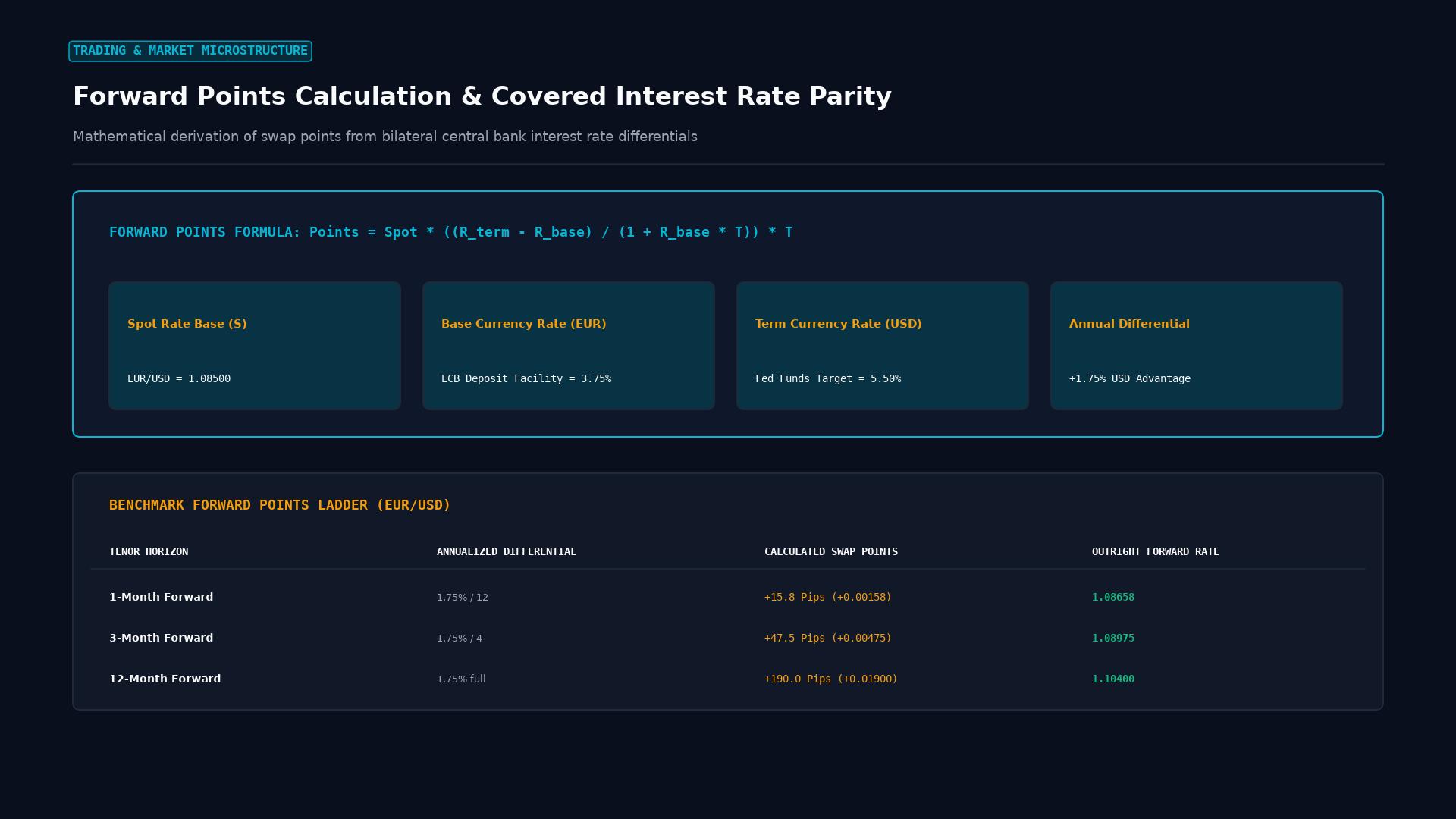 Figure: Mathematical derivation of FX swap points: interest rate differentials determining forward premiums (added to spot) or forward discounts (subtracted from spot).
Mathematical Derivation: Covered Interest Parity
Forward points are derived from Covered Interest Parity (CIP), a non-arbitrage condition stating that investors should achieve equivalent returns whether they hold domestic sovereign debt or convert capital into foreign currency, invest in foreign debt, and hedge the exchange rate risk using a forward contract.
The mathematical formula for forward points is expressed as:
$$\text{Forward Points} = F - S = S \times \left[ \frac{1 + \left(r_d \times \frac{t}{\text{basis}}\right)}{1 + \left(r_f \times \frac{t}{\text{basis}}\right)} - 1 \right]$$
Where:
- $F$ = Outright forward exchange rate
- $S$ = Prevailing spot exchange rate
- $r_d$ = Domestic interest rate (the quote currency)
- $r_f$ = Foreign interest rate (the base currency)
- $t$ = Number of days to forward maturity
- basis = Day count convention (typically 360 days for USD, EUR, and CHF; 365 days for GBP and AUD)
For quick institutional estimations, money market dealers approximate forward points using this simplified rule of thumb:
$$\text{Forward Points} \approx S \times (r_d - r_f) \times \frac{t}{360}$$
Forward Premium vs. Forward Discount
Whether forward points are added to or subtracted from the spot rate depends entirely on which currency carries the higher interest rate:
- Forward Premium (Points Added): When the base currency carries a lower interest rate than the quote currency ($r_f < r_d$), the base currency trades at a forward premium. Forward points are positive and added to the spot price.
- Forward Discount (Points Subtracted): When the base currency carries a higher interest rate than the quote currency ($r_f > r_d$), the base currency trades at a forward discount. Forward points are negative and deducted from the spot price.
This adjustment prevents risk-free arbitrage. If the forward rate did not discount the higher-yielding currency, global macro funds could borrow cheaply in the low-yielding currency, invest in the high-yielding currency, and lock in a guaranteed profit via an unadjusted forward contract.
Practical Calculation: EUR/USD 3-Month Outright Forward
Consider an interbank dealer pricing a 90-day forward contract on EUR/USD:
- Spot EUR/USD ($S$): 1.0850
- US 3-Month Secured Overnight Financing Rate (SOFR, $r_d$): 5.20% per annum
- Eurozone 3-Month EURIBOR ($r_f$): 3.70% per annum
- Time to Maturity ($t$): 90 days (Money market year: 360 days)
Applying the forward pricing formula:
$$F = 1.0850 \times \frac{1 + \left(0.0520 \times \frac{90}{360}\right)}{1 + \left(0.0370 \times \frac{90}{360}\right)}$$
$$F = 1.0850 \times \frac{1 + 0.01300}{1 + 0.00925} = 1.0850 \times \frac{1.01300}{1.00925} = 1.0850 \times 1.0037156 \approx 1.08903$$
Calculating the forward points:
$$\text{Forward Points} = 1.08903 - 1.08500 = +0.00403 \text{ (or } +40.3 \text{ pips)}$$
Because the quote currency (USD) has a higher yield than the base currency (EUR), the EUR trades at a forward premium of +40.3 pips against the dollar for a 3-month settlement.
Quotation Conventions: Bid and Ask Forward Points
Interbank dealers quote forward points as a two-way two-sided market (Bid / Ask):
| Scenario | Point Structure | Rule | Calculation Method |
|---|---|---|---|
| Rising Points (e.g., 25 / 30) | Bid < Ask | Premium | Add points to Spot Bid and Spot Ask |
| Falling Points (e.g., 45 / 40) | Bid > Ask | Discount | Subtract points from Spot Bid and Spot Ask |
Example 1: Forward Premium (Points Increasing)
- Spot GBP/USD: 1.2700 / 1.2702
- 6-Month Forward Points: 50 / 55
- Outright Forward Rate:
- Bid: $1.2700 + 0.0050 = \mathbf{1.2750}$
- Ask: $1.2702 + 0.0055 = \mathbf{1.2757}$
- The dealer spread widens from 2 pips on spot to 7 pips on the forward, reflecting term liquidity risk.
Example 2: Forward Discount (Points Decreasing)
- Spot USD/JPY: 155.20 / 155.22
- 1-Year Forward Points: 420 / 410
- Outright Forward Rate:
- Bid: $155.20 - 4.20 = \mathbf{151.00}$
- Ask: $155.22 - 4.10 = \mathbf{151.12}$
How Retail Brokers Use Forward Points for Daily Rollover (Swap)
Retail forex traders holding leveraged positions past 5:00 PM Eastern Time encounter forward points every single day in the form of overnight rollover or swap charges.
To keep a retail client’s spot position open into the next trading day without triggering actual cash delivery, the broker executes an overnight foreign exchange swap (Tom-Next: Tomorrow to Next business day). The swap rate credited or debited to the trader’s balance is calculated directly from the interbank Tom-Next forward points, plus or minus the broker’s administrative markup.
Key Takeaways
- Forward points represent the number of pips added to or subtracted from the spot rate to compute an outright forward rate.
- Forward points are determined by the interest rate differential between the two currencies via Covered Interest Parity.
- A currency with a lower interest rate trades at a forward premium (points added); a currency with a higher interest rate trades at a forward discount (points subtracted).
- Forward points do not predict where exchange rates will trade; they merely reflect the mathematical cost of carrying currency positions over time.
- Daily retail forex swap fees are derived directly from 1-day (Tom-Next) interbank forward points.
Frequently Asked Questions
Why do forward spreads widen for longer maturities?
Forward points carry wider bid-ask spreads for distant maturities (e.g., 1-year vs. 1-week) because interbank market liquidity declines over extended time horizons, and bank funding costs face greater uncertainty.
Can forward points be negative?
Yes. When forward points are negative, the base currency is at a forward discount because its domestic interest rate exceeds that of the quote currency. The points are subtracted from the spot rate.
What is the difference between forward points and swap points?
The terms are used interchangeably in institutional foreign exchange. “Swap points” typically refers to the pricing of FX swaps (simultaneous spot and forward transactions), while “forward points” refers to the adjustment applied to outright forward contracts.
Ready to trade forex?
Open a free demo account with a regulated broker. Practice with virtual funds before risking real money.