Forward Rate
A forward rate is a legally contracted exchange rate or interest rate established today for a financial transaction that will be executed and settled on a predetermined future date beyond the standard spot settlement horizon.
What Is a Forward Rate?
In financial markets, a forward rate is a predetermined, legally binding price or yield agreed upon today for a transaction that will settle on a specific future date. While a spot rate prices transactions for immediate delivery (typically two business days from trade date, or T+2), a forward rate locks in the contractual terms for settlement weeks, months, or years in advance.
Forward rates operate across two fundamental pillars of modern finance:
- In Foreign Exchange (Forward Exchange Rate): The exchange rate at which an entity agrees to buy or sell a foreign currency on a future value date (e.g., locking in EUR/USD at 1.0950 for settlement in six months).
- In Fixed-Income & Money Markets (Forward Interest Rate): An interest rate applicable to a future financial period, mathematically derived from the current spot yield curve (e.g., the interest rate for a 1-year loan beginning two years from today).
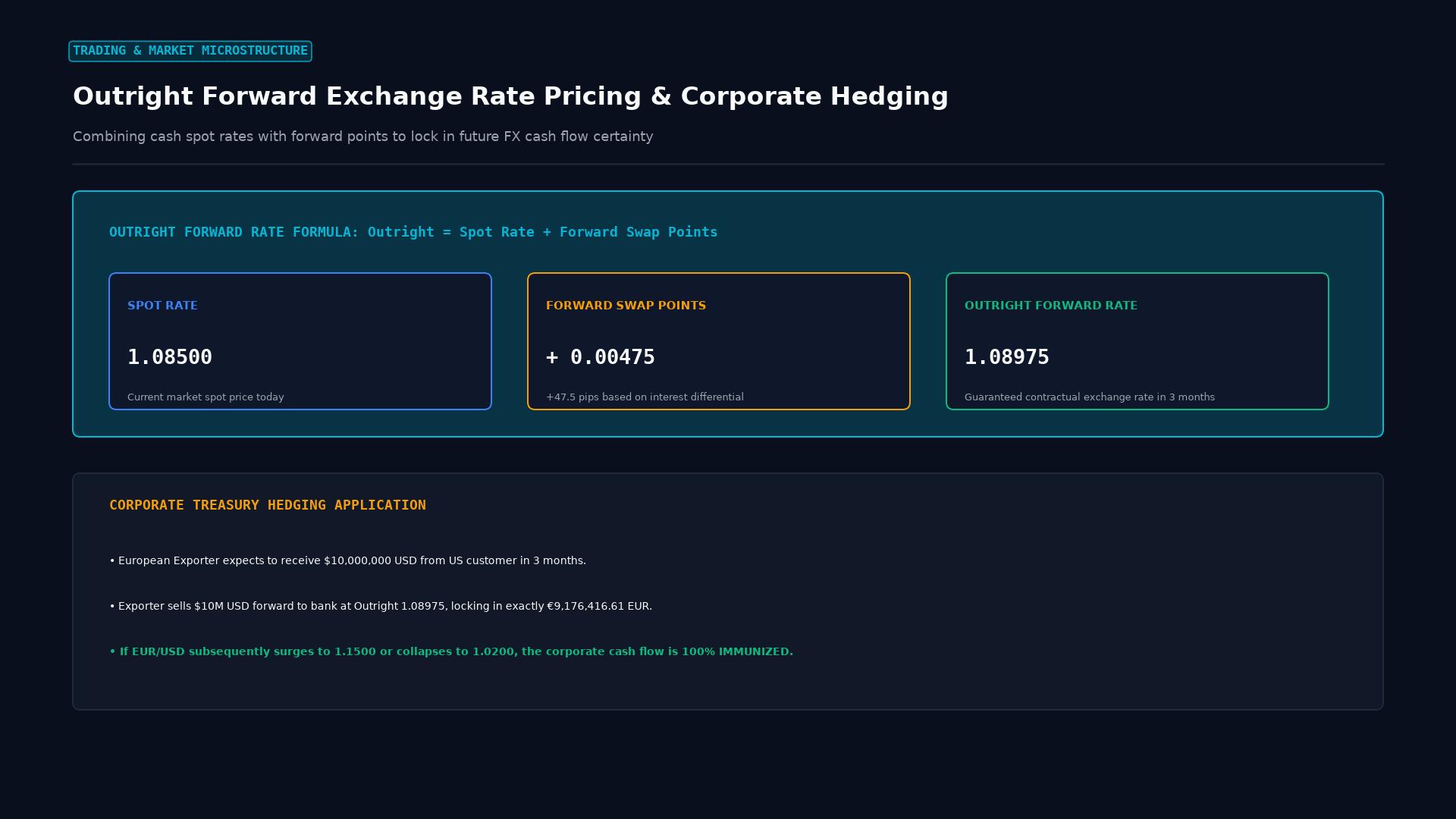 Figure: Pricing outright currency forwards: adding swap points to current spot exchange rates to lock in guaranteed future foreign exchange rates for commercial treasuries.
Key Takeaways
- No Future Guesswork: A forward exchange rate is not a prediction of where market prices will be in the future; it is a mathematical calculation based strictly on interest rate parity.
- Covered Interest Rate Parity (CIP): Forward rates are derived from spot prices adjusted for the interest rate differential between the two currencies over the contract tenure.
- Forward Points (Swap Points): The mathematical variance between the forward rate and the spot rate is expressed in forward points: $\text{Forward Rate} = \text{Spot Rate} + \text{Forward Points}$.
- Essential Hedging Tool: Multinational corporations use forward rates to eliminate foreign exchange risk from forward supply contracts and overseas capital investments.
The Mathematics of the Forward Exchange Rate
Under Covered Interest Rate Parity (CIP), forward rates eliminate risk-free arbitrage between international money markets. The theoretical forward rate ($F$) is calculated as:
$$F = S \times \left[ \frac{1 + r_{\text{quote}} \times (d / 360)}{1 + r_{\text{base}} \times (d / 360)} \right]$$
Where:
- $S$ is the current spot exchange rate.
- $r_{\text{quote}}$ is the nominal interest rate of the quote currency.
- $r_{\text{base}}$ is the nominal interest rate of the base currency.
- $d$ is the number of days to settlement (using actual/360 or actual/365 money market day count conventions).
Forward Premium vs. Forward Discount
- If $r_{\text{base}} > r_{\text{quote}}$, the base currency trades at a forward discount (forward rate is lower than spot rate; forward points are negative).
- If $r_{\text{base}} < r_{\text{quote}}$, the base currency trades at a forward premium (forward rate is higher than spot rate; forward points are positive).
Numerical Example: EUR/USD 1-Year Forward
- Current Spot Rate ($S$): 1.0800
- U.S. Dollar 1-Year Interest Rate ($r_{\text{USD}}$): 5.00%
- Eurozone 1-Year Interest Rate ($r_{\text{EUR}}$): 3.00%
- Days to Maturity ($d$): 360 Days
$$F = 1.0800 \times \left[ \frac{1 + 0.05}{1 + 0.03} \right] = 1.0800 \times 1.019417 = 1.1010$$
The 1-year forward rate is 1.1010. The +210 forward points compensate for the higher interest yield an investor gives up by holding Euros instead of U.S. Dollars.
Forward Rates in Fixed-Income Markets
In bond and money markets, an implied forward interest rate is the break-even interest rate linking two different maturity spot rates:
$$(1 + s_2)^2 = (1 + s_1)(1 + f_{1,2})$$
Where $s_1$ is the 1-year spot bond rate, $s_2$ is the 2-year spot bond rate, and $f_{1,2}$ is the 1-year forward rate beginning one year from today.
Is the Forward Rate an Unbiased Predictor of Future Spot?
In academic financial theory, the Unbiased Forward Rate Hypothesis (UFRH) posits that the forward rate should equal the market’s expected future spot rate: $F_t = E(S_{t+1})$.
However, empirical market data has consistently disproved this hypothesis—a famous market phenomenon known as the Forward Premium Anomaly (or the Fama Puzzle):
- Historically, currencies trading at a forward discount (high-yielding currencies) tend to appreciate or stay stable rather than depreciate as predicted by theory.
- This failure of theory creates the foundation of the Currency Carry Trade, where hedge funds harvest persistent yield premia by selling forward discount currencies and investing in high-yield debt.
Frequently Asked Questions
Does entering a forward rate contract require upfront cash?
No. Standard Over-the-Counter (OTC) FX Forward contracts require zero upfront cash payment on trade date. However, depending on the client’s creditworthiness and the broker’s credit policies, the client may need to post collateral (initial margin) or sign an ISDA Credit Support Annex (CSA) requiring daily mark-to-market variation margin.
What is the difference between a forward rate and a futures price?
A forward rate is a customized Over-the-Counter (OTC) contract negotiated privately between two institutions with bespoke dates and sizes. A futures price is the standardized, exchange-traded equivalent (traded on venues like the CME) featuring daily mark-to-market cash settlement and guaranteed by a central clearinghouse.
What are “broken dates” in forward rate pricing?
Standard forward tenors trade for regular intervals (1 week, 1 month, 3 months, 6 months, 1 year). If a corporate treasurer needs to settle on an irregular date (e.g., 47 days from today to match a supplier invoice), dealer banks calculate a customized forward rate using linear interpolation between standard tenor points, known as a “broken date” or “odd date” forward.
Ready to trade forex?
Open a free demo account with a regulated broker. Practice with virtual funds before risking real money.