Direct Quote
A direct quote (direct quotation) is a foreign exchange rate quotation that expresses the price of one single unit of a foreign currency in terms of a variable number of domestic currency units.
What Is a Direct Quote?
In foreign exchange trading and international finance, a direct quote (commonly termed a direct quotation or American terms when referenced from a U.S. perspective) is an exchange rate quotation that expresses the value of one fixed unit of a foreign base currency in terms of a variable number of domestic currency units.
Under a direct quote convention, the foreign currency always serves as the base currency (fixed at exactly 1.00 unit), while the domestic currency serves as the counter (quote) currency. For an investor or business based in the United States, a quotation of EUR/USD = 1.0850 is a direct quote: it indicates that an American buyer must pay precisely $1.0850 U.S. Dollars to purchase 1.00 Euro.
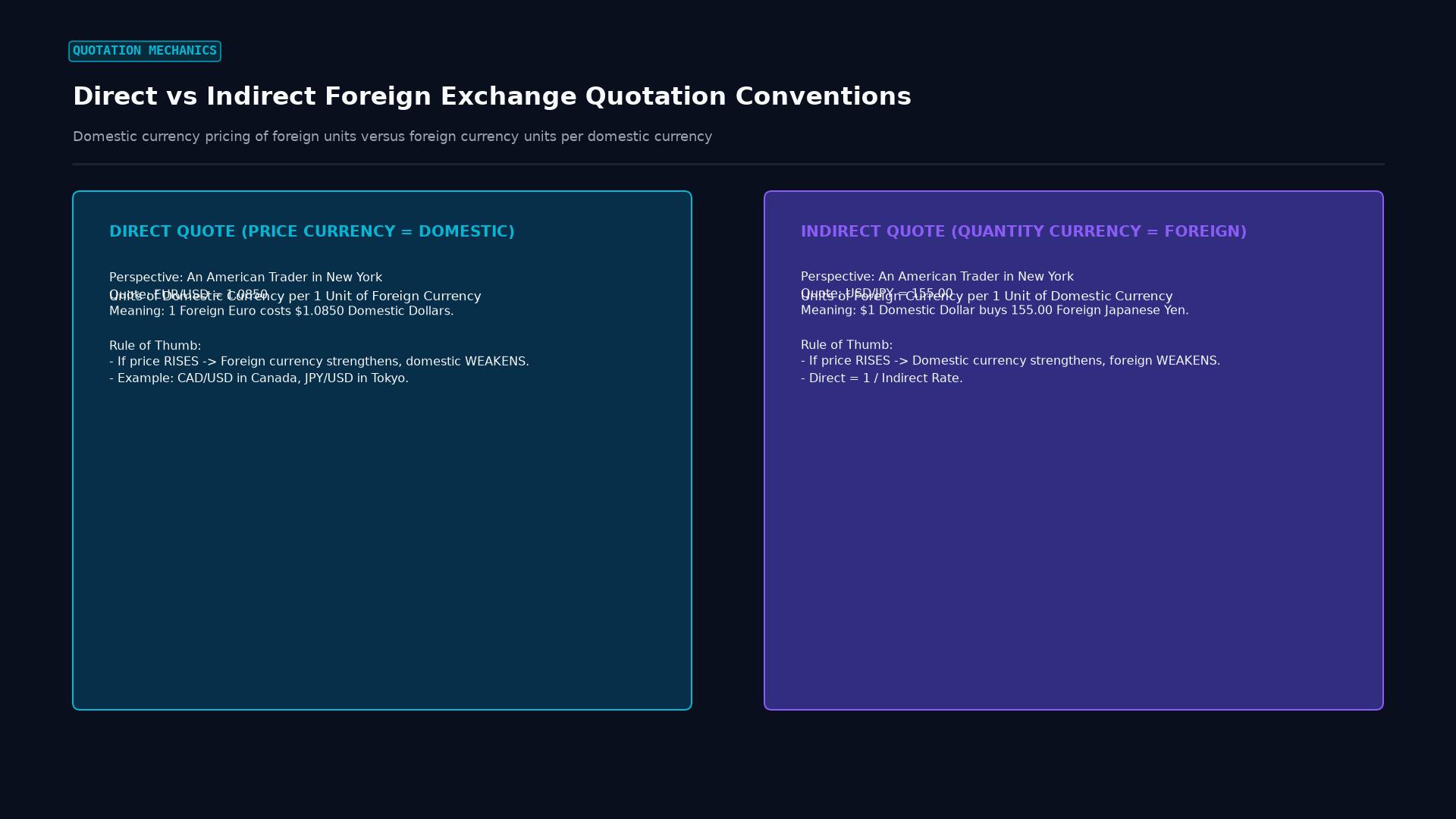 Figure: Quotation mechanics: pricing units of domestic currency per foreign unit (direct quote) versus foreign units per domestic unit (indirect quote).
Key Takeaways
- Intuitive Valuation: A direct quote aligns with standard grocery and commodity pricing: it tells the domestic consumer exactly how much domestic cash is needed to buy one physical unit of the foreign asset.
- Directional Inverse Interpretation: In a direct quote, when the numerical exchange rate rises (e.g., EUR/USD increases from 1.0500 to 1.1000), the domestic currency is weakening/depreciating, because it now takes more domestic dollars to purchase one foreign unit.
- Direct vs. Indirect Relationship: A direct quote is the exact mathematical reciprocal of an indirect quote: $\text{Direct Quote} = 1 / \text{Indirect Quote}$.
- Interbank Quotation Standards: Global interbank conventions standardize quotation priority regardless of national perspective: EUR, GBP, AUD, and NZD are quoted directly against the U.S. Dollar.
Mathematical Formulation: Direct vs. Indirect Conversion
The mathematical conversion between direct and indirect quotations is expressed through reciprocal parity:
$$\text{Direct Quote} = \frac{1}{\text{Indirect Quote}}$$
$$\text{Indirect Quote} = \frac{1}{\text{Direct Quote}}$$
Calculating Domestic Cost of Foreign Goods:
To determine the domestic currency cost of an imported item invoiced in a foreign currency under a direct quote:
$$\text{Domestic Cash Required} = \text{Foreign Invoice Amount} \times \text{Direct Exchange Rate}$$
Example: An American importer purchases machinery from Germany for €250,000 EUR. The direct quotation for EUR/USD is 1.0800:
$$\text{Cost in USD} = €250,000 \times 1.0800 = $270,000 \text{ USD}$$
Regional Perspectives: Direct Quotation Examples Worldwide
Whether a quotation is “direct” depends entirely upon the geographic location and domestic currency of the observer:
| Currency Pair | Market Quotation | Perspective | Direct or Indirect? | Interpretation |
|---|---|---|---|---|
| EUR/USD | 1.0850 |
United States (USD) | Direct Quote | $1.0850 USD required to purchase 1.00 EUR |
| EUR/USD | 1.0850 |
Germany / France (EUR) | Indirect Quote | 1.00 EUR buys $1.0850 USD foreign currency |
| GBP/USD | 1.2800 |
United States (USD) | Direct Quote | $1.2800 USD required to purchase £1.00 GBP |
| USD/CAD | 1.3650 |
Canada (CAD) | Direct Quote | C$1.3650 CAD required to purchase $1.00 USD |
| USD/JPY | 155.00 |
Japan (JPY) | Direct Quote | ¥155.00 JPY required to purchase $1.00 USD |
| USD/JPY | 155.00 |
United States (USD) | Indirect Quote | $1.00 USD buys ¥155.00 JPY foreign currency |
Trading Mechanics: Pip Values in Direct Quotations
For retail and institutional traders whose account equity is denominated in the domestic currency, trading a pair with a direct quote significantly simplifies risk calculations:
$$\text{Pip Value (in Account Currency)} = \text{Contract Size} \times \text{Pip Increment}$$
Because the domestic currency serves as the counter currency in a direct quote:
- On a Standard Lot (100,000 units) of EUR/USD, the pip value is fixed at $10.00 USD per pip, regardless of whether the pair trades at 1.0500 or 1.2000.
- On a Micro Lot (1,000 units), the pip value is fixed at $0.10 USD per pip.
- Unlike indirect pairs (like USD/JPY or USD/CHF), traders do not need to perform dynamic currency conversions to calculate stop-loss dollar risk on direct quotes.
Real-World Case Study: Cross-Border Treasury Invoicing
A U.S. consumer electronics corporation imports components from Japan and the United Kingdom:
The Quotes Received from the FX Dealing Desk:
- Pound Sterling Quote: Quoted directly as
GBP/USD = 1.2750. - Japanese Yen Quote: Quoted indirectly in standard interbank terms as
USD/JPY = 150.00.
The Treasury Conversion:
- To invoice £1,000,000 GBP: The treasurer applies the direct quote immediately: $$\text{USD Outflow} = £1,000,000 \times 1.2750 = $1,275,000 \text{ USD}$$
- To invoice ¥150,000,000 JPY: The treasurer must first invert the indirect quote into a direct quote: $$\text{Direct JPY Quote} = \frac{1}{150.00} \approx 0.006667 \text{ USD per JPY}$$ $$\text{USD Outflow} = ¥150,000,000 \times 0.006667 = $1,000,000 \text{ USD}$$
By maintaining automated treasury management software that converts all foreign exposures into standardized direct quotes, corporate treasurers eliminate keying errors and streamline multi-currency balance-sheet hedging.
Frequently Asked Questions
Why does a rising direct quote mean the domestic currency is falling?
Because a direct quote expresses the price of the foreign currency in domestic money. If the direct quote of EUR/USD rises from $1.05 to $1.15, you must now surrender 10 cents more of domestic U.S. currency to purchase the same single Euro. The Euro has strengthened, which mathematically means the U.S. Dollar has weakened.
What is the difference between direct quotes and “American Terms”?
In the global foreign exchange interbank market, “American Terms” is an institutional synonym for quoting any foreign currency directly against the U.S. Dollar (e.g., quoting EUR, GBP, AUD, or NZD as the base currency with USD as the quote currency). Conversely, “European Terms” refers to indirect quotations where USD is the base currency (e.g., USD/JPY, USD/CAD, USD/CHF).
Can cross currency pairs be direct quotes?
Yes, depending on your domestic base. For an investor in the United Kingdom whose domestic currency is the British Pound, the cross pair EUR/GBP is a direct quote (expressing how many pence/pounds are needed to buy 1.00 Euro).
Ready to trade forex?
Open a free demo account with a regulated broker. Practice with virtual funds before risking real money.