FX Forward
An FX forward (or outright forward) is a customized Over-the-Counter derivative contract between two parties to exchange a specified quantity of one currency for another at an agreed-upon exchange rate on a designated future date beyond the standard spot settlement horizon.
What Is an FX Forward?
An FX forward (also known as an outright forward or foreign exchange forward contract) is a binding Over-the-Counter (OTC) financial agreement between two counterparties—typically a commercial corporation and an investment dealer bank—to exchange two currencies at an agreed exchange rate on a specified future date. While spot foreign exchange contracts settle two business days after trade date (T+2), FX forwards are customized to settle weeks, months, or years in the future.
FX forwards are the primary tool used by multinational corporate treasurers, institutional asset managers, and sovereign funds to hedge foreign currency cash-flow exposures. By entering into an FX forward, an enterprise locks in its future exchange rate today, completely removing foreign exchange volatility from international import/export contracts, foreign dividend repatriations, and overseas debt obligations.
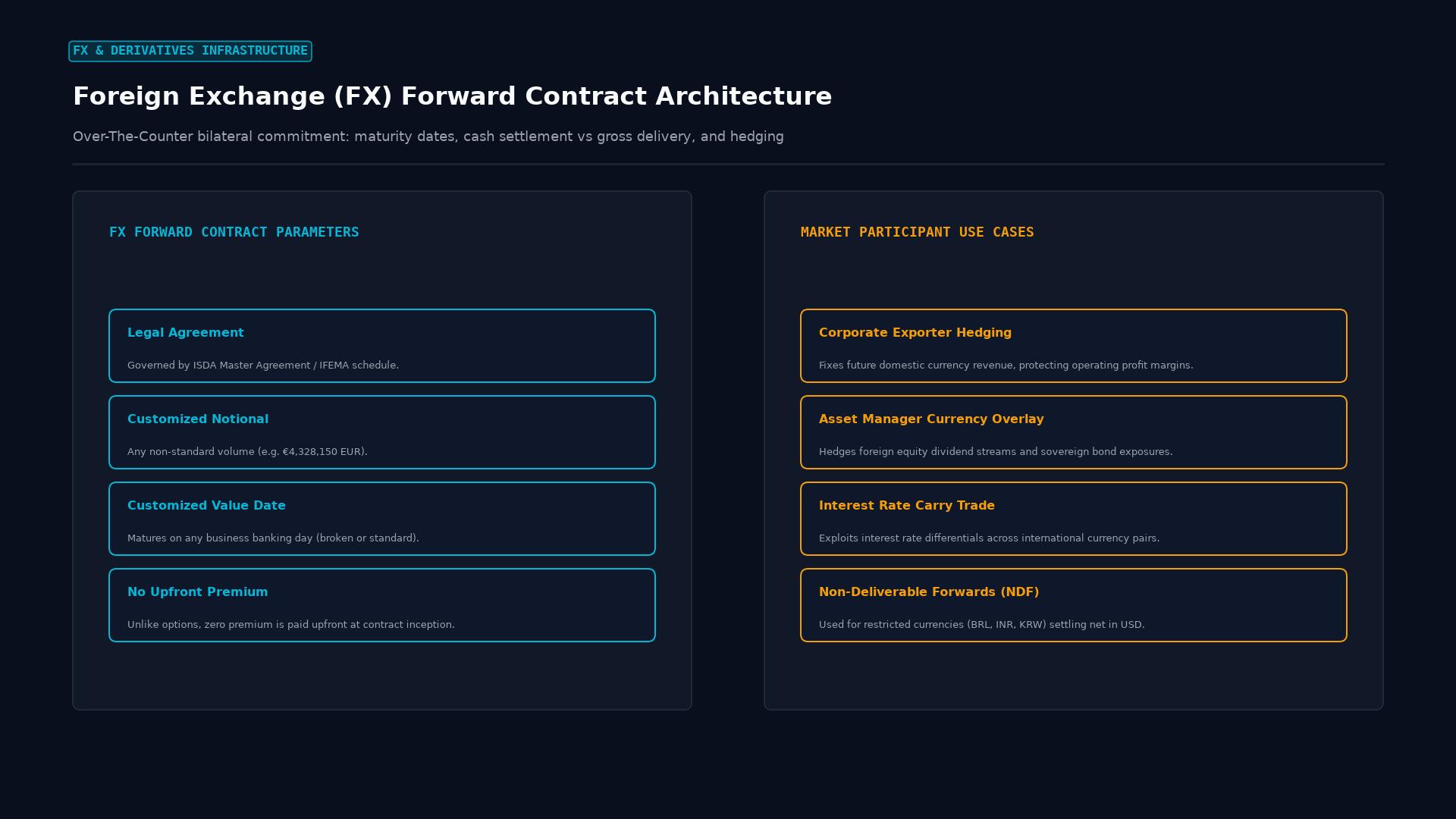 Figure: Bilateral OTC currency forward structure: customizing notional volume and settlement value dates to completely immunize corporate cash flows against currency volatility.
Key Takeaways
- Bespoke Over-the-Counter Contract: Unlike exchange-traded currency futures, FX forwards feature customized notional sizes, broken settlement dates, and non-standard currency pairs negotiated privately with a dealer bank.
- Zero Initial Outlay: Standard outright forwards require no upfront cash exchange on trade date; the full notional amounts are exchanged only upon final settlement.
- Pricing via Covered Interest Parity: The forward rate is calculated using the spot rate and the interest rate differential between the two nations: $\text{Forward Rate} = \text{Spot Rate} + \text{Forward Points}$.
- Outright Forward vs. FX Swap: An outright forward is a single, stand-alone forward trade. An FX Swap involves two simultaneous legs: a spot transaction combined with an equal and offsetting forward transaction.
The Mathematics of FX Forward Pricing
The forward price is derived strictly from Covered Interest Rate Parity (CIP) to eliminate cross-border arbitrage:
$$F = S \times \left[ \frac{1 + r_{\text{term}} \times \left(\frac{d}{360}\right)}{1 + r_{\text{base}} \times \left(\frac{d}{360}\right)} \right]$$
Where:
- $S$ is the current spot exchange rate.
- $r_{\text{term}}$ is the interest rate of the term (quote) currency.
- $r_{\text{base}}$ is the interest rate of the base currency.
- $d$ is the number of calendar days between spot date and forward maturity.
The difference ($F - S$) represents the forward points (or swap points). If the base currency has a higher interest rate than the quote currency, the base currency trades at a forward discount (negative forward points) to offset the carry yield benefit.
Deliverable Forwards vs. Non-Deliverable Forwards (NDFs)
In international corporate treasury, forwards are split into two operational frameworks based on currency convertibility:
| Feature | Deliverable FX Forward | Non-Deliverable Forward (NDF) |
|---|---|---|
| Settlement Mechanism | Physical exchange of both currencies via SWIFT | Net cash settlement in a convertible reserve currency (typically USD) |
| Applicable Currencies | Fully convertible G10 currencies (USD, EUR, GBP, JPY, CAD, CHF, AUD) | Restricted emerging currencies (BRL, INR, CNY, KRW, TWD, IDR) |
| Regulatory Barriers | Unrestricted international capital mobility | Sovereign capital controls; foreign currency cannot leave domestic banking system |
| Benchmark Reference | Agreed physical interbank delivery | Official onshore central bank fixing rate on valuation date |
Tactical Motivations for Using FX Forwards
1. Corporate Cash Flow Budget Certainty
A corporate manufacturer planning a $50 million capital expenditure project in Europe next year cannot afford for EUR/USD to appreciate by 15%, which would create a $7.5 million budget deficit. By purchasing a 12-month FX forward, the CFO fixes the exact dollar cost in today’s corporate balance sheet, insulating the project from currency shocks.
2. Eliminating Speculative Temptation
Corporate treasury guidelines mandate that firms focus on their core operating business (e.g., manufacturing cars or developing software) rather than taking speculative currency bets. Locking in forward rates eliminates foreign exchange speculation.
3. Credit and Margin Requirements
Under institutional banking agreements (governed by an ISDA Master Agreement), corporate clients typically do not have to post daily cash variation margin if they maintain approved credit facilities with the dealer bank, preserving corporate operational cash.
Frequently Asked Questions
Can an FX forward be closed or settled early?
Yes. An outright forward can be terminated early through an early draw-down (taking delivery before maturity) or by executing an offsetting forward contract that matures on the same value date, neutralizing market exposure. The net mark-to-market difference is settled between the bank and client.
What is a “Window Forward”?
A window forward (or flexible forward) is an outright contract that allows the buyer to execute the currency exchange at the contracted forward rate on any business day within a specified date window (e.g., between October 1 and October 31) rather than on a single fixed calendar day. This is ideal for exporters with unpredictable shipping schedules.
What happens if an FX forward counterparty defaults before maturity?
If an OTC counterparty goes bankrupt before settlement, the non-defaulting party faces replacement cost risk. The surviving firm must enter the open spot market to replace the contract at prevailing market exchange rates, absorbing any adverse price movement accumulated since the forward was initiated.
Ready to trade forex?
Open a free demo account with a regulated broker. Practice with virtual funds before risking real money.