Leverage (Margin)
Leverage in forex is the ability to control a large position with a small amount of capital. Expressed as a ratio (e.g., 100:1), it amplifies both profits and losses proportionally. Margin is the collateral required to open and maintain a leveraged position.
What Is Leverage in Forex?
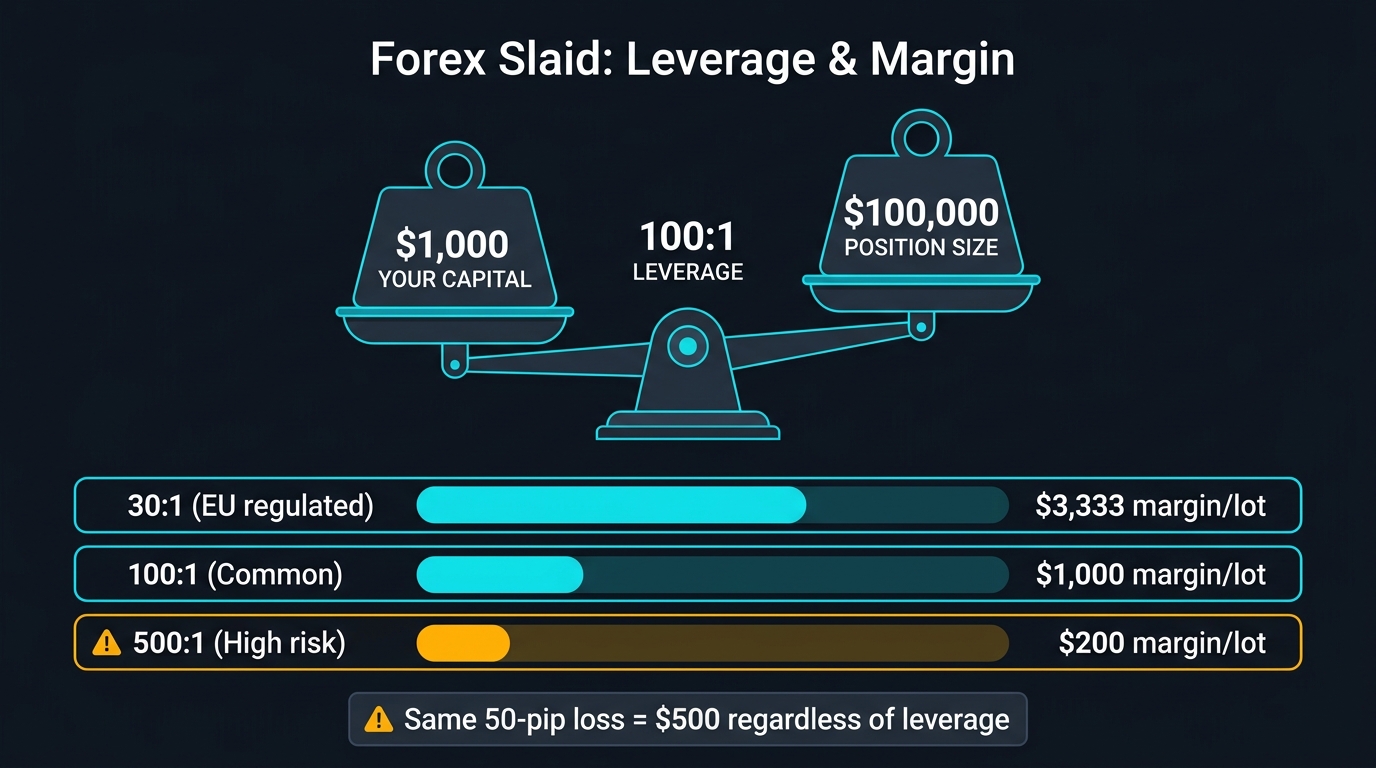
Leverage is borrowing power. When a broker offers 100:1 leverage, they allow you to control $100,000 in currency with just $1,000 of your own capital. The broker essentially lends you the rest. This is standard in forex — it’s why retail traders can participate in a market where institutional players move in multi-million dollar increments.
The appeal is obvious. A 50-pip move on a standard EUR/USD lot generates roughly $500 in profit. Without leverage, you’d need $100,000 in your account to make that trade. With 100:1 leverage, you need $1,000. The return on capital is 50% vs 0.5%. Same market move, radically different outcome — in both directions.
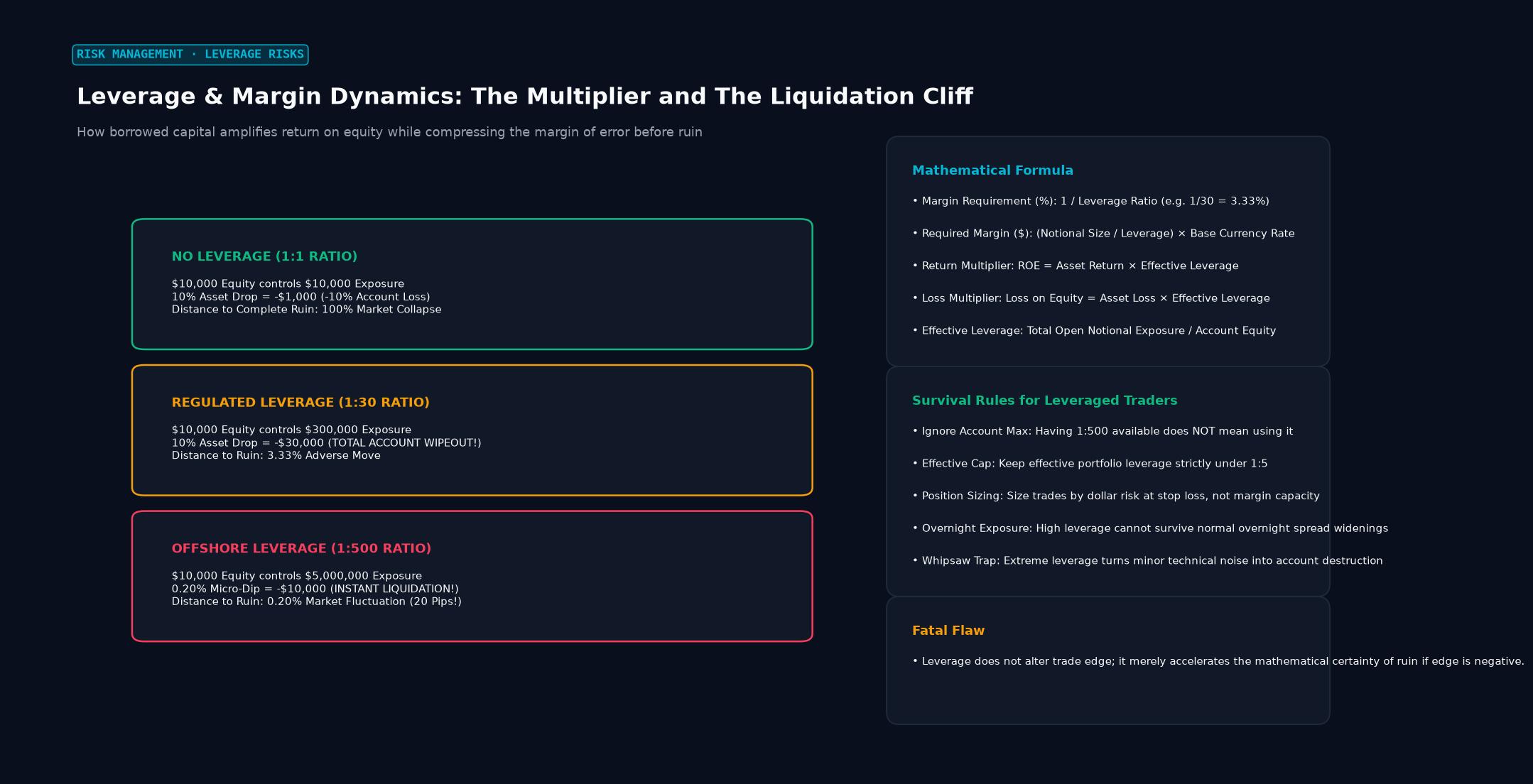 Figure: How borrowed capital amplifies return on equity while compressing the margin of error before ruin
Understanding Margin
Margin is not a cost or a fee. It’s a security deposit — collateral the broker holds to cover potential losses while your position is open. When you open a position, a portion of your account balance gets locked as margin. The rest is your free margin, available for additional trades.
The relationship between leverage and margin is straightforward:
Margin Required = Trade Size / Leverage Ratio
At 100:1 leverage on a standard lot ($100,000):
- Margin required = $100,000 / 100 = $1,000
At 50:1 leverage on the same trade:
- Margin required = $100,000 / 50 = $2,000
Lower leverage means more capital locked per position. The benefit is a larger buffer before any margin call scenario kicks in.
Initial Margin vs. Maintenance Margin
Two margin thresholds matter for every open trade:
Initial margin is the amount required to open the position in the first place. The figure above — $1,000 at 100:1 — is initial margin.
Maintenance margin (sometimes called variation margin) is the minimum balance you must maintain to keep the position open. If losses erode your account below this threshold, your broker issues a margin call — a demand to deposit more funds or close positions. At many brokers, if you don’t respond fast enough, the platform will automatically liquidate positions to bring margin levels back into compliance.
This automatic liquidation is not a punishment; it’s the mechanism that prevents your account from going negative. Some brokers guarantee against negative balances; others don’t. Read the fine print.
Leverage Ratios: What’s Normal, What’s Dangerous
Leverage ratios vary significantly by jurisdiction and broker type:
- ESMA-regulated EU/UK brokers: Maximum 30:1 for major pairs, 20:1 for minors, 2:1 for crypto. These were mandated in 2018 specifically to protect retail traders from blowing up accounts.
- Offshore brokers (Seychelles, Vanuatu, etc.): Often 500:1 or even 1000:1. Legally available but comes with minimal regulatory protection.
- US brokers: Capped at 50:1 for major pairs, 20:1 for minors under CFTC/NFA rules.
- Australian brokers (ASIC): 30:1 for major pairs since 2021 reforms.
Higher leverage is not inherently better. Professional traders at large banks and funds often operate at much lower effective leverage — sometimes 5:1 or 10:1 — because their risk management frameworks require it. The ability to trade at 500:1 doesn’t mean it’s wise.
The Double-Edged Reality
One thing leverage cannot do: change the probability of a trade being correct. It only scales the outcome. A 50-pip loss on a micro lot with no leverage might cost you $5. The same 50-pip loss on a standard lot at 100:1 leverage costs $500.
This asymmetry trips up new traders constantly. The psychological experience of watching leveraged losses mount in real time is categorically different from paper trading or small-lot practice. Markets don’t move more slowly because your leverage is higher.
A practical rule used by many experienced traders: never use more than 10:1 effective leverage, regardless of what your broker allows. If you’re risking 1% of your account per trade (a common professional benchmark), high leverage gives you flexibility in position sizing without actually requiring you to use it all.
Leverage and Your Trading Style
Day traders and scalpers typically need higher leverage because they’re targeting small pip moves (5–20 pips) and need position sizes large enough to make the trade worthwhile. A scalper chasing 10-pip targets on micro lots isn’t really using leverage aggressively — the math just requires a certain minimum position size to generate meaningful P&L.
Swing traders and position traders, holding trades for days or weeks, can operate at lower leverage. Their wider stop-losses and larger pip targets mean smaller lot sizes still produce meaningful returns.
Key Takeaways
- Leverage lets you control large positions with small capital; margin is the collateral required to do so
- Typical retail leverage ranges from 30:1 (regulated EU/UK) to 500:1 (offshore)
- Maintenance margin is the minimum balance; falling below it triggers a margin call
- Higher leverage amplifies losses as effectively as it amplifies profits
- Professional traders typically keep effective leverage well below the maximum available
FAQ
What happens if my account goes below zero with leverage? It depends on your broker. Many retail brokers offer negative balance protection, meaning your losses are capped at your account balance. Verify this before depositing, as it is not universal.
Is leverage different from margin? They’re two sides of the same coin. Leverage is the multiplier (100:1). Margin is the resulting deposit required ($1,000 on a $100,000 position). One defines the other.
Ready to trade forex?
Open a free demo account with a regulated broker. Practice with virtual funds before risking real money.