Grid Trading
Grid trading is an algorithmic trading strategy that places a ladder of automated buy and sell orders at regular price intervals above and below a baseline price, capturing profit from market volatility without requiring directional trend forecasting.
What Is Grid Trading?
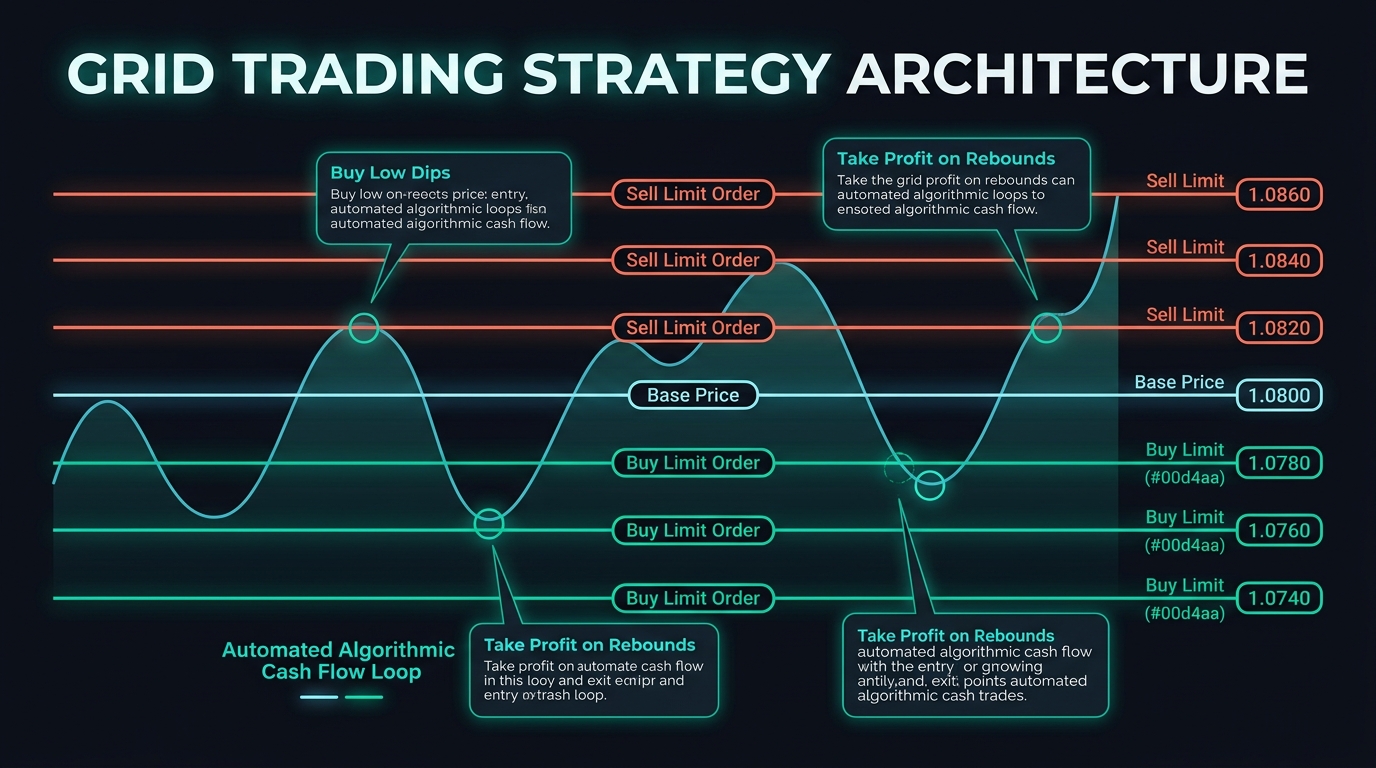
Grid trading is a mechanical, non-directional trading system widely deployed by retail algorithmic traders and quantitative foreign exchange bots. Rather than attempting to forecast whether a currency pair will appreciate or depreciate, a grid strategy systematically places a series of pending buy and sell limit orders at predefined fixed pip intervals (the “grid spacing”) above and below a central baseline price.
As the market fluctuates within an established consolidation corridor, price action naturally triggers these layered orders. Every time a buy order is filled on a dip, a corresponding sell order is placed at the grid rung above it to lock in profit when the market rebounds. In horizontal, choppy markets, this continuous buying low and selling high produces regular cash flow regardless of macro headlines.
+-------------------------------------------------------------------------+
|                        CLASSIC RANGE GRID LADDER                        |
|                                                                         |
|  Sell Limit Level 2 (1.0840)  ---------> Take Profit for 1.0820 Buy     |
|  Sell Limit Level 1 (1.0820)  ---------> Take Profit for 1.0800 Buy     |
|                                                                         |
|  BASE PRICE (1.0800)          ---------> Initial Starting Point         |
|                                                                         |
|  Buy Limit Level 1  (1.0780)  ---------> Fills on Dips (Target: 1.0800) |
|  Buy Limit Level 2  (1.0760)  ---------> Fills on Dips (Target: 1.0780) |
+-------------------------------------------------------------------------+
The Two Core Grid Frameworks
Depending on prevailing market volatility, algorithmic traders employ two distinct grid architectures:
1. Classic Counter-Trend Grid (Range-Bound)
Designed specifically for sideways, non-trending markets:
- Above Base Price: Sells limit orders (shorting rallies, expecting mean reversion).
- Below Base Price: Buys limit orders (buying pullbacks, expecting price to bounce).
- Ideal Pairs: Highly mean-reverting cross pairs that lack persistent single-direction macro trends, such as EUR/GBP or AUD/NZD.
2. Trend-Following Grid (Breakout)
Designed for high-volatility breakout conditions:
- Above Base Price: Buy Stop orders (accumulating long positions as price breaks upward).
- Below Base Price: Sell Stop orders (accumulating short positions as price breaks downward).
- Exit Strategy: Trailing stop-loss triggers that close the entire basket once trend momentum exhausts.
Concrete Numerical Example: 20-Pip EUR/USD Range Grid
Consider a trader deploying an automated counter-trend grid on EUR/USD:
- Baseline Spot Price: 1.0800
- Grid Step Spacing: 20 pips (0.0020)
- Position Size per Rung: 0.10 standard lots ($1 per pip)
- Take-Profit Distance: 20 pips ($20 profit per closed tranche)
Price Action Sequence:
- EUR/USD dips to 1.0780: Buy Order 1 fills (0.10 lot long at 1.0780; TP set at 1.0800).
- EUR/USD drops further to 1.0760: Buy Order 2 fills (0.10 lot long at 1.0760; TP set at 1.0780).
- EUR/USD rebounds to 1.0780:
- Buy Order 2 reaches its target: +$20.00 realized profit.
- A fresh Buy Limit is automatically reset at 1.0760.
- EUR/USD rallies back to 1.0800:
- Buy Order 1 reaches its target: +$20.00 realized profit.
- Floating exposure drops back to zero, with $40.00 secured in closed gains.
Over days or weeks of oscillating price action between 1.0760 and 1.0840, the system executes dozens of micro-trades, compounding small profits.
The Fatal Vulnerability: Unchecked Trends and Margin Calls
While grid trading delivers consistent winning percentages during quiet market consolidation, it harbors catastrophic tail risk.
If the market breaks out into an aggressive, uncorrected macroeconomic trend (such as a 400-pip drop driven by an emergency central bank rate decision), a counter-trend grid will repeatedly buy into the falling knife:
Runaway Trend Catastrophe
------------------------------------------------------------------------
Level 1 (1.0800): Buy fills -> Floating Loss: -400 pips
Level 2 (1.0780): Buy fills -> Floating Loss: -380 pips
Level 3 (1.0760): Buy fills -> Floating Loss: -360 pips
Level 4 (1.0740): Buy fills -> Floating Loss: -340 pips
Level 5 (1.0720): Buy fills -> Floating Loss: -320 pips
...
Price crashes to 1.0400 without a 20-pip pullback.
RESULT: Margin consumption explodes exponentially -> TOTAL ACCOUNT LIQUIDATION.
Risk Controls for Grid Traders
To survive inevitable trend breakouts, robust grid implementations enforce three essential safety mechanisms:
- Hard Maximum Grid Levels: Limiting the ladder to a maximum of 5 to 7 orders rather than expanding indefinitely.
- Basket Stop Loss: Closing the entire portfolio if cumulative floating drawdown exceeds a fixed threshold (e.g., 5% of total account capital).
- Avoid Martingale Multipliers: Never increase lot sizes exponentially on lower rungs (e.g., 0.1, 0.2, 0.4, 0.8), as Martingale sizing guarantees rapid margin exhaustion during genuine black-swan events.
Key Takeaways
- Grid trading executes automated orders at fixed price intervals above and below a central baseline.
- The strategy profits from market oscillation and mean reversion without forecasting trend direction.
- It performs exceptionally well in low-volatility, ranging currency pairs like EUR/GBP.
- The greatest risk of grid trading is a runaway one-way trend, which can accumulate massive floating drawdowns and trigger account liquidation.
- Successful grid algorithms require strict basket stop-losses and conservative position sizing to survive trend breakouts.
Frequently Asked Questions
Can grid trading work on trending currency pairs?
Standard counter-trend grids will blow up accounts on strong trending pairs like USD/JPY. However, a trend-following grid that uses stop orders to add to winning positions in the direction of the trend can be profitable during sustained bull or bear runs.
How do swap fees affect long-term grid strategies?
Negative overnight rollover (swap) fees can severely degrade grid profitability. If a grid holds dozens of open long positions against a higher-yielding currency for weeks while waiting for a price recovery, accumulated swap debits can exceed the eventual grid trading profits.
What is the ideal currency pair for grid trading?
Currency crosses that exhibit high statistical mean-reversion, tight spreads, and low long-term macroeconomic drift—such as EUR/GBP, AUD/NZD, or EUR/CHF—are the most popular instruments for range grid algorithms.
Ready to trade forex?
Open a free demo account with a regulated broker. Practice with virtual funds before risking real money.