International Monetary Fund (IMF)
The International Monetary Fund (IMF) is a global financial institution of 190 member nations tasked with ensuring international monetary stability, promoting sustainable economic growth, and providing emergency lending facilities to countries confronting balance-of-payments crises.
What Is the International Monetary Fund (IMF)?
The International Monetary Fund (IMF) is an international organization headquartered in Washington, D.C., comprising 190 member countries. Established in July 1944 at the Bretton Woods Conference alongside its sister institution, the World Bank, the IMF was conceived to prevent a recurrence of the disastrous economic policies of the 1930s—such as protectionist trade wars and competitive currency devaluations—that deepened the Great Depression.
While the World Bank focuses on long-term poverty alleviation and developing infrastructure in emerging markets, the IMF operates primarily as the global financial system’s lender of last resort. The Fund oversees international exchange rate arrangements, monitors global macroeconomic stability, and provides temporary balance-of-payments financing to sovereign governments unable to meet their international financial commitments.
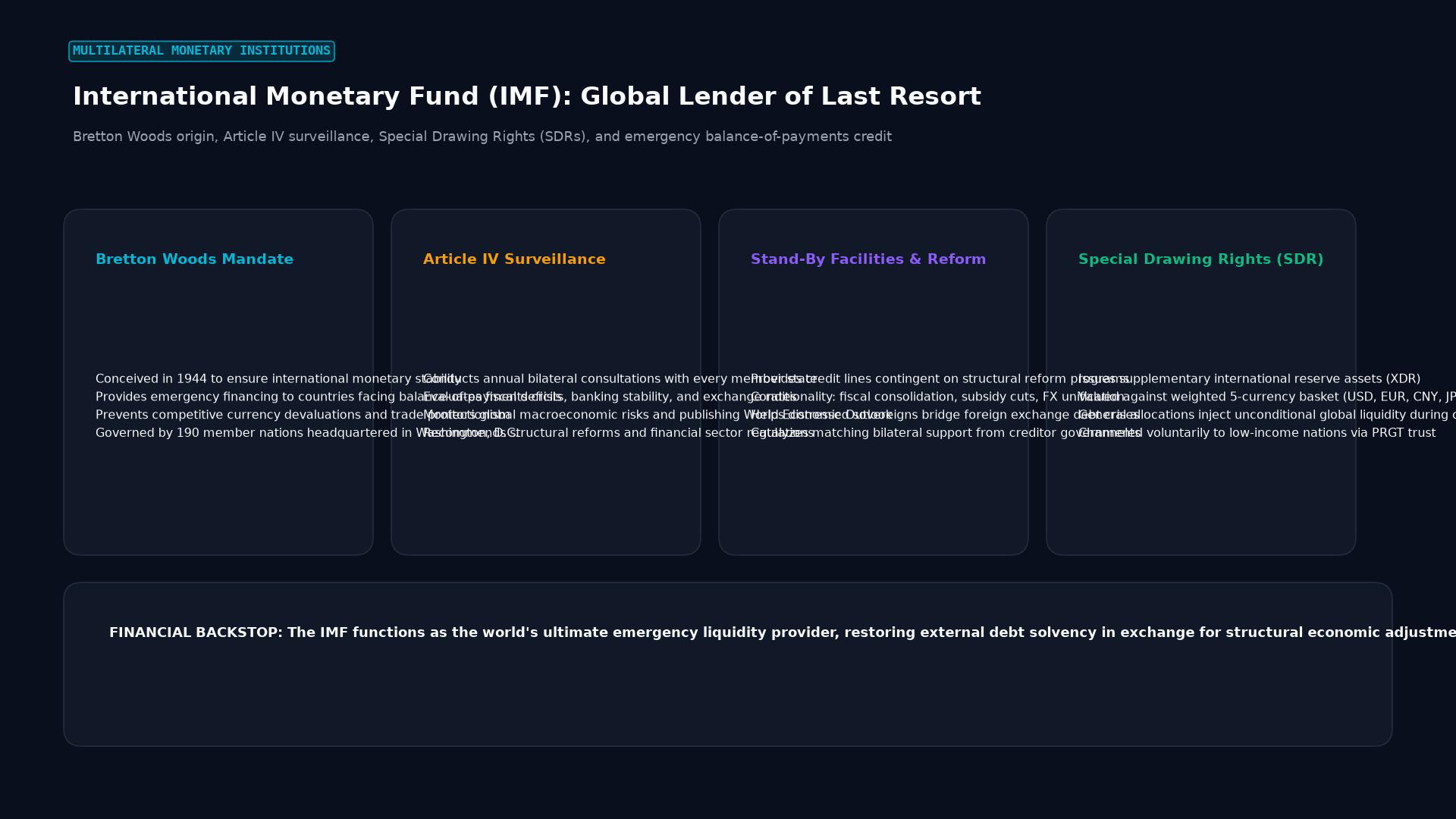 Figure: Bretton Woods origin, Article IV surveillance, Special Drawing Rights (SDRs), and emergency balance-of-payments credit
The Three Core Functions of the IMF
The IMF fulfills its international mandate through three operational pillars:
1. Macroeconomic Surveillance
The IMF continuously monitors economic and financial developments on global, regional, and national levels. Under Article IV Consultations, an IMF mission team travels annually to each member country to audit economic health, engage with central bank governors and finance ministers, and issue a formal public assessment detailing fiscal vulnerabilities, inflation risks, and exchange rate misalignments.
2. Capacity Development and Technical Assistance
The Fund provides expert training and institutional advice to emerging and developing economies. This includes assisting central banks with monetary policy formulation, strengthening banking supervisory frameworks, modernizing revenue and tax administrations, and standardizing economic reporting.
3. Financial Assistance (Emergency Lending)
When a country faces a severe external financing gap—meaning its official foreign exchange reserves have depleted to levels where it cannot pay for essential imports or service external sovereign debt—it turns to the IMF for an emergency loan program (such as a Stand-By Arrangement or Extended Fund Facility).
Bailout Mechanics and Structural Conditionality
IMF financing is not an unconditional grant. It is extended under strict legal agreements known as IMF Conditionality.
To secure bailout funds and disburse loan tranches, the recipient government must commit to comprehensive macroeconomic stabilization reforms designed to restore solvency:
Typical IMF Stabilization Requirements
------------------------------------------------------------------------
1. Fiscal Austerity: Cutting government budget deficits and fuel/food subsidies.
2. Exchange Rate Reform: Abandoning unsustainable currency pegs to let the
   currency find its true market-clearing equilibrium.
3. Monetary Tightening: Raising central bank interest rates to combat inflation.
4. Structural Governance: Privatizing inefficient state enterprises and reforming
   banking regulations to combat corruption.
The Austerity Debate and Criticisms
While conditionality aims to restore external debt sustainability, it has historically drawn sharp criticism from economists and civil society. Critics argue that aggressive fiscal austerity (cutting healthcare, education, and public sector employment during economic crises) depresses domestic demand, deepens recessions, and disproportionately harms lower-income populations. Modern IMF programs have evolved to incorporate explicit “social spending floors” to cushion vulnerable demographics.
Special Drawing Rights (SDR): The IMF’s Global Reserve Asset
In 1969, the IMF created the Special Drawing Right (SDR)—an international reserve asset designed to supplement member countries’ official foreign exchange reserves.
The SDR is not a physical currency, nor is it a direct claim on the IMF. Instead, it is a potential claim on the freely usable currencies of IMF member states. Members holding SDRs can exchange them with other central banks for hard currencies to replenish foreign exchange reserves during liquidity shortages.
The value of the SDR is determined by a daily weighted currency basket reviewed by the IMF Executive Board every five years:
| Currency | 2022–2027 SDR Basket Weight | Key Global Role |
|---|---|---|
| US Dollar (USD) | 43.38% | Dominant global reserve currency |
| Euro (EUR) | 29.31% | Core European trade and settlement currency |
| Chinese Renminbi (CNY) | 12.28% | Included in 2016; Asia-Pacific trade power |
| Japanese Yen (JPY) | 7.59% | Historical global funding and safe-haven asset |
| British Pound (GBP) | 7.44% | International commercial banking currency |
How IMF Programs Impact Foreign Exchange Markets
For currency traders, IMF loan agreements represent major macroeconomic inflection points:
- Immediate Currency Devaluation: If an emerging nation has maintained an artificial currency peg using dwindling foreign exchange reserves (such as Egypt, Pakistan, or Nigeria), the IMF almost invariably mandates a transition to a flexible floating exchange rate as a condition for aid. This requirement typically triggers an immediate 20% to 50% plunge in the currency’s official rate to align with parallel black-market rates.
- Post-Agreement Stabilization Rally: Once a formal IMF staff-level agreement is signed and multi-billion-dollar loan tranches are unlocked, international investor confidence often rebounds. Sovereign bond yields decline, capital flight abates, and the currency stabilizes or stages an aggressive relief rally as external default risk is removed.
Key Takeaways
- The IMF is an international organization of 190 countries established at Bretton Woods to maintain global monetary stability.
- It acts as a sovereign lender of last resort for nations facing catastrophic balance-of-payments crises.
- Loans require strict structural conditionality, including fiscal deficit reduction and flexible exchange rates.
- The Special Drawing Right (SDR) is a basket-backed international reserve asset based on the USD, EUR, CNY, JPY, and GBP.
- IMF agreements often cause immediate currency devaluations (abandoning pegs), followed by long-term financial stabilization.
Frequently Asked Questions
What is the difference between the IMF and the World Bank?
The IMF focuses on macroeconomic stability, exchange rate regimes, and resolving short-to-medium-term balance-of-payments panics. The World Bank focuses on long-term developmental projects, building schools, highways, and energy grids to eradicate poverty in developing nations.
How does the IMF get its lending capital?
The IMF’s primary capital originates from member “quotas.” Each member country is assigned a financial quota based on its relative size and role in the world economy, which determines both its financial contribution to the Fund and its voting power.
Why do countries wait until the last moment before approaching the IMF?
Approaching the IMF carries significant domestic political stigma. Enforcing IMF-mandated austerity reforms—such as cutting fuel subsidies and raising taxes—frequently sparks domestic political unrest, leading governments to delay negotiations until foreign reserves are virtually exhausted.
Ready to trade forex?
Open a free demo account with a regulated broker. Practice with virtual funds before risking real money.