Investment
An investment is the deployment of capital into financial assets, real estate, or productive enterprises with the expectation of generating income, capital appreciation, or purchasing power preservation over an extended economic horizon.
What Is an Investment?
An investment is the commitment of financial capital or economic resources to an asset, contract, or enterprise today in exchange for uncertain future financial returns. Unlike current consumption, which exhausts economic utility immediately, an investment defers gratification to build productive capacity or preserve purchasing power against monetary debasement.
In modern financial economics, investment operates on two interrelated levels:
- Macroeconomic Capital Formation: Physical investment by corporations and governments into factories, software architectures, logistics networks, and human capital, which expands the productive frontier of the economy.
- Financial Capital Allocation: Purchase of claims on productive cash flows, such as common stock, municipal bonds, mortgage obligations, or private commercial real estate.
Financial markets function as the transmission mechanism that matches economic units running capital surpluses (savers and institutional allocators) with economic units experiencing capital deficits (corporations, developers, and sovereign treasuries).
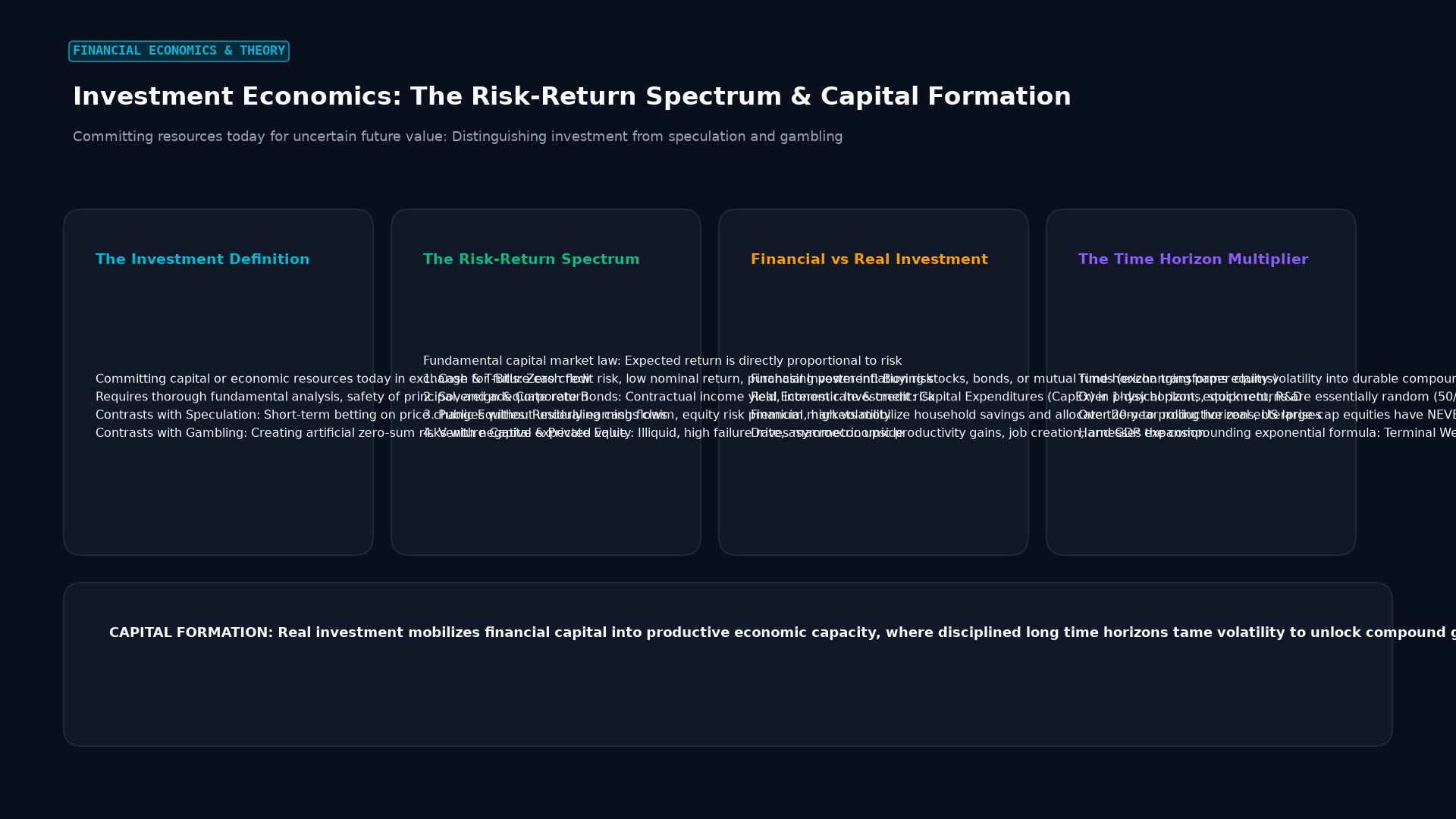 Figure: Committing resources today for uncertain future value: Distinguishing investment from speculation and gambling
Fundamental Asset Classes
Institutional allocators organize investment opportunities into distinct asset categories based on contractual rights, cash-flow predictability, and economic sensitivities.
1. Equities (Public and Private)
Equities represent fractional residual ownership in a corporate enterprise. Equity investors sit at the bottom of the corporate capital structure; they hold junior claims that receive distributions only after operating expenses, supplier invoices, taxes, and debt service are satisfied. In exchange for absorbing this operational and insolvency risk, equity investors enjoy unlimited upside participation through corporate earnings expansion, dividend payouts, and share price appreciation.
2. Fixed Income (Debt Instruments)
Fixed income instruments are legal contracts establishing a debtor-creditor relationship. The borrower agrees to repay the borrowed principal amount (par value) at a defined maturity date while distributing periodic interest payments (coupons) along the way. Debt claims take senior priority over equity in bankruptcy. Categories range from risk-free short-term sovereign paper (such as United States Treasury bills) to high-yield corporate bonds and asset-backed debt obligations.
3. Real Assets (Real Estate and Infrastructure)
Real assets include physical commercial property, residential developments, farmland, timberland, and energy infrastructure. Real assets provide tangible collateral and structural hedges against unanticipated consumer price inflation, as lease agreements frequently include contractual escalations pegged to price indices.
4. Commodities
Raw materials such as crude oil, natural gas, copper, agricultural grains, and precious metals generate no organic cash flow, dividends, or interest. Their investment return derives entirely from price changes driven by global supply disruptions, industrial demand cycles, and currency fluctuations. Physical gold has historically functioned as a monetary reserve asset and store of value during systemic sovereign debt crises.
5. Cash and Cash Equivalents
Instruments with maturities under one year, such as Treasury bills, commercial paper, and certificates of deposit, provide immediate liquidity and capital preservation. However, extended cash allocations suffer from purchasing power drag whenever nominal yields lag the prevailing rate of consumer inflation.
Quantitative Mechanics of Investment
Evaluating an investment demands rigorous mathematical tools to price future cash flows and isolate risk-adjusted returns.
The Time Value of Money and Discounted Cash Flow
Financial theory states that a dollar received today possesses greater economic worth than a dollar promised in the future. Capital in hand can be immediately deployed to earn risk-free interest, and future promises carry purchasing power erosion and default uncertainty.
The intrinsic value ($PV$) of any income-producing asset equals the sum of its future cash flows discounted back to the present day:
        CF_1          CF_2                 CF_n
PV = ----------- + ----------- + ... + -----------
     (1 + r)^1     (1 + r)^2           (1 + r)^n
Where $CF_t$ represents the expected net cash flow in period $t$, and $r$ denotes the discount rate reflecting the opportunity cost of capital and underlying risk premium. When market price falls below this computed present value, an investor identifies an attractive margin of safety.
The Fisher Equation: Real vs Nominal Returns
Investors must distinguish between nominal dollars and real purchasing power. The Irving Fisher relationship formalizes this interaction:
(1 + R) = (1 + r) * (1 + i)Where $R$ is the nominal interest or return rate, $r$ is the real return rate, and $i$ is the expected inflation rate. In linear approximations, real return equals nominal return minus inflation ($r \approx R - i$). An investor earning an 8% nominal yield in a jurisdiction experiencing 9% annual inflation is suffering an annualized 1% loss in real purchasing power.
Risk-Adjusted Evaluation: The Sharpe Ratio
Nominal returns fail to reflect the volatility endured to achieve them. The Sharpe ratio isolates excess return generated per unit of total volatility:
     R_portfolio - R_riskfree
SR = ------------------------
         sigma_portfolio
An equity fund returning 12% with a 20% annual standard deviation produces a lower Sharpe ratio than a balanced corporate bond portfolio returning 8% with a 5% standard deviation, assuming a 3% risk-free rate.
Strategic Investment Approaches
Investors employ divergent operational philosophies to extract returns from financial markets.
| Approach | Theoretical Foundation | Core Mechanism | Primary Risk |
|---|---|---|---|
| Value Investing | Benjamin Graham & David Dodd | Purchasing securities trading below estimated intrinsic book or earnings value | Value traps and technological disruption |
| Growth Investing | Modern Corporate Finance | Backing firms expanding revenues and earnings faster than industry peers | Extreme valuation multiples and earnings misses |
| Factor Investing | Fama-French Multi-Factor Models | Systematically capturing risk premia (Size, Value, Momentum, Quality, Low Volatility) | Extended cyclical factor drawdowns |
| Passive Indexing | Efficient Market Hypothesis (EMH) | Replicating broad market indices at minimal operational expense | Direct exposure to systemic market corrections |
| Absolute Return | Macro & Long/Short Hedging | Generating uncorrelated positive returns regardless of market direction | High fee structures and leverage hazards |
Investment vs Speculation
The boundary between investing and speculation is defined by cash-flow certainty, analytical rigor, and holding horizons.
+-----------------------+-----------------------+-----------------------+
| PARAMETER             | INVESTMENT            | SPECULATION           |
+-----------------------+-----------------------+-----------------------+
| Underlying Asset      | Productive asset with | Asset with uncertain  |
|                       | demonstrable cashflow | or non-existent yield |
+-----------------------+-----------------------+-----------------------+
| Primary Return Source | Dividends, coupons,   | Resale price to a     |
|                       | organic profit growth | subsequent buyer      |
+-----------------------+-----------------------+-----------------------+
| Time Horizon          | Multi-year or decade  | Hours, days, or weeks |
+-----------------------+-----------------------+-----------------------+
| Analytical Focus      | Fundamental balance   | Price action, market  |
|                       | sheets and cash flows | sentiment, order flow |
+-----------------------+-----------------------+-----------------------+
| Capital Risk          | Controlled via margin | Elevated probability  |
|                       | of safety principles  | of permanent loss     |
+-----------------------+-----------------------+-----------------------+
An investor purchasing shares in an enterprise with stable operating margins, moderate debt, and consistent free cash flow relies on organic compounding. A market participant purchasing an unprofitable momentum asset simply in hopes that another trader will pay a higher price tomorrow is speculating on market psychology.
Psychological Barriers to Long-Term Wealth Accumulation
Quantitative mastery is useless if behavioral flaws undermine capital preservation. Behavioral finance identifies core psychological biases that damage investor returns:
- Loss Aversion: Amos Tversky and Daniel Kahneman demonstrated that the emotional pain of a financial loss is roughly twice as intense as the pleasure of an equivalent gain. This bias leads market participants to liquidate high-quality assets at market bottoms out of sheer panic, or hold catastrophic losers indefinitely to avoid booking a recognized loss.
- Recency Bias: Investors project current market momentum indefinitely into the future. During bull markets, participants assume double-digit gains will persist indefinitely, driving them to take dangerous leverage at market peaks. Conversely, during bear markets, recency bias convinces investors that systemic collapse is permanent.
- Overconfidence and Churn: Excessive confidence in short-term forecasting leads to hyperactive trading. High turnover generates heavy brokerage friction, bid-ask slippage, and adverse tax events, eroding net capital compounding over time.
Key Takeaways
- An investment commits capital to productive assets or contracts to generate income, capital growth, and long-term purchasing power preservation.
- Capital markets allocate surplus savings from households and institutions to deficit units such as corporations and sovereign entities.
- Assets range along a continuous risk-return spectrum from risk-free sovereign debt to volatile growth equities and illiquid private assets.
- Intrinsic asset value equals the discounted present value of expected future cash flows adjusted for the opportunity cost of capital.
- Real returns dictate purchasing power growth by subtracting price inflation from nominal gross performance.
- True investment focuses on fundamental cash generation and margin of safety, whereas speculation relies on sentiment swings and short-term price momentum.
Frequently Asked Questions
What is the difference between saving and investing?
Saving focuses on capital preservation and immediate liquidity, typically through FDIC-insured bank accounts or money market instruments with minimal principal risk. Investing commits capital to productive assets where principal is exposed to market volatility in pursuit of higher expected returns and inflation protection.
How does compounding accelerate investment returns over time?
Compounding occurs when investment returns generate their own subsequent earnings. Reinvesting dividends and interest allows the capital base to expand geometrically rather than arithmetically. Over a 30-year horizon, the majority of a portfolio’s total value typically stems from accumulated compound growth rather than original cash contributions.
What is the concept of a margin of safety in investing?
Introduced by Benjamin Graham, the margin of safety involves purchasing an asset at a substantial discount to its conservatively calculated intrinsic value. This valuation cushion protects the investor against analytical errors, competitive setbacks, or severe economic downturns, lowering the probability of permanent capital destruction.
Ready to trade forex?
Open a free demo account with a regulated broker. Practice with virtual funds before risking real money.