IQD
IQD is the ISO 4217 currency code for the Iraqi Dinar, the legal tender of Iraq, issued by the Central Bank of Iraq and governed through managed foreign exchange auction windows tied to hydrocarbon export revenues.
What Is the IQD?
The IQD is the three-letter currency code for the Iraqi Dinar, the official monetary unit of the Republic of Iraq. Subdivided into 1,000 fils (though inflation has rendered fils coins obsolete), the dinar is issued and regulated by the Central Bank of Iraq (CBI).
The Iraqi economy represents one of the world’s most hydrocarbon-dependent sovereign systems. Crude petroleum exports routinely generate over 95% of state fiscal receipts and more than 99% of merchandise export earnings. Consequently, the institutional dynamics of the IQD are defined by the flow of petrodollars from international oil buyers to sovereign accounts, and their subsequent redistribution into the domestic economy through the central bank’s foreign currency allocation mechanisms.
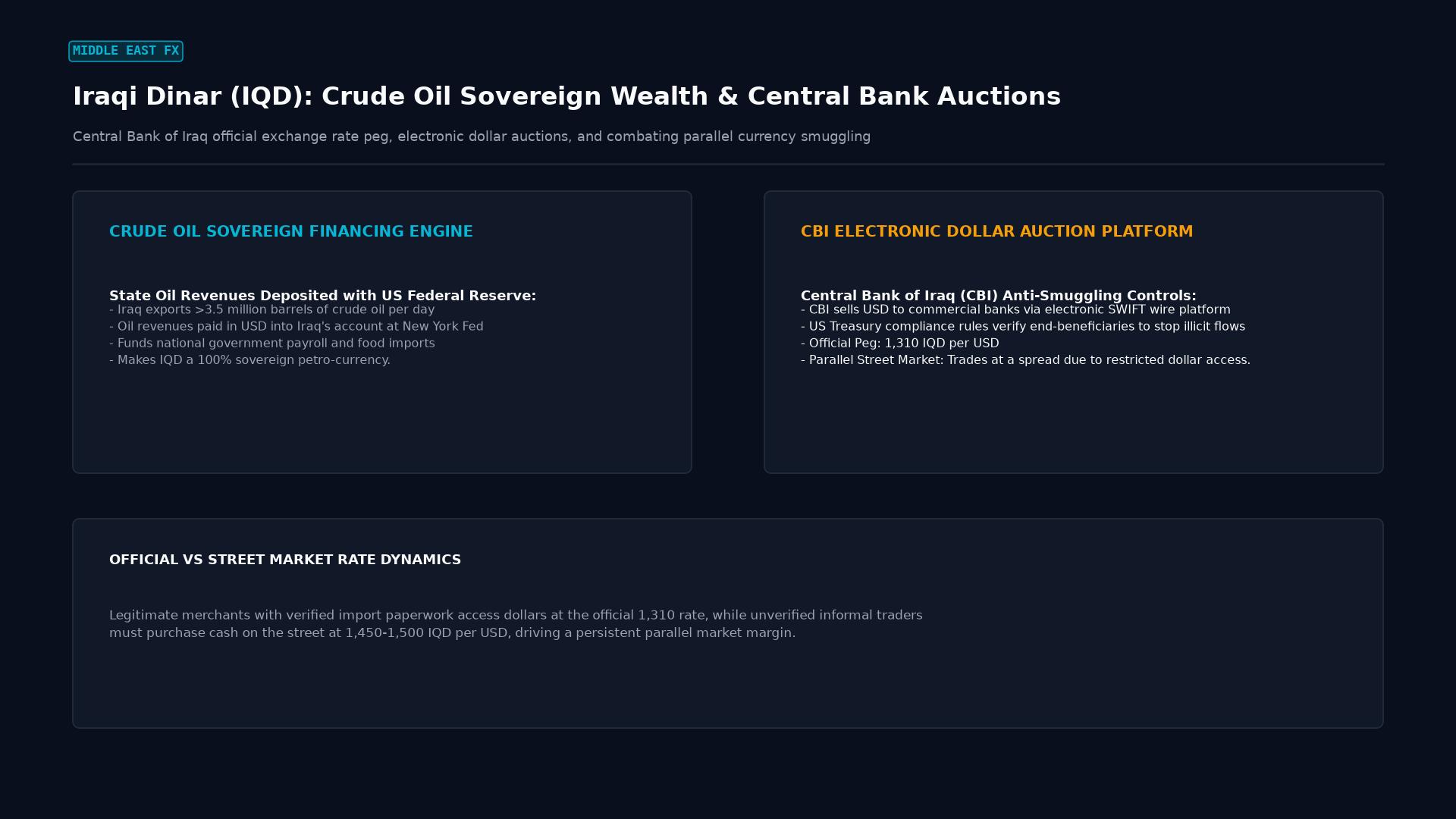 Figure: Central Bank of Iraq official exchange rate peg, electronic dollar auctions, and combating parallel currency smuggling
Monetary Architecture: The Currency Auction Window
Unlike freely floating currencies, the exchange rate of the Iraqi Dinar is managed directly through the CBI Foreign Exchange Auction Window, known locally as the Nafitha.
Because Iraq imports the vast majority of its consumer packaged goods, foodstuffs, industrial machinery, and refined fuels, the domestic merchant class requires a continuous supply of US dollars to settle foreign trade contracts. The Central Bank of Iraq satisfies this demand by converting sovereign dollar oil revenues into physical Iraqi dinars for the state budget while selling dollars to commercial banks at a fixed official peg.
The Electronic Platform and Compliance Reforms
Historically, the CBI auction window operated with minimal transaction auditing, allowing billions of dollars to exit the formal banking system via paper invoices. In late 2022, the Federal Reserve Bank of New York and the United States Department of the Treasury enforced strict anti-money laundering (AML) and counter-terrorist financing (CFT) standards on dollar transfers leaving Iraq.
Under these mandates, wire transfers must pass through an electronic platform (the K2 platform) that cross-checks ultimate beneficial owners and foreign suppliers against global sanctions watchlists before the Federal Reserve clears the funds. While this system reduced illicit capital flight, initial rejection rates exceeding 70% caused severe dollar shortages in Baghdad, widening the gap between the official exchange rate and street cash market prices.
Dual Exchange Rate Dynamics: Official Peg vs Parallel Market
The operational reality of the IQD centers on the spread between the official central bank rate and the parallel street market rate quoted in financial hubs like Baghdad’s Al-Kifah and Al-Harithiya bourses.
| Market Segment | Mechanism | Quoted Rate (USD/IQD Benchmark) | Access Restrictions |
|---|---|---|---|
| Official Central Bank Rate | Direct central bank allocation to audited banks and state entities | 1,300 - 1,320 IQD per USD | Requires documentary proof of trade, verified invoices, and full AML/CFT screening |
| Parallel Street Cash Market | Physical dollar banknotes traded through exchange shops and informal dealers | 1,450 - 1,550+ IQD per USD | Unrestricted physical liquidity, serving untracked trade and informal capital flight |
| Government Accounting Rate | Statutory rate for national budget computations and oil accounting | Fixed statutory baseline | Closed sovereign transfer accounting |
When domestic importers cannot obtain documentary approvals through the official platform (due to tax disputes, informal supplier networks, or international trade restrictions), they source cash dollars from the parallel market. This merchant demand pushes the street price of the dollar higher, forcing the Iraqi dinar to trade at a substantial market discount to its official peg.
Historical Evolution of the Iraqi Dinar
The currency has undergone dramatic structural transformations over the past four decades, reflecting periods of war, international embargoes, and post-conflict monetary design:
1. The Swiss Dinar Era (Pre-1990)
Prior to the 1990 Gulf War, the Iraqi dinar was a strong, internationally respected currency officially pegged at 1 IQD = 3.2169 USD. Banknotes were printed by Bradbury Wilkinson and De La Rue in the United Kingdom using advanced engraving techniques, earning them the moniker “Swiss Dinar” due to their high printing quality.
2. The Sanctions and Printings Era (1991–2003)
Following United Nations sanctions and the cutoff of international security printing contracts, the Iraqi government printed massive quantities of low-quality banknotes on domestic wood-pulp paper. This unbacked monetary expansion triggered hyperinflation. By 2002, the exchange rate collapsed from 3 dollars per dinar to roughly 3,000 dinars per single US dollar. In the autonomous Kurdish northern region, citizens refused the new notes and continued using pre-1990 Swiss Dinars, creating two separate circulating currencies within the country.
3. The 2003 Currency Reform (Bremer Dinar)
Following the 2003 intervention, the Coalition Provisional Authority under Paul Bremer executed an emergency currency exchange between October 2003 and January 2004. Printed by De La Rue with modern anti-counterfeiting features, the new unified dinar replaced both the Saddam-era paper notes at 1:1 and the northern Swiss Dinars at 1:150, re-establishing a single national currency.
4. Recent Peg Devaluations and Adjustments
In December 2020, facing collapsed oil prices during global pandemic lockdowns, the Iraqi Ministry of Finance and CBI executed a sharp 23% devaluation, moving the official peg from 1,182 IQD to 1,450 IQD per USD to plug a yawning budget deficit. In February 2023, following political pressure over surging consumer living costs, the CBI reversed course and revalued the official rate to 1,300 IQD per USD for sales to commercial banks and 1,320 IQD for public transactions.
Trading Realities for Global FX Market Participants
Institutional and retail participants must approach the IQD with clear-eyed market understanding:
- Non-Deliverable Currency: The Iraqi Dinar cannot be freely transferred, settled, or converted through global CLS (Continuous Linked Settlement) systems. International foreign exchange desks do not trade spot deliverable USD/IQD.
- Retail Speculation Schemes: For years, fraudulent online promoters marketed physical Iraqi Dinar banknotes to retail savers, claiming an imminent central bank “RV” (massive revaluation) would return the dinar to its pre-1990 rate of 3 USD per dinar. These claims contradict fundamental sovereign balance sheet realities. Iraq maintains trillions of dinars in circulation; an overnight revaluation to 3 dollars per dinar would demand hundreds of trillions in foreign reserves that do not exist.
- Physical Currency Spreads: Purchasing physical paper IQD outside Iraq incurs exorbitant retail bid-ask spreads often exceeding 25% to 40%, guaranteeing substantial capital losses upon liquidation.
Key Takeaways
- The IQD (Iraqi Dinar) is the official currency of Iraq, governed by the Central Bank of Iraq under a heavily managed peg anchored to petroleum export earnings.
- The country’s oil revenues are cleared through sovereign accounts at the Federal Reserve Bank of New York before funding the CBI foreign exchange auction window.
- Implementation of the K2 electronic platform and international compliance auditing has restricted informal dollar outflows, creating a persistent divergence between the official peg (1,300–1,320 IQD/USD) and the parallel cash market rate.
- The currency transitioned from the pre-1990 Swiss Dinar to the 2003 unified De La Rue notes, with recent official rate revisions occurring in December 2020 (devaluation) and February 2023 (revaluation).
- The IQD is not a freely convertible international currency, and retail speculations claiming guaranteed windfall revaluations reflect deceptive internet promotions rather than economic reality.
Frequently Asked Questions
Can the Iraqi Dinar be traded on standard retail forex trading platforms?
No. Mainstream retail brokers and institutional forex platforms do not offer deliverable spot pairs for the Iraqi Dinar. The currency operates under exchange restrictions and capital controls that prevent continuous interbank settlement through Western clearinghouses.
Why is there a parallel street rate for the Iraqi Dinar in Baghdad?
The parallel rate exists because central bank compliance checks block transactions that lack transparent documentation or involve sanctioned entities. Merchants unable to obtain dollars at the official 1,300–1,320 rate must purchase physical dollars from private exchange bureaus, driving up the parallel market rate.
What determines the fundamental value of the Iraqi Dinar?
The fundamental value of the dinar depends on the volume of daily crude oil exports, the global price of Brent crude, the size of foreign exchange reserves held by the Central Bank of Iraq, and sovereign fiscal discipline in managing civil service payrolls and public subsidies.
Ready to trade forex?
Open a free demo account with a regulated broker. Practice with virtual funds before risking real money.