IRR
IRR is the ISO 4217 currency code for the Iranian Rial, issued by the Central Bank of Iran and characterized by a multi-tiered exchange rate system, severe capital controls, and persistent currency depreciation; the acronym also denotes Internal Rate of Return in corporate finance.
What Is the IRR?
In global foreign exchange and central banking terminology, the IRR is the official ISO 4217 three-letter currency code for the Iranian Rial, the legal tender of the Islamic Republic of Iran. Issued and regulated by the Central Bank of the Islamic Republic of Iran (CBI, or Bank Markazi), the rial reflects an economy shaped by hydrocarbon export reliance, extensive international economic sanctions, structural trade isolation, and elevated domestic inflation.
While the rial serves as the official legal currency for government accounting, contracts, and banking records, domestic commerce almost exclusively prices goods in toman. One toman equals 10 rials. A street price quoted as 50,000 tomans corresponds to a nominal legal tender value of 500,000 rials. In 2020, Iran’s parliament approved legislation to formalize the toman as the official national currency by cutting four zeros (10,000 rials to 1 new toman), though full administrative transition remains a multi-year phased process.
(Financial Terminology Note: Outside currency markets, IRR is universally recognized in corporate finance and private equity as the acronym for Internal Rate of Return, the discount rate at which the net present value of an investment’s cash flows equals zero. Both definitions are analyzed in this reference guide).
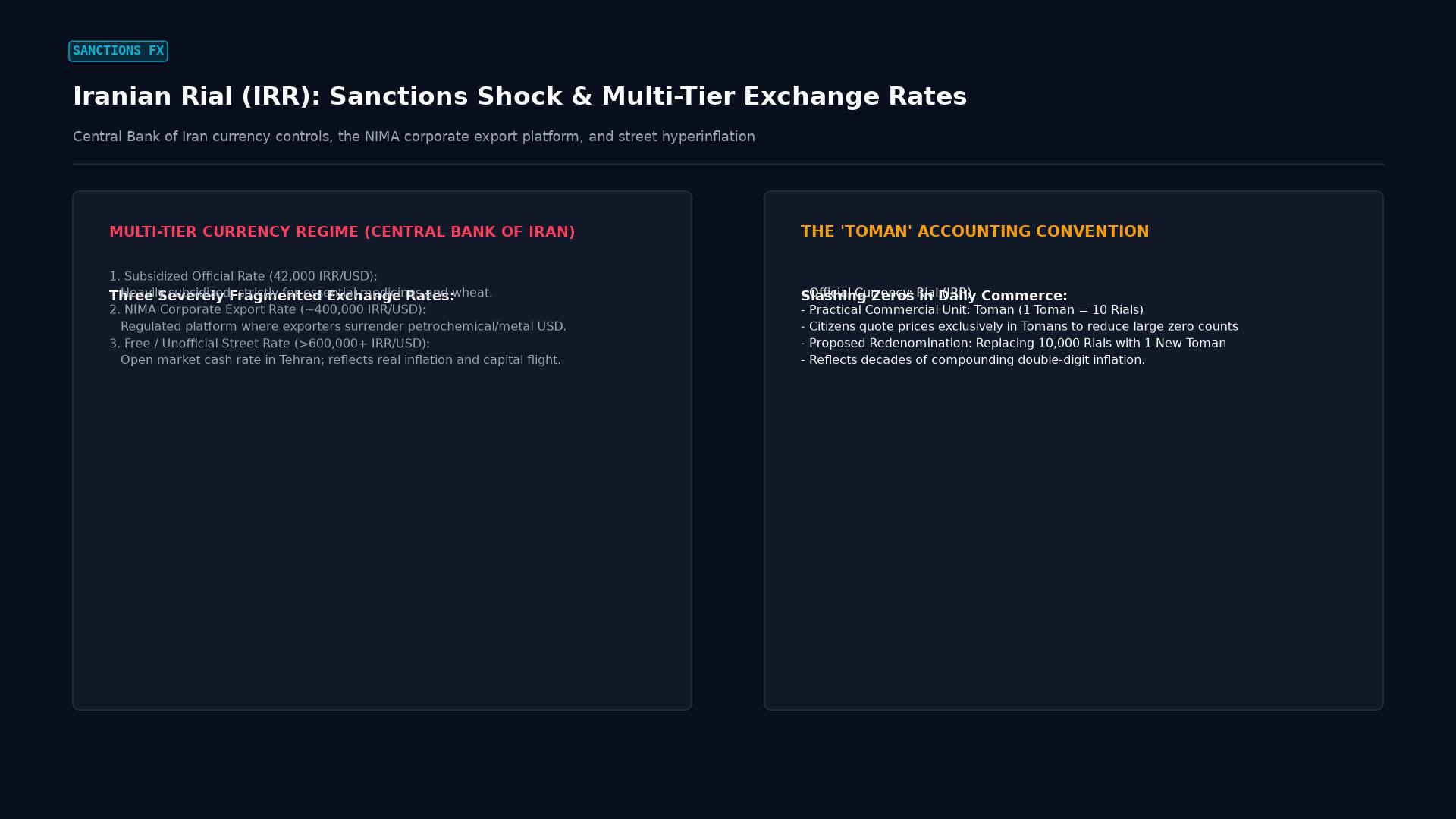 Figure: Central Bank of Iran currency controls, the NIMA corporate export platform, and street hyperinflation
The Multi-Tier Foreign Exchange Regime
Due to chronic hard currency shortages caused by sanctions and central bank asset freezes, Iran operates one of the world’s most fragmented multi-tier foreign exchange regimes. Rather than allowing a single market-clearing equilibrium rate, the Central Bank of Iran maintains distinct foreign exchange tiers:
1. The Subsidized Official Rate (42,000 IRR / USD)
Established in April 2018 in an attempt to unify exchange rates, the 42,000 IRR per dollar rate quickly became unsustainable for general trade. The government subsequently restricted this preferential tier to state-directed imports of life-saving medical supplies and essential staple foods (such as wheat, cooking oil, and animal feed). Over time, fiscal deficits and widespread subsidy arbitrage prompted authorities to phase down the list of subsidized goods.
2. The NIMA Platform (Nezam-e Yekparche-ye Moamelat-e Arzi)
Introduced in 2018, NIMA functions as a controlled wholesale interbank electronic exchange. State-backed industrial exporters (predominantly petrochemical refineries, mining conglomerates, and primary metal smelters) are legally mandated to surrender their foreign currency earnings on NIMA. Authorized domestic manufacturers purchase these funds to import raw materials and production machinery. The NIMA rate trades at a discount to the open street market, effectively functioning as a tax on major exporters to subsidize domestic manufacturing inputs.
3. The SANA Benchmark Rate
SANA (Samaneh Nezarat-e Arzi) is the central bank’s supervisory data system that records and computes average foreign currency transaction prices reported by licensed currency exchange offices (sarrafi). It represents the legal retail cash exchange tier for personal travel allowances and documented service payments.
4. The Azad Free Market Rate
The unregulated open market rate (the Azad or free market rate) represents unconstrained supply and demand in trading hubs such as Tehran’s Ferdowsi Street, Dubai exchange houses, and border markets in Herat and Sulaymaniyah. This is the rate ordinary citizens pay when converting local currency savings into gold coins (Bahar Azadi) or physical US dollar banknotes to protect against domestic hyperinflation. The Azad rate routinely trades at more than ten times the old official subsidized rate.
Macroeconomic Pressures and Sanctions Architecture
The structural depreciation of the Iranian Rial stems from fundamental macroeconomic imbalances amplified by international sanctions:
- SWIFT Disconnection: Major Iranian commercial banks and the central bank remain disconnected from the SWIFT international messaging network, preventing direct electronic settlement through global correspondent banking networks. Cross-border trade relies on complex third-country intermediary accounts, hawala networks, and bilateral trade clearing accounts.
- FATF Blacklisting: Iran’s placement on the Financial Action Task Force (FATF) high-risk jurisdiction blacklist imposes enhanced due diligence requirements on global financial institutions, discouraging foreign institutional counterparties.
- Monetary Expansion and Inflation: Chronic sovereign budget deficits have historically been financed through central bank borrowing and indirect credit expansion through commercial banks. With annual money supply (M2) growth routinely exceeding 30% to 40% and consumer price inflation running at comparable rates, the purchasing power of the rial erodes continuously against real assets and foreign hard currencies.
Financial Metric Disambiguation: Internal Rate of Return (IRR)
In corporate finance, private equity, and capital budgeting, IRR does not refer to the Iranian currency, but stands for Internal Rate of Return.
The Internal Rate of Return is the annualized compound discount rate that equates the net present value (NPV) of all future cash flows from an investment project to zero:
          CF_1          CF_2                 CF_n
NPV = ----------- + ----------- + ... + ----------- - CF_0 = 0
      (1 + IRR)^1   (1 + IRR)^2         (1 + IRR)^n
Where $CF_0$ represents the initial capital outlay and $CF_t$ represents the expected net cash flow in period $t$.
+-------------------------------------------------------------------------+
|                  IRR AS A CAPITAL BUDGETING DECISION TOOL               |
+-------------------------------------------------------------------------+
|                                                                         |
|  CALCULATE PROJECT IRR                                                  |
|  (Discount rate where Net Present Value = 0)                            |
|                            |                                            |
|                            v                                            |
|  COMPARE AGAINST COST OF CAPITAL (Hurdle Rate / WACC)                   |
|                            |                                            |
|              +-------------+-------------+                              |
|              |                           |                              |
|              v                           v                              |
|     [ IRR > Hurdle Rate ]       [ IRR < Hurdle Rate ]                   |
|              |                           |                              |
|              v                           v                              |
|     PROJECT ADDS VALUE          PROJECT DESTROYS VALUE                  |
|     Recommendation: ACCEPT      Recommendation: REJECT                  |
|                                                                         |
+-------------------------------------------------------------------------+
The Reinvestment Rate Flaw and MIRR
While popular among corporate executives and private equity general partners due to its intuitive percentage format, standard IRR contains a major mathematical flaw: it assumes intermediate cash inflows are reinvested at the internal rate of return itself, rather than at the firm’s realistic cost of capital. When a project displays an extraordinary IRR of 45%, assuming subsequent cash distributions can also compound at 45% distorts capital allocation decisions.
To resolve this limitation, institutional analysts utilize the Modified Internal Rate of Return (MIRR), which discounts negative cash flows back using the financing cost and compounds positive cash flows forward to terminal value using a realistic reinvestment rate.
Key Takeaways
- In foreign exchange, IRR is the ISO 4217 code for the Iranian Rial, managed by the Central Bank of the Islamic Republic of Iran.
- In everyday domestic trade, prices are quoted in Toman (1 Toman = 10 Rials), with ongoing sovereign plans to redenominate the currency by dropping four zeros.
- Iran’s foreign exchange landscape is defined by a multi-tier rate architecture spanning subsidized official allocations, the wholesale exporter NIMA platform, the regulated SANA system, and the unregulated Azad street market.
- SWIFT disconnection, FATF blacklisting, and high domestic money supply growth drive structural rial depreciation and reliance on informal hawala channels.
- In corporate finance, IRR designates the Internal Rate of Return, a discounted cash flow hurdle metric evaluated against a firm’s weighted average cost of capital.
Frequently Asked Questions
Why do Iranian stores quote prices in Toman instead of Rial?
Due to decades of high inflation, calculating transactions in rials requires unwieldy strings of zeros. The public adopted the toman (cutting one zero off the rial amount) as a mental shortcut to simplify everyday accounting, invoicing, and retail transactions.
What is the NIMA exchange rate in Iran?
NIMA is an electronic currency exchange platform operated under central bank supervision where non-oil exporters (such as petrochemical and mining firms) sell their foreign exchange revenues to licensed domestic importers at regulated wholesale rates.
What is the primary drawback of using Internal Rate of Return in project evaluation?
The primary limitation is the reinvestment rate assumption. Standard IRR mathematically presumes that all intermediate cash flows generated by a project are reinvested at the project’s IRR rate rather than the company’s actual weighted average cost of capital, often exaggerating the financial attractiveness of high-return ventures.
Ready to trade forex?
Open a free demo account with a regulated broker. Practice with virtual funds before risking real money.