ISK
ISK is the ISO 4217 currency code for the Icelandic Króna, the official legal tender of Iceland, managed by the Central Bank of Iceland (Sedlabanki Íslands) in a small open economy characterized by volatile terms of trade, tourism cycles, and a pioneering framework of macroprudential capital controls.
What Is the ISK?
The ISK is the three-letter currency code for the Icelandic Króna (plural krónur), the national monetary unit of the Republic of Iceland. Issued and regulated by the Central Bank of Iceland (Sedlabanki Íslands), the króna represents the smallest independent currency unit in the developed economic world, serving a sovereign domestic population of roughly 390,000 residents.
Despite the modest size of its domestic economy, the ISK occupies an outsized position in international financial history. The currency’s trajectory offers a masterclass in the vulnerabilities of a small open economy exposed to cross-border carry trades, sudden capital stop dynamics, systemic banking failure, and the subsequent implementation of comprehensive capital controls.
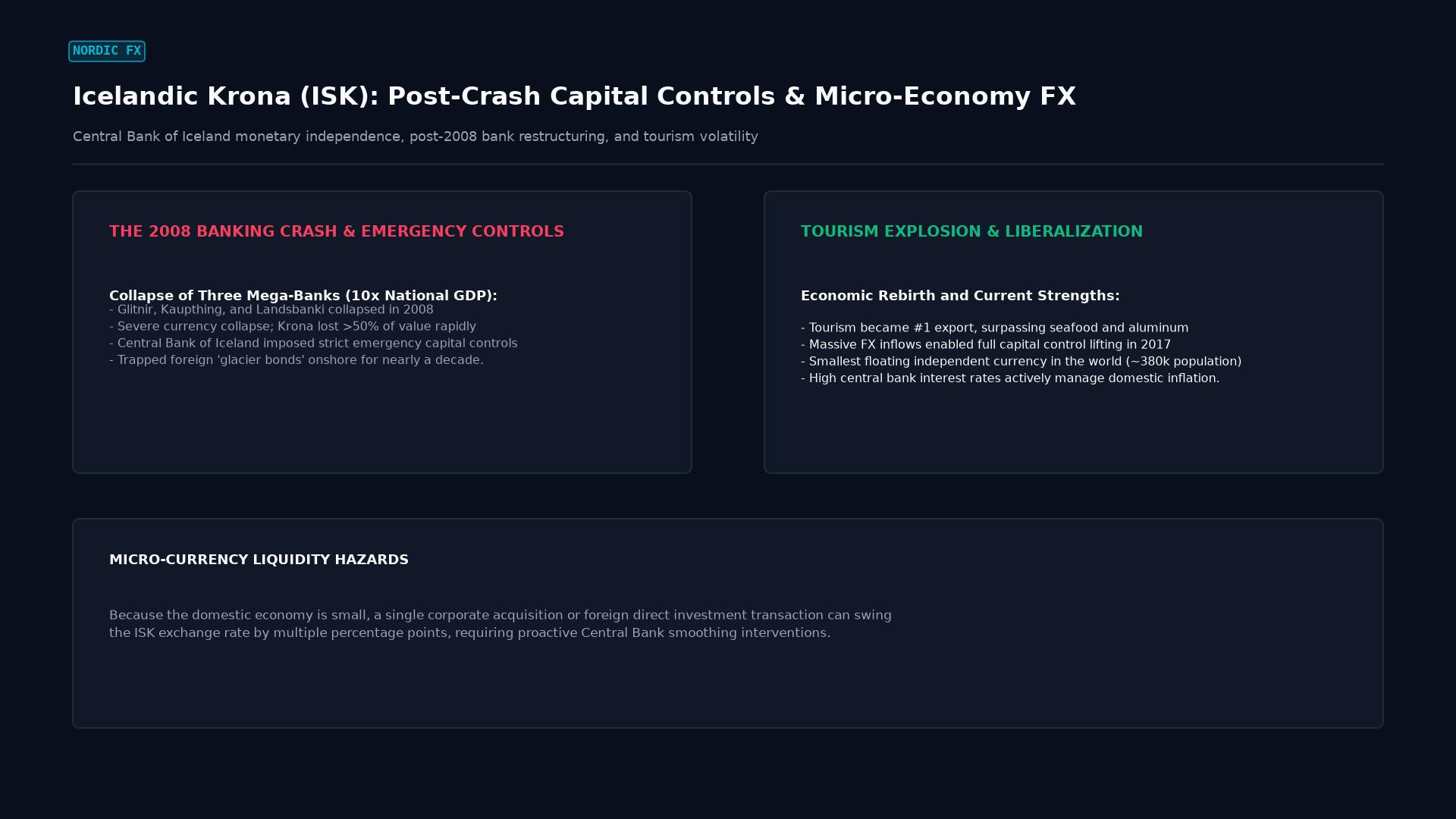 Figure: Central Bank of Iceland monetary independence, post-2008 bank restructuring, and tourism volatility
Economic Drivers of the Icelandic Króna
The fundamental valuation of the ISK is dictated by distinct structural pillars that generate foreign exchange receipts:
1. Marine Sector Exports
Historically, Iceland’s current account was anchored entirely by marine catches, particularly cod, haddock, and capelin. While fishing remains a cornerstone of physical merchandise exports, fluctuations in global seafood prices and fish migration patterns produce noticeable swings in seasonal export earnings.
2. Geothermal Energy and Aluminum Smelting
Abundant, low-cost geothermal and hydroelectric energy attracted global multinational aluminum producers (such as Alcoa and Rio Tinto). These conglomerates ship raw bauxite to Iceland, utilize local renewable electricity to smelt it into primary aluminum, and export finished metal ingot. The trade balance is therefore sensitive to the global aluminum pricing cycle quoted on the London Metal Exchange.
3. Services and International Tourism
Over the past two decades, tourism expanded into Iceland’s single largest generator of foreign exchange receipts. Tourism creates pronounced seasonal liquidity in the ISK market: heavy foreign currency inflows flood the Reykjavik interbank market during the summer travel peak (June through August), while winter months typically see lower commercial currency demand and wider trading spreads.
The 2008 Financial Crisis and the Capital Controls Experiment
The modern institutional framework of the ISK was forged in the fire of the October 2008 systemic financial collapse.
In the years leading up to 2008, Iceland’s three largest private commercial banks (Kaupthing, Landsbanki, and Glitnir) expanded aggressively across Europe. By mid-2008, the combined assets of the banking system had grown to more than ten times the nation’s total Gross Domestic Product. Foreign investors flooded into high-yielding króna-denominated bonds (popularly dubbed “Glacier bonds” or Jöklabréf), exploiting the massive interest rate spread between Sedlabanki’s policy rate (which reached 15.5%) and low yields in Japan, Switzerland, and the Eurozone.
+-------------------------------------------------------------------------+
|                  THE 2008 ICELANDIC BANKING COLLAPSE TIMELINE           |
+-------------------------------------------------------------------------+
|                                                                         |
|  2003 - 2007: MASSIVE CARRY TRADE INFLOWS                               |
|  Foreign investors pour capital into high-yield Glacier Bonds           |
|  (Jöklabréf). Bank assets balloon to 10x national GDP.                  |
|                            |                                            |
|                            v                                            |
|  SEPTEMBER - OCTOBER 2008: SYSTEMIC RUN & COLLAPSE                      |
|  Lehman Brothers fails. Wholesale credit markets freeze globally.       |
|  Kaupthing, Landsbanki, and Glitnir collapse within a single week.      |
|                            |                                            |
|                            v                                            |
|  CURRENCY COLLAPSE & DEFAULT RISK                                       |
|  The ISK plunges over 50% against the Euro in offshore trading.         |
|  Foreign exchange reserves near exhaustion. Sovereign insolvency looms. |
|                            |                                            |
|                            v                                            |
|  NOVEMBER 2008: IMF STABILIZATION & CAPITAL CONTROLS                    |
|  Iceland signs IMF emergency stand-by arrangement. Sweeping legal       |
|  capital controls freeze roughly $4 billion in trapped offshore króna.  |
|                            |                                            |
|                            v                                            |
|  2008 - 2017: ASSET RESOLUTION & CONTROLLED LIBERALIZATION              |
|  Domestic bank assets carved into "New Banks". Offshore króna resolved  |
|  via central bank auctions. Capital controls lifted in March 2017.      |
|                                                                         |
+-------------------------------------------------------------------------+
When global wholesale funding froze in October 2008, all three mega-banks collapsed within a single week. The króna plummeted, offshore liquidity vanished, and foreign exchange trading ground to a virtual halt.
To halt sovereign default and reserve depletion, the Icelandic parliament and Sedlabanki, supported by an emergency International Monetary Fund program, took an unprecedented step for a developed Western democracy: they introduced sweeping capital controls. Under these regulations, cross-border capital transfers were outlawed; domestic residents could not purchase foreign securities or transfer savings abroad, and foreign holders of Glacier bonds found their funds legally trapped inside Iceland.
The capital controls remained in force for nearly nine years, shielding the domestic banking system while insolvent bank estates were unwound. Through a series of central bank auctions, offshore króna holders were offered the choice of long-term government infrastructure bonds or conversion into euros at a punitive discount. Iceland finally dismantled the final broad restrictions on individual and corporate capital accounts in March 2017.
Macroprudential Tools: The Capital Flow Management (CFM) Framework
Determined never to permit unregulated carry trades to destabilize the currency again, Sedlabanki developed specialized macroprudential defense mechanisms.
In June 2016, the central bank implemented a Capital Flow Management Tool (CFM) known as the Special Reserve Ratio on foreign portfolio investment. When foreign hot money pours into Icelandic bonds to exploit high domestic interest rates, Sedlabanki can legally mandate that foreign investors deposit a significant percentage of their capital (historically set between 20% and 40%) into a non-interest-bearing reserve account at the central bank for a mandatory holding period (such as one year). This mechanism effectively taxes incoming speculative capital flows without impeding foreign direct investment or standard commercial trade.
FX Trading Realities and Technical Nuances
Trading the ISK presents unique market microstructure features:
- Trading Hours and Liquidity Concentration: The liquid market for spot ISK operates strictly during European trading hours (09:00 to 17:00 GMT). Outside these hours, liquidity dries up, and quote spreads between institutional market makers widen dramatically.
- Interbank Market Structure: Major Icelandic commercial banks (Islandsbanki, Landsbankinn, and Arion Banki) act as primary market makers, with Sedlabanki regularly intervening via discrete spot transactions to smooth excessive, disorderly exchange rate swings.
- Cross-Currency Pairs: EUR/ISK is the primary quote convention in institutional foreign exchange, reflecting Iceland’s dominant trade links with the European Union. USD/ISK is actively referenced for petroleum imports and international tourism pricing.
Key Takeaways
- The ISK (Icelandic Króna) is the national currency of Iceland, overseen by Sedlabanki Íslands in the developed world’s smallest independent sovereign currency area.
- The currency’s trade balance depends heavily on marine seafood products, aluminum smelting, and international seasonal tourism revenues.
- The 2008 collapse of Iceland’s major commercial banks triggered a multi-year crisis resulting in emergency IMF stabilization and nearly a decade of sweeping capital controls.
- To prevent speculative carry trade destabilization, Sedlabanki employs specialized Capital Flow Management tools, including reserve holding requirements on foreign bond inflows.
- Institutional trading centers on EUR/ISK and USD/ISK during European business hours, subject to wider spreads and central bank liquidity management.
Frequently Asked Questions
Why does Iceland maintain its own currency instead of adopting the Euro?
Maintaining the króna provides Iceland with sovereign monetary independence. Floating exchange rates allow the króna to devalue during fishing harvest declines, aluminum price drops, or tourism recessions, restoring export competitiveness without imposing painful domestic nominal wage cuts.
What were “Glacier bonds” (Jöklabréf) in Icelandic financial history?
Glacier bonds were high-yielding króna-denominated bonds issued offshore prior to 2008. International investors borrowed money in low-interest currencies (like the Japanese yen or Swiss franc) to buy these bonds, creating a massive carry trade bubble that imploded during the 2008 banking collapse.
How does the Central Bank of Iceland counter rapid speculative inflows?
Sedlabanki utilizes a Capital Flow Management tool that requires foreign portfolio investors buying local sovereign debt to place a portion of their capital into non-interest-bearing reserve accounts for a mandatory holding term, reducing the speculative appeal of short-term carry trades.
Ready to trade forex?
Open a free demo account with a regulated broker. Practice with virtual funds before risking real money.