JPY
JPY is the ISO 4217 currency code for the Japanese Yen, the official legal tender of Japan, issued by the Bank of Japan, serving as the third most traded currency globally and the world's premier funding vehicle for cross-border carry trades.
What Is the JPY?
The JPY is the three-letter ISO 4217 currency code for the Japanese Yen (symbol: ¥), the official currency of Japan. Issued and administered by the Bank of Japan (BOJ), the yen is the third most actively traded currency in the global foreign exchange market, trailing only the United States Dollar and the Euro. It also constitutes roughly 5% to 6% of global allocated foreign exchange reserves held by world central banks.
In global finance, the yen occupies a unique structural position. For more than two decades, Japan combined massive current account surpluses, deep domestic private savings, a net international creditor position, and rock-bottom domestic interest rates. These conditions transformed the yen into the primary funding vehicle for the global currency carry trade and a traditional safe-haven asset during international financial panics.
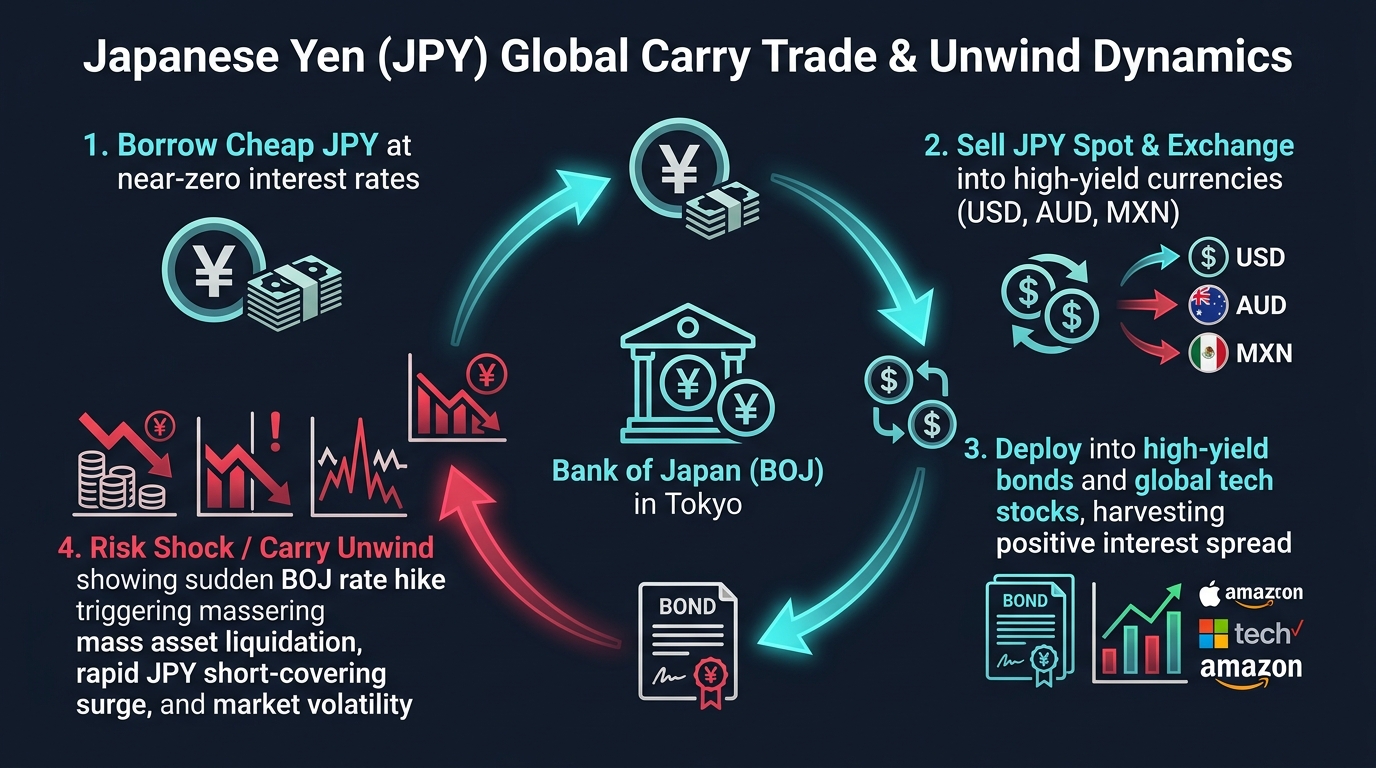
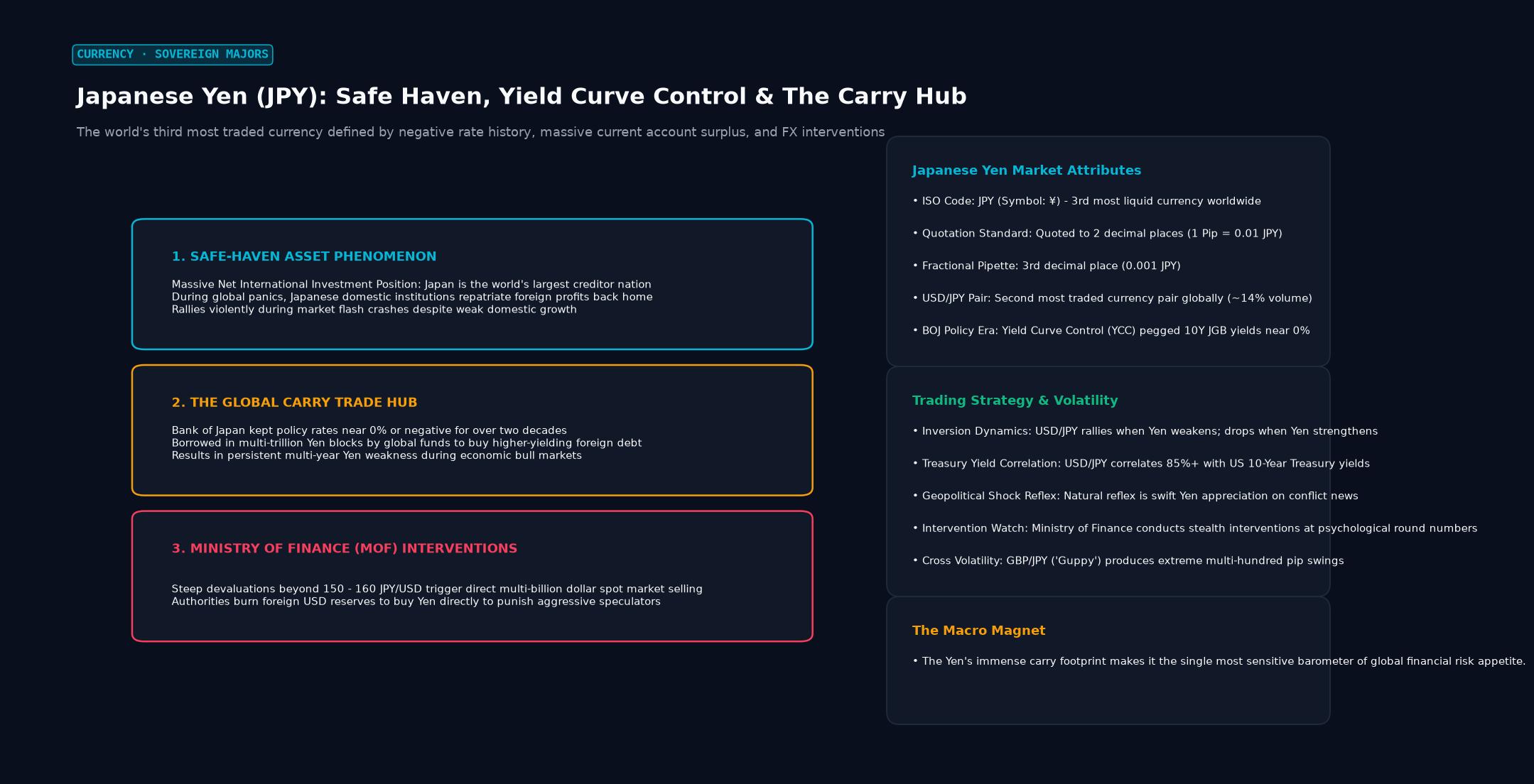 Figure: The world’s third most traded currency defined by negative rate history, massive current account surplus, and FX interventions
The Bank of Japan and Unconventional Monetary Policy
To understand the modern behavior of the yen, one must trace the evolution of the Bank of Japan’s pioneering monetary experiments designed to escape the deflationary trap that followed the early 1990s collapse of Japan’s asset bubble:
1. ZIRP and Quantitative Easing (1999–2006)
In 1999, the BOJ became the first modern central bank to adopt a Zero Interest Rate Policy (ZIRP). Two years later, in March 2001, it pioneered Quantitative Easing (QE), directly expanding commercial bank reserve balances by purchasing Japanese Government Bonds (JGBs).
2. Abenomics and QQE with Yield Curve Control (2013–2023)
In 2013, under Governor Haruhiko Kuroda and Prime Minister Shinzo Abe, the BOJ introduced Quantitative and Qualitative Monetary Easing (QQE). In 2016, this policy expanded into a dual-pillar regime:
- Negative Interest Rate Policy (NIRP): A -0.10% interest rate imposed on a tier of commercial banks’ excess reserves held at the BOJ, designed to force banks to lend into the real economy.
- Yield Curve Control (YCC): The BOJ pledged to purchase unlimited quantities of 10-year JGBs to pin the 10-year sovereign yield near 0.00% (with an initial fluctuation band of +/- 0.10%, gradually widening over the years to +/- 1.00%).
YCC successfully anchored domestic borrowing costs, but it had a massive side effect: whenever the US Federal Reserve and European Central Bank aggressively raised interest rates to combat inflation, the gap between foreign yields and frozen Japanese yields expanded dramatically. This interest differential caused the yen to depreciate sharply, driving USD/JPY from roughly 115 in early 2022 to above 160 by mid-2024.
3. The Historic March 2024 Policy Pivot
In March 2024, under Governor Kazuo Ueda, the BOJ executed its first interest rate hike in 17 years. The central bank dismantled Yield Curve Control, discontinued purchases of exchange-traded funds (ETFs) and Japan real estate investment trusts (J-REITs), and raised its overnight policy target rate back into positive territory. A subsequent policy rate increase to 0.25% in July 2024 triggered one of the sharpest carry trade unwinds in modern financial history, causing the yen to appreciate violently and sparking double-digit single-day declines in Japanese equity indices.
Ministry of Finance (MOF) Interventions
A critical legal and operational distinction in Japanese foreign exchange governance is the division between policy authority and market execution:
- The Ministry of Finance (MOF): Holds statutory legal authority over Japan’s foreign exchange policy. The Vice Minister of Finance for International Affairs (Japan’s “currency chief”) decides whether, when, and at what scale currency intervention occurs.
- The Bank of Japan (BOJ): Acts strictly as the operational agent executing the physical market orders dictated by the MOF.
| Intervention Type | Operational Mechanism | Historical Precedent |
|---|---|---|
| Yen-Selling Intervention (Weaken JPY) | BOJ sells yen and buys foreign currency (primarily US dollars), financing operations by issuing short-term Financing Bills (FBs) | 2011 post-Tohoku earthquake interventions when yen reached 75.35 per USD |
| Yen-Buying Intervention (Strengthen JPY) | BOJ sells foreign exchange reserves (US Treasuries and cash deposits) and buys spot yen to halt speculative depreciation | September/October 2022 (approaching 145–151) and April/May/July 2024 (above 160 USD/JPY) |
When the MOF intervenes to support the yen, it must draw upon finite foreign exchange reserves, selling dollar assets held at the Federal Reserve. These multi-billion-dollar market operations typically inject massive immediate volatility, punishing aggressive speculative short-yen momentum traders.
Trading Characteristics and FX Microstructure
Professional currency traders recognize distinct technical and operational features when dealing with the Japanese Yen:
1. Pip Pricing Conventions
Unlike most major currency pairs (such as EUR/USD or GBP/USD) where a standard pip represents the fourth decimal place (0.0001), yen crosses are quoted with two decimal places. A single pip in USD/JPY, EUR/JPY, or GBP/JPY equals 0.01 yen. Fractional pips (pipettes) are quoted to the third decimal place (0.001).
USD/JPY Quote: 154.253
               ||| ||^ Fractional pip (pipette)
               ||| |^ Standard pip (0.01 JPY)
2. The Tokyo Fix (Gotobi Days)
Liquidity in JPY spikes around the daily Tokyo Fix at 9:55 AM Japan Standard Time (JST). Commercial Japanese banks determine their baseline retail exchange rate (Nakane) for the day during this window. Liquidity and order flow are particularly intense on Gotobi days (calendar dates ending in 5 or 0, such as the 5th, 10th, 15th, 20th, 25th, and final day of each month) when domestic Japanese corporations settle foreign invoices and balance cross-border trade payments.
3. Safe-Haven Status vs Rate Differentials
Historically, the yen functioned as a classic safe-haven currency. During global equity selloffs, geopolitical escalations, or sovereign debt crises, Japanese overseas investors repatriated foreign assets back into domestic yen, while international macro funds unwound yen-funded carry positions.
However, during periods of extreme cross-border interest rate divergences, this safe-haven property can temporarily decouple. If foreign interest rates remain substantially higher than Japanese yields, the high negative carry cost of holding long yen positions can suppress safe-haven buying until central bank policy pivots.
Key Takeaways
- The JPY (Japanese Yen) is the legal tender of Japan, overseen by the Bank of Japan, and ranks as the third most traded currency globally.
- Decades of Zero Interest Rate Policy (ZIRP), Quantitative Easing, and Yield Curve Control established the yen as the premier funding currency for the global carry trade.
- In March 2024, the Bank of Japan ended negative rates and Yield Curve Control, embarking on monetary normalization after 17 years of ultra-loose policy.
- Currency interventions are legally decided by the Ministry of Finance (MOF) and executed operationally by the Bank of Japan.
- Yen pairs are quoted with two decimal places (1 pip = 0.01 JPY), and intraday volatility often concentrates around the 9:55 AM JST Tokyo Fix on Gotobi settlement dates.
Frequently Asked Questions
Why is the Japanese Yen referred to as a “funding currency”?
The yen is called a funding currency because Japan maintained near-zero or negative interest rates for decades. Global investors borrowed yen cheaply, converted the funds into other currencies, and purchased higher-yielding assets worldwide to capture the interest rate spread.
How did the unwinding of the Yen carry trade in mid-2024 impact global markets?
When the Bank of Japan raised its policy rate in July 2024 while foreign central banks prepared to cut rates, the yield advantage of carry trades shrank. Investors rapidly liquidated foreign assets and repurchased yen to close out debt lines, triggering sharp global stock market declines and a sudden surge in JPY valuation.
Who decides when Japan intervenes in the currency market?
The legal authority to conduct foreign exchange market interventions rests solely with the Japanese Ministry of Finance (MOF). The Bank of Japan acts as the executive agent, executing spot currency transactions on interbank markets under the direct instruction of the MOF.
Ready to trade forex?
Open a free demo account with a regulated broker. Practice with virtual funds before risking real money.