JMD
JMD is the ISO 4217 currency code for the Jamaican Dollar, the legal tender of Jamaica, issued by the Bank of Jamaica under an inflation-targeting monetary framework featuring the market-driven B-FXITT foreign exchange auction mechanism.
What Is the JMD?
The JMD is the three-letter ISO 4217 currency code for the Jamaican Dollar, the national currency of Jamaica. Subdivided into 100 cents (though low-denomination coins are largely symbolic due to historical inflation), the Jamaican Dollar is issued and administered by the Bank of Jamaica (BOJ), the country’s central bank based in Kingston.
In Caribbean and emerging market finance, the Jamaican Dollar represents one of the most remarkable monetary turnaround stories of the 21st century. After enduring decades of chronic currency depreciation, double-digit inflation, and high sovereign debt ratios that exceeded 145% of GDP in the early 2010s, Jamaica executed an ambitious series of fiscal and monetary reforms. Today, the JMD operates under a modern, flexible inflation-targeting regime supported by transparent foreign exchange auction architecture.
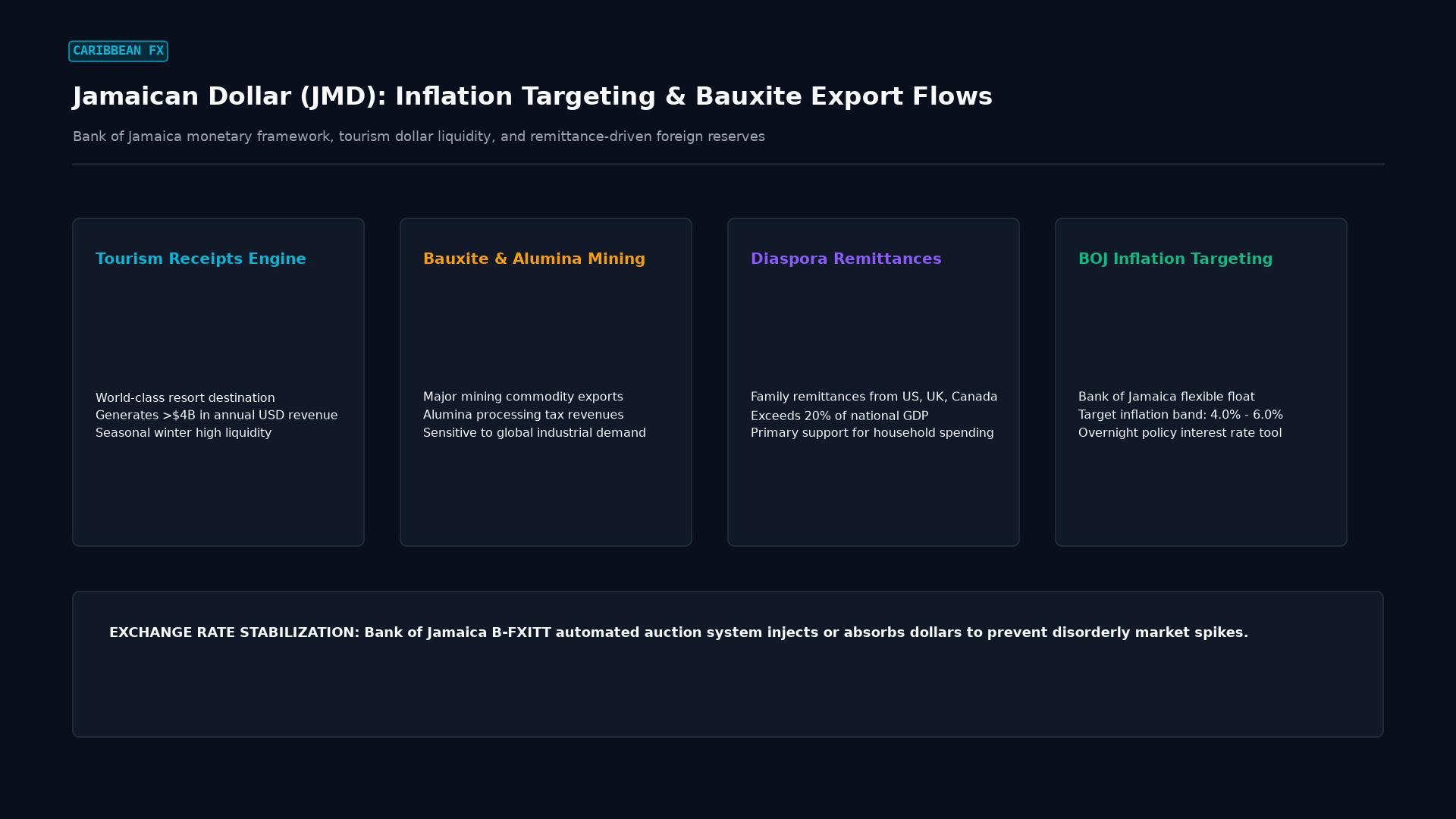 Figure: Bank of Jamaica monetary framework, tourism dollar liquidity, and remittance-driven foreign reserves
Monetary Framework: The Shift to Inflation Targeting
For much of its post-independence history, Jamaica attempted various pegged or managed exchange rate arrangements that frequently collapsed due to fiscal deficits and inadequate foreign reserves.
In 2017, the Bank of Jamaica initiated a structural transition toward a full-fledged, price-based inflation-targeting framework, which was codified into law with the passage of the Bank of Jamaica (Amendment) Act in 2020. The statutory mandate established:
- Central Bank Operational Autonomy: The BOJ gained institutional independence from the Ministry of Finance, eliminating direct government financing through central bank credit.
- Target Inflation Band: The primary policy objective is maintaining annual headline consumer price inflation within a transparent target band of 4.0% to 6.0%.
- Price-Based Transmission: Rather than targeting the nominal exchange rate directly, the BOJ adjusts its policy interest rate (the rate offered on 30-day certificates of deposit) to influence domestic credit conditions, interbank borrowing costs, and aggregate demand.
Under this regime, the exchange rate of the Jamaican Dollar is market-determined, acting as a natural economic shock absorber. The central bank intervenes only to address disorderly market volatility or systemic liquidity shortfalls.
The B-FXITT Foreign Exchange Auction Mechanism
A pivotal component of Jamaica’s monetary modernization was the introduction of the BOJ Foreign Exchange Intervention Tool (B-FXITT) in 2017.
Prior to B-FXITT, central bank market interventions occurred through opaque bilateral negotiations with select commercial banks, fostering market uncertainty and hoarding. B-FXITT replaced this with an algorithmic, competitive, multiple-price auction platform:
- Pre-Announced Auctions: The BOJ announces the date, time, and volume of foreign exchange it intends to sell (or buy) to the market.
- Competitive Bidding: Authorized Dealers (commercial banks) and large licensed Cambios submit discrete bids specifying both volume and price.
- Transparent Allocation: Bids are filled from the highest exchange rate down until the allocated volume is exhausted. All market participants receive immediate public reporting of average selling prices and participation statistics.
B-FXITT established true market-clearing price discovery, deepened liquidity, and substantially reduced the bid-ask spreads quoted across domestic financial institutions.
Balance of Payments Drivers and Dollarization
The equilibrium value of the JMD is tied to distinct cross-border capital and trade flows:
| Flow Category | Primary Economic Driver | Impact on JMD Valuation |
|---|---|---|
| Diaspora Remittances | Cash transfers from Jamaicans working in the US, UK, and Canada | Structural stabilizer; supplies $3+ billion annually in resilient hard currency inflows |
| Tourism Sector | Visitor spending in Montego Bay, Negril, and Ocho Rios resorts | High seasonal sensitivity; generates direct US dollar receipts but drives partial domestic dollarization |
| Commodity Exports | Mining and export of bauxite and refined alumina | Dependent on global industrial aluminum demand and international commodity pricing |
| Energy Import Bill | Heavy dependence on imported crude oil and refined petroleum | High vulnerability; surges in Brent crude prices increase dollar demand, pressuring the JMD |
| Sovereign Debt Consolidation | Fiscal discipline reducing public debt from 145%+ to below 75% of GDP | Drastically lowers sovereign default premia, attracting foreign direct investment |
The Dollarization Challenge
Because tourism and remittances bring billions of US dollars directly into the economy, Jamaica experiences partial domestic financial dollarization. Many commercial contracts, luxury real estate leases, and hotel room rates are priced directly in US dollars. A substantial portion of private bank deposits are held in foreign currency accounts. The BOJ manages this by enforcing distinct reserve requirements on foreign currency liabilities to safeguard banking system solvency against currency mismatch risks.
Institutional Trading Realities and FX Microstructure
For institutional treasurers and regional portfolio managers, trading the JMD involves unique operational parameters:
- Two-Tier Domestic Market: Foreign exchange transactions are concentrated among Authorized Dealers (such as National Commercial Bank Jamaica, Scotiabank Jamaica, and CIBC FirstCaribbean) and Cambios (private exchange houses regulated by the BOJ that service smaller retail and merchant transactions).
- Quote Conventions: The currency is conventionally quoted in terms of Jamaican Dollars per one US Dollar (USD/JMD). A quote of 155.00 indicates that one US dollar purchases 155 Jamaican dollars.
- Absence of Liquid Offshore Derivatives: Unlike major emerging market currencies, there is no liquid offshore Non-Deliverable Forward (NDF) market for the JMD. Hedging foreign exchange risk is typically conducted through onshore commercial bank forward contracts, structured currency swaps, or natural balance sheet asset-liability matching.
Key Takeaways
- The JMD (Jamaican Dollar) is the official currency of Jamaica, regulated by an independent Bank of Jamaica under a 4.0% to 6.0% inflation-targeting framework.
- The implementation of the competitive B-FXITT auction platform modernized foreign exchange price discovery and eliminated opaque bilateral central bank interventions.
- Jamaica’s balance of payments is anchored by resilient diaspora remittances and tourism receipts, balanced against heavy reliance on imported energy and foodstuffs.
- Landmark fiscal reforms reduced national debt from over 145% of GDP to under 75%, transforming the JMD from a chronically depreciating currency into a stabilized regional asset.
- The onshore FX market operates through commercial Authorized Dealers and licensed Cambios, with limited offshore derivative liquidity.
Frequently Asked Questions
What is the B-FXITT system used by the Bank of Jamaica?
B-FXITT stands for the BOJ Foreign Exchange Intervention Tool. It is a competitive, transparent, market-driven electronic auction platform through which the Bank of Jamaica buys or sells foreign currency to authorized commercial banks and cambios to manage systemic liquidity.
Why is the US Dollar widely accepted in Jamaica?
The US Dollar is widely accepted in Jamaica’s resort corridors and commercial hubs due to heavy visitor traffic from North American tourists and deep trade ties with the United States. Many merchants hold US dollar accounts to purchase imported inventory directly.
What caused the stabilization of the Jamaican Dollar over the past decade?
The stabilization was driven by aggressive fiscal discipline under International Monetary Fund economic programs, structural debt reduction, operational central bank independence, and the transition to transparent inflation targeting.
Ready to trade forex?
Open a free demo account with a regulated broker. Practice with virtual funds before risking real money.