Kicker
A kicker is an equity feature, warrant, or profit-sharing right attached to a debt instrument to provide lenders with capital appreciation upside alongside fixed interest distributions, compensating for elevated credit risk in subordinated and mezzanine financing.
What Is a Kicker?
In corporate finance, private credit, and leveraged debt markets, a kicker (commonly referred to as an equity kicker or equity sweetener) is an additional contractual feature attached to a loan or debt obligation. A kicker grants the lender an ownership stake, equity purchase warrant, or share of future corporate profits in addition to regular periodic interest payments.
Kickbacks and kickers sound similar in name, but they operate in entirely different realms: while kickbacks are illegal commercial bribes, equity kickers are sophisticated, legally binding financial instruments. Lenders negotiate kickers when underwriting debt for high-growth enterprises, private equity buyouts, or distressed recapitalizations where standard nominal coupon yields fail to compensate for the underlying credit risk.
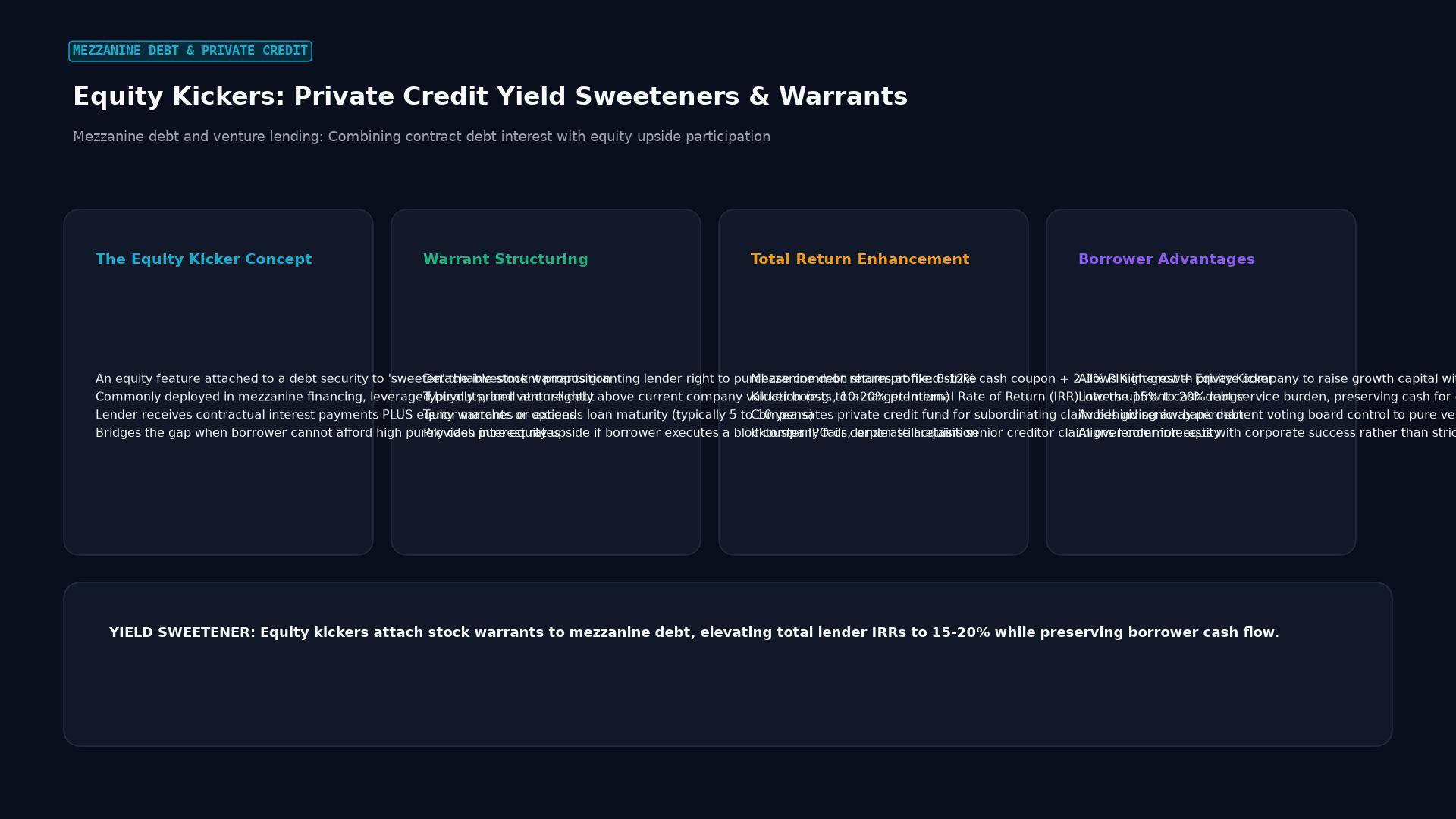 Figure: Mezzanine debt and venture lending: Combining contract debt interest with equity upside participation
Structural Forms of Equity Kickers
Private credit funds, venture debt firms, and mezzanine investors deploy distinct kicker mechanisms based on the borrower’s capital structure and projected liquidity events:
1. Penny Warrants
The most common institutional kicker is the detachment of stock purchase warrants. The lender receives warrants to purchase a specified percentage of the company’s fully diluted common stock at a nominal strike price (such as $0.01 per share). If the borrower executes an initial public offering (IPO) or sells to a strategic acquirer at a premium valuation, the lender exercises the penny warrants and reaps substantial equity profit.
2. Convertible Debt Features
Rather than issuing separate warrants, the loan contract may contain an embedded conversion privilege. This structure allows the lender to convert all or a designated portion of the outstanding debt principal into common or preferred shares at a pre-agreed conversion price, particularly if the borrower hits operational milestones.
3. Revenue or Net Cash Flow Participation
In real estate development, natural resource extraction, or royalty financing, kickers often take the form of synthetic profit interests. The lender receives a contractual right to collect a defined percentage (such as 2% to 5%) of gross property revenues or net oil field production royalties once project cash flows surpass a predetermined hurdle.
4. Co-Investment Rights
A non-dilutive kicker structure gives the credit provider the contractual right to co-invest alongside private equity sponsors in subsequent equity funding rounds at favorable valuations without paying traditional sponsor management fees.
The Quantitative Impact on Internal Rate of Return (IRR)
Institutional debt allocators measure investment performance through total blended Internal Rate of Return (IRR). A pure cash interest rate on subordinated debt is often constrained by the borrower’s operating cash flow; demanding an 18% cash coupon could bankrupt a growing software firm.
An equity kicker resolves this constraint by splitting the return into two components: a manageable current-pay cash coupon and delayed equity upside:
Total Investment Return (IRR) = Current Cash Coupon + Deferred PIK Interest + Equity Kicker RealizationFor example, a mezzanine debt fund issues a $20 million subordinated loan to a mid-market manufacturing company:
- Stated Cash Coupon: 11% per annum ($2.2 million annual cash interest)
- Payment-in-Kind (PIK) Interest: 2% capitalized into loan principal annually
- Equity Kicker: Warrants representing 5% of common equity with an exit horizon in year 5
If the company achieves an enterprise value sale of $150 million at year 5 with $50 million of net senior debt, the $100 million equity value yields $5 million to the warrant holder. This equity windfall transforms an otherwise pedestrian 13% debt yield into an annualized fund IRR exceeding 17.5%.
Comparison: Senior Debt vs Mezzanine with Kicker vs Pure Equity
| Dimension | Senior Secured Debt | Mezzanine Debt with Kicker | Common Equity |
|---|---|---|---|
| Claim Priority | First lien on assets | Subordinated to senior bank debt | Residual claimant |
| Primary Return Source | Floating interest rate (SOFR spread) | Fixed coupon plus equity warrants | Capital appreciation and dividends |
| Target IRR | 6% to 9% | 14% to 20% | 20%+ |
| Covenants | Strict maintenance covenants | Incurrence covenants and board observer rights | Full voting board control |
| Dilution to Founders | Zero equity dilution | Minor equity dilution (typically 2% to 8%) | Substantial equity dilution |
The Borrower’s Strategic Perspective
From the perspective of corporate founders and private equity sponsors, granting an equity kicker represents a calculated financial tradeoff:
Advantages for the Borrower
- Preserves Operating Liquidity: By accepting an equity sweetener, the lender accepts a lower cash interest coupon, reducing monthly debt service and freeing cash for research, hiring, and capital expenditures.
- Avoids Senior Debt Restrictions: Senior commercial banks enforce strict debt-to-EBITDA leverage limits. Subordinated lenders accepting kickers will finance leverage ratios well beyond conservative bank guidelines.
- Less Dilutive than Pure Equity: Issuing common stock to venture capital funds might require giving away 25% to 40% of the company. A mezzanine debt facility with penny warrants typically dilutes existing ownership by only 3% to 7%.
Disadvantages for the Borrower
- Significant Value Surrender upon Exit: If the company achieves extraordinary commercial success and commands a multi-billion-dollar valuation, the equity kicker transfers substantial enterprise value to a credit provider that assumed junior debt risk rather than foundational equity risk.
- Governance Friction: Warrants and conversion rights typically include information rights, board observer seats, and protective covenants that restrict management’s ability to issue subsequent debt or execute M&A without lender consent.
Key Takeaways
- An equity kicker is a contractual warrant, conversion right, or profit share attached to debt to provide lenders with equity upside alongside interest payments.
- Kickers are foundational to mezzanine financing, venture debt, and subordinated leveraged buyout lending structures.
- Attaching equity sweeteners bridges valuation gaps, allowing borrowers to pay lower current cash coupons while delivering high blended IRRs (15% to 20%+) to credit funds.
- Common structures include penny warrants, convertible loan tranches, gross revenue participation rights, and co-investment privileges.
- Borrowers utilize kickers to secure growth capital and preserve working cash flow while surrendering less ownership dilution than traditional common equity rounds.
Frequently Asked Questions
Why do lenders demand an equity kicker instead of simply charging a higher interest rate?
High cash interest rates drain a borrowing company’s working capital, increasing the mathematical probability of debt default. An equity kicker aligns lender incentives with corporate growth, keeping current debt service obligations manageable while rewarding the lender if the enterprise expands successfully.
How does an equity kicker affect a company’s financial statements?
Under US GAAP (ASC 470) and IFRS (IAS 32), the fair value of detachable warrants is separated from the debt principal and recorded as additional paid-in capital in the equity section of the balance sheet. The resulting debt discount is amortized over the life of the loan as additional non-cash interest expense, lowering reported accounting net income.
What is the difference between an equity kicker and convertible debt?
An equity kicker typically consists of a separate, detachable warrant issued alongside a loan, allowing the lender to collect both full loan repayment and equity profits. In standard convertible debt, the lender must choose between receiving full cash principal repayment or converting that debt principal into shares.
Ready to trade forex?
Open a free demo account with a regulated broker. Practice with virtual funds before risking real money.