Kitchen sink bond
A kitchen sink bond is a colloquial Wall Street term for a subordinated or residual tranche of a Collateralized Mortgage Obligation (CMO) constructed from the volatile, non-conforming, and hard-to-sell mortgage cash flows left over after senior tranches have been carved out.
What Is a Kitchen Sink Bond?
A kitchen sink bond is a slang market term used by fixed income desks, mortgage traders, and institutional portfolio managers to describe the most speculative, heterogeneous, and volatile residual tranches of a Collateralized Mortgage Obligation (CMO) or Real Estate Mortgage Investment Conduit (REMIC). The name derives from the classic idiom “everything but the kitchen sink,” reflecting how Wall Street securitization desks package together all the leftover, unpredictable, and difficult-to-sell cash-flow slices that could not be engineered into pristine, senior investment-grade tranches.
When an investment bank pools thousands of residential or commercial mortgages into a structured securitization, it divides the incoming principal and interest payments into distinct risk tiers. High-grade investors (such as commercial banks and pension funds) demand stable, predictable cash flows, which are directed into senior Planned Amortization Class (PAC) tranches.
The unpredictable residuals (support tranches, interest-only (IO) strips, principal-only (PO) strips, inverse floaters, and high-risk subordinated equity slices) are bundled together into a single instrument: the kitchen sink bond. In exchange for absorbing extreme prepayment and default risks, these bonds offer eye-popping nominal coupon yields to opportunistic hedge funds and distressed debt specialists.
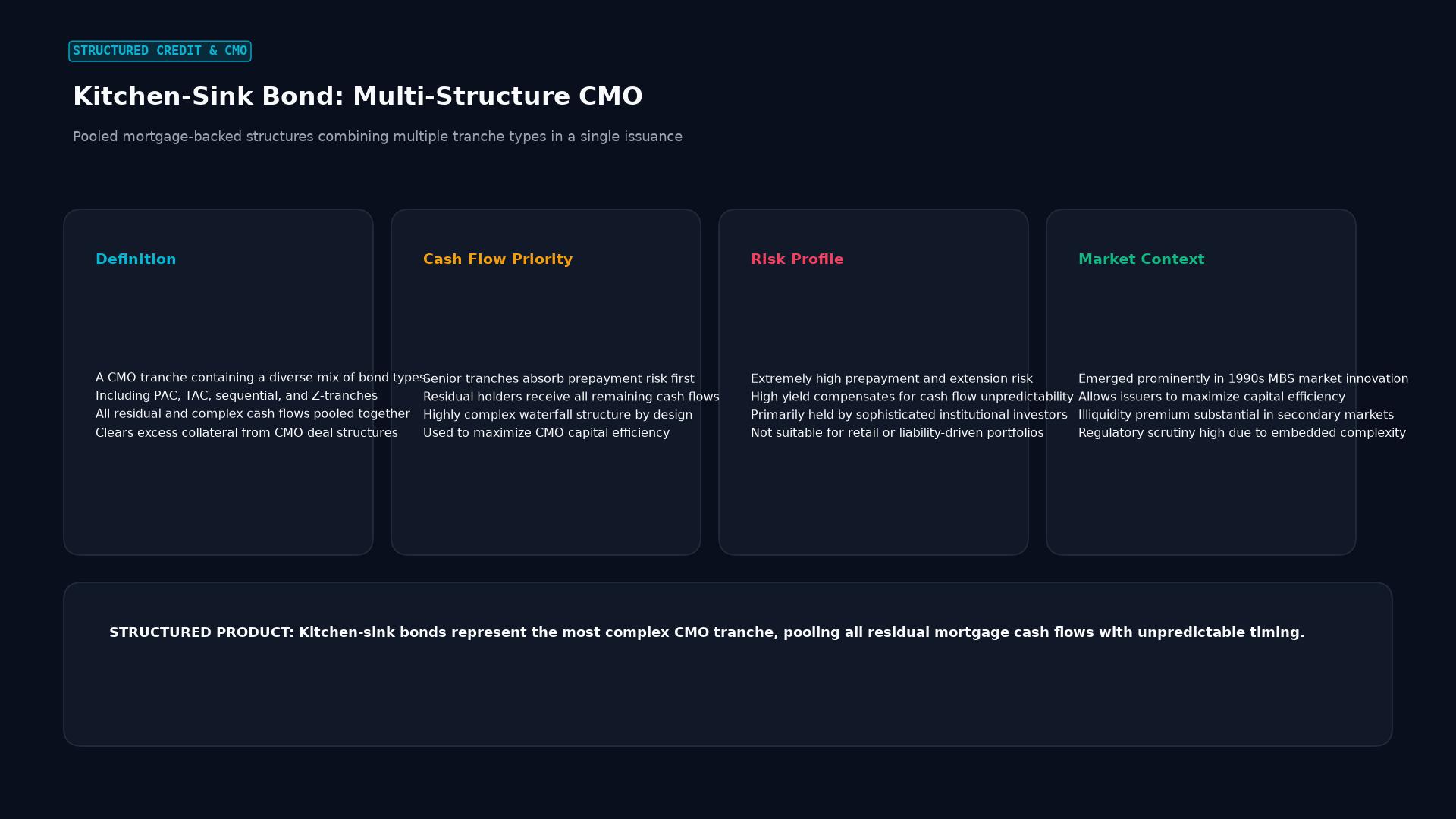 Figure: Pooled mortgage-backed structures combining multiple tranche types in a single issuance
Structural Components and Risk Mechanics
Kitchen sink bonds are not standard fixed-rate debt instruments; they represent complex derivatives on mortgage prepayment behavior and interest rate volatility. Their operational profile is governed by distinct structural hazards:
1. Dual Prepayment Hazards: Contraction vs Extension Risk
Mortgage borrowers hold an embedded prepayment option: they can pay off their home loans early without penalty by refinancing or selling the property. This dynamic exposes kitchen sink bonds to severe prepayment risk:
- Contraction Risk: When interest rates decline rapidly, homeowners refinance en masse. Prepayments flood into the mortgage pool. For high-yielding kitchen sink tranches, this is disastrous: their high-coupon principal is returned prematurely, forcing investors to reinvest capital at prevailing lower market rates.
- Extension Risk: When interest rates surge, refinancing activity freezes. Mortgage prepayments drop to near zero. The expected average life of a kitchen sink bond can suddenly stretch from 3 years out to 25 or 30 years, trapping the investor in an illiquid instrument while market yields climb.
2. Negative Convexity
Standard sovereign and corporate bonds exhibit positive convexity: when interest rates decline, their prices rise at an accelerating rate, and when interest rates rise, their prices decline at a decelerating rate.
Kitchen sink bonds suffer from extreme negative convexity. As interest rates fall, the upside price potential is capped by accelerating homeowner refinancings. Conversely, as interest rates climb, the bond’s duration expands dramatically, accelerating capital losses.
BOND PRICE
    ^
    |          / Standard Bond (Positive Convexity)
    |         /
    |        /  -- Kitchen Sink CMO (Negative Convexity)
    |       /  /
    |      /  /
    |     /  /  (Upside capped by prepayments)
    |    /  /
    |   / -'
    |  /
    | /   (Downside accelerated by extension)
    +------------------------------------------> INTEREST RATES DROP
3. First-Loss Default Subordination
In non-agency mortgage-backed securities (loans not guaranteed by government-sponsored enterprises like Fannie Mae or Freddie Mac), kitchen sink tranches sit at the very bottom of the credit stack. They act as first-loss credit enhancements for the senior classes. Every dollar of foreclosed mortgage principal is charged off directly against the kitchen sink tranche before senior bondholders absorb a single cent of capital loss.
Tranche Comparison: Senior MBS vs PAC vs Kitchen Sink
| Dimension | Senior Pass-Through MBS | Planned Amortization Class (PAC) | Kitchen Sink Residual Tranche |
|---|---|---|---|
| Credit Rating | AAA / Government-Backed | AAA to AA | Unrated, B, or Distressed |
| Cash Flow Schedule | Pro-rata share of monthly pool payments | Strictly protected within a defined prepayment collar | Highly erratic; receives residual cash only |
| Prepayment Exposure | Moderate | Very Low (shielded by support classes) | Maximum (absorbs shocks to protect PACs) |
| Yield Profile | Benchmark Treasury spread + 50–120 bps | Modest yield spread over Treasuries | High double-digit yields (12% to 25%+) |
| Secondary Liquidity | Highly liquid (Fed-cleared, active interbank) | Strong institutional liquidity | Deeply illiquid; wide bid-ask dealer spreads |
Historical Lessons: Orange County and the 2008 Crisis
The structural fragility of kitchen sink bonds has triggered several legendary financial blowups:
- The 1994 Orange County Bankruptcy: Orange County Treasurer Robert Citron invested billions of dollars from the municipal investment pool into leveraged inverse floaters and volatile CMO tranches. When the Federal Reserve embarked on an aggressive rate-hiking cycle in 1994, the duration of these derivative bonds extended violently, resulting in a $1.6 billion paper loss that forced the affluent California county into Chapter 9 municipal bankruptcy.
- The 2007–2008 Global Financial Crisis: Wall Street conduit desks struggled to sell subprime residual tranches. To clear their balance sheets, securitizers bundled non-agency kitchen sink bonds into Collateralized Debt Obligations (CDOs), obtaining artificial AAA ratings through credit default swap insurance. When subprime defaults spiked, these residual cash flows vanished completely, bringing down major investment banks like Bear Stearns and Lehman Brothers.
Institutional Valuation: The Option-Adjusted Spread (OAS)
Valuing a kitchen sink bond requires sophisticated quantitative simulation models rather than simple yield-to-maturity formulas.
Institutional desks deploy Monte Carlo interest rate engines that generate thousands of randomized interest rate paths to model homeowner prepayment behavior under varying refinancing incentives. By stripping out the cost of the homeowner’s prepayment option, analysts calculate the Option-Adjusted Spread (OAS):
OAS = Spread over Benchmark Yield Curve - Cost of Embedded Borrower Prepayment OptionsIf a kitchen sink bond displays a nominal yield spread of 900 basis points over Treasuries, but the modeled cost of the volatile prepayment options is 750 basis points, the true OAS is only 150 basis points. An institutional investor assuming catastrophic duration and credit risk for an effective 150 basis point return is grossly undercompensated.
Key Takeaways
- A kitchen sink bond is the residual, subordinated tranche of a CMO that bundles leftover, volatile, and hard-to-sell mortgage cash flows.
- These instruments absorb the prepayment shocks, contraction risk, and extension risk required to keep senior Planned Amortization Class (PAC) tranches stable.
- Kitchen sink bonds exhibit severe negative convexity, capping upside gains during rate drops while magnifying capital losses during rate hikes.
- In non-agency securitizations, the residual tranche absorbs initial default losses, acting as the credit shield for senior bond classes.
- Institutional valuation requires Monte Carlo modeling to isolate the Option-Adjusted Spread (OAS) and evaluate whether nominal yields justify liquidity and duration risks.
Frequently Asked Questions
Why do institutional investors buy kitchen sink bonds if they are so risky?
Specialized hedge funds, private credit allocators, and mortgage opportunity funds purchase kitchen sink bonds at steep discounts to face value (often 30 to 50 cents on the dollar). If interest rates remain stable and mortgage defaults remain lower than worst-case projections, these deeply discounted residuals can generate annual cash yields exceeding 20%.
What is the difference between a support tranche and a kitchen sink bond?
A support tranche (or companion tranche) is a structured CMO class designed specifically to absorb prepayments outside a PAC collar. A kitchen sink bond is often a composite residual that bundles support pieces, interest-only strips, and unrated junior paper together, representing the most extreme residual tier of the deal.
What happens to a kitchen sink bond during an aggressive central bank tightening cycle?
When the central bank hikes interest rates aggressively, mortgage refinancings collapse. The kitchen sink bond suffers severe extension risk: its expected maturity stretches out by decades, its price plummets due to high negative convexity, and secondary market liquidity evaporates.
Ready to trade forex?
Open a free demo account with a regulated broker. Practice with virtual funds before risking real money.