Kiwi bond
A Kiwi Bond is a retail sovereign debt instrument issued directly by the New Zealand Government through New Zealand Debt Management, denominated in NZD and offered exclusively to New Zealand resident individual savers.
What Is a Kiwi Bond?
A Kiwi Bond is a retail sovereign fixed-income security issued directly by the Crown (the Government of New Zealand) through New Zealand Debt Management (NZDM), an operational unit of the New Zealand Treasury (Te Tai Ōhanga). Denominated in New Zealand Dollars (NZD), Kiwi Bonds are designed specifically for retail household savers, offering an unyielding government-backed haven for capital preservation.
A common misconception found in outdated financial glossaries describes Kiwi Bonds as shares of public companies. In institutional finance, Kiwi Bonds are pure sovereign debt obligations. They carry the unconditional credit guarantee of the New Zealand Government, backed by the sovereign power of taxation. Available exclusively to New Zealand tax residents, Kiwi Bonds provide domestic citizens with a direct conduit to lend capital to their own government, bypassing commercial banking intermediaries.
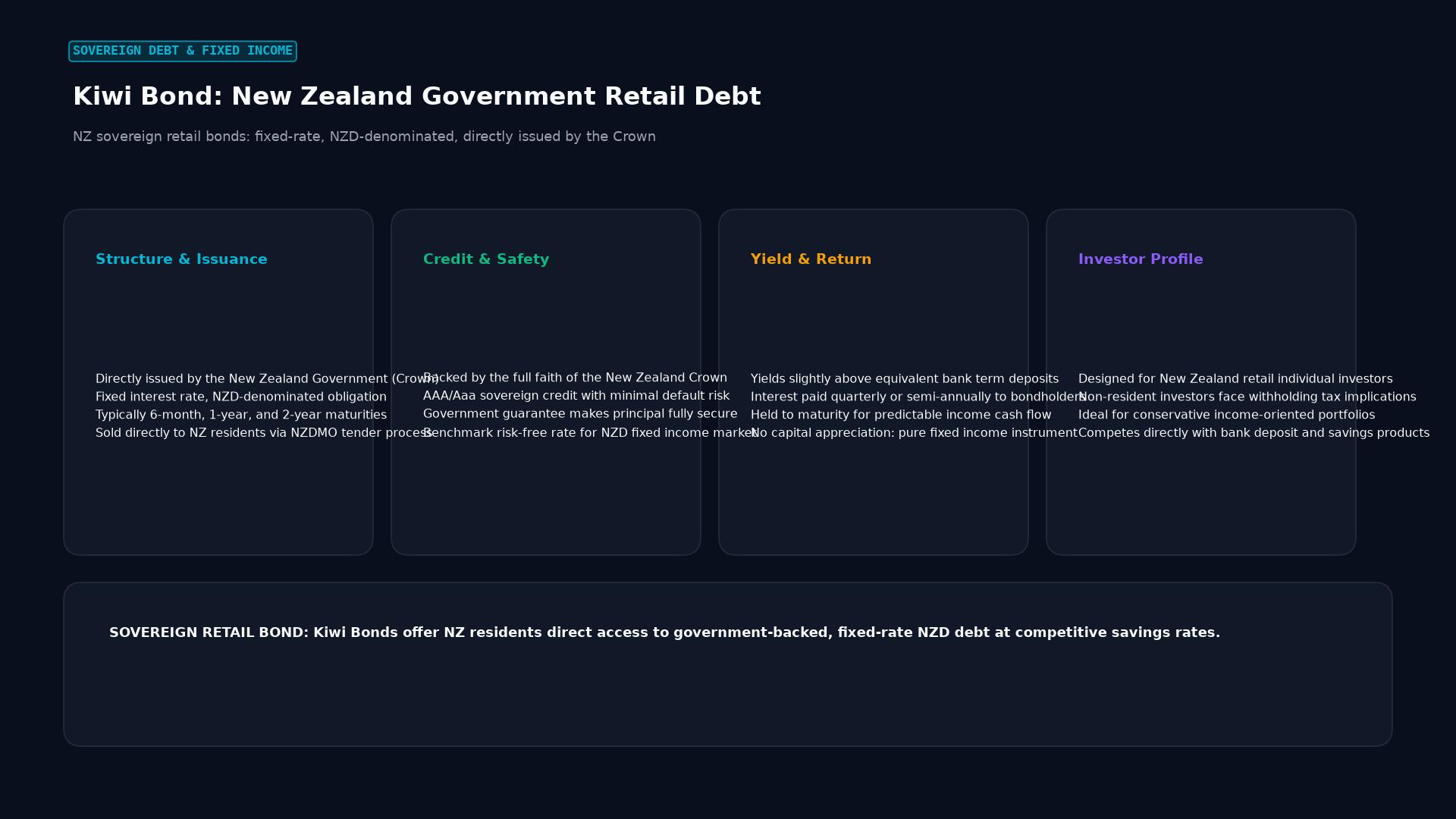 Figure: NZ sovereign retail bonds: fixed-rate, NZD-denominated, directly issued by the Crown
Key Contractual Terms and Features
The issuance of Kiwi Bonds is governed by strict regulatory rules established by the Treasury to keep the program accessible while preventing institutional crowding:
1. Eligibility Constraints
Kiwi Bonds are strictly limited to New Zealand residents. Eligible applicants include:
- Individual New Zealand citizens and permanent tax residents
- Registered domestic charitable organizations
- Domestic family testamentary trusts and incorporated societies
Foreign institutional funds, non-resident offshore accounts, and multinational corporations are legally prohibited from purchasing Kiwi Bonds. Those entities must instead buy wholesale New Zealand Government Bonds (NZGBs) on interbank markets.
2. Investment Thresholds
To ensure the facility serves retail savers rather than wholesale capital, the Treasury enforces defined subscription boundaries:
- Minimum Subscription: NZ$1,000 per application
- Maximum Ceiling: NZ$500,000 per single bond issue across all accounts linked to an individual investor
3. Available Maturity Tenors
Investors can select from standardized fixed-term maturities tailored to medium-term savings objectives:
- 6 Months
- 1 Year
- 2 Years
- 4 Years
4. Interest Payment Options
Interest rates are fixed for the entirety of the chosen maturity term. Investors can elect to receive interest payouts:
- Paid quarterly in arrears directly into a registered New Zealand bank account
- Paid semi-annually
- Compounded quarterly and paid out in full upon final maturity of the bond
Interest Rate Determination: How Rates Are Set
The interest rates offered on Kiwi Bonds are set periodically by New Zealand Debt Management. Unlike wholesale bonds whose yields fluctuate tick-by-tick on interbank trading screens, Kiwi Bond interest rates remain static until the Treasury announces an official rate revision.
NZDM determines Kiwi Bond rates by analyzing:
- Wholesale New Zealand Government Bond benchmark yields across matching maturity curves
- Prevailing interest rates offered on retail term deposits by major domestic commercial banks (such as ANZ, ASB, BNZ, and Westpac)
- The monetary policy Official Cash Rate (OCR) set by the Reserve Bank of New Zealand (RBNZ)
The Treasury typically positions Kiwi Bond rates slightly below wholesale sovereign yields. Because retail sovereign debt incurs higher administrative processing costs per dollar raised than multi-billion-dollar wholesale syndications, the government prices Kiwi Bonds to encourage household thrift without competing aggressively against domestic retail bank deposit bases.
Non-Transferable Nature and Early Redemption
A defining operational characteristic of Kiwi Bonds is their complete absence of secondary market liquidity:
- Non-Transferable: Kiwi Bonds cannot be sold, traded, or transferred to another party on the New Zealand Stock Exchange (NZX) or via private contracts. The bond certificate remains locked to the registered holder until maturity, except in cases of estate probate following the death of the investor or a formal court restructuring order.
- Early Redemption Penalties: While wholesale bonds can be sold immediately at current market prices (exposing the holder to capital losses if yields have risen), Kiwi Bond holders can request early redemption directly from the Treasury prior to maturity. However, early repayment incurs an interest penalty, typically the forfeiture of 30 to 90 days of accrued interest, safeguarding the Crown against capricious capital withdrawals.
Comparison: Kiwi Bonds vs Wholesale NZGBs vs Bank Deposits
| Parameter | Kiwi Bonds | Wholesale NZ Government Bonds (NZGB) | Commercial Bank Term Deposits |
|---|---|---|---|
| Target Audience | NZ retail citizens only | Global institutional investors & banks | Retail & corporate depositors |
| Minimum Investment | NZ$1,000 | NZ$1,000,000 (standard lot sizes) | NZ$1,000 to NZ$10,000 |
| Credit Risk | Sovereign Crown backing (AAA/Aaa) | Sovereign Crown backing (AAA/Aaa) | Commercial bank default risk |
| Secondary Liquidity | Non-transferable; no exchange trading | High liquidity on global interbank desks | Non-tradable; early withdrawal penalties |
| Price Volatility | Zero principal volatility | Daily capital price fluctuation | Zero principal volatility |
| Maximum Investment | NZ$500,000 per issue | Unlimited | Typically unlimited |
Taxation: Resident Withholding Tax (RWT)
Interest distributions generated by Kiwi Bonds constitute taxable income under New Zealand tax law.
When applying for Kiwi Bonds, the investor must supply their New Zealand Inland Revenue Department (IRD) number and designate their applicable Resident Withholding Tax (RWT) rate. The Treasury automatically deducts RWT at the source before depositing net interest proceeds into the investor’s bank account.
Current RWT rate tiers correlate with individual marginal income brackets:
- 10.5% (for annual taxable income up to NZ$15,600)
- 17.5% (for income between NZ$15,601 and NZ$53,500)
- 30.0% (for income between NZ$53,501 and NZ$78,100)
- 33.0% (for income between NZ$78,101 and NZ$180,000)
- 39.0% (for income exceeding NZ$180,000)
If an investor fails to provide a verified IRD number, the Treasury is legally obligated to deduct withholding tax at the non-declaration rate of 45%, penalizing unverified accounts.
Strategic Purpose for the Crown and Retail Investors
From a sovereign macro perspective, the Kiwi Bond facility fulfills essential public policy goals:
- Domestic Savings Culture: It provides New Zealand families with an incorruptible benchmark for risk-free savings, fostering financial literacy and long-term capital accumulation.
- Sovereign Funding Diversification: While retail issuance constitutes only a minor fraction of the Crown’s overall debt portfolio (the vast majority being raised through wholesale auctions), it anchors a dedicated pool of non-speculative domestic capital that never flees offshore during global currency panics.
- Counterparty Security for Savers: In times of global banking stress, Kiwi Bonds provide households with absolute peace of mind: unlike private commercial deposits that depend on bank balance sheet solvency, Kiwi Bonds are backed directly by the sovereign state.
Key Takeaways
- A Kiwi Bond is a retail sovereign debt security issued directly by the New Zealand Government through New Zealand Debt Management (NZDM).
- The bonds are denominated in New Zealand Dollars (NZD) and restricted exclusively to New Zealand tax-resident individuals and non-profit trusts.
- Investment thresholds range from a minimum of NZ$1,000 up to a maximum cap of NZ$500,000 per issue across 6-month, 1-year, 2-year, and 4-year tenors.
- Kiwi Bonds are non-transferable and do not trade on secondary financial exchanges, shielding investors from capital price volatility.
- Earnings are subject to New Zealand Resident Withholding Tax (RWT) deducted directly at source based on the investor’s marginal tax rate.
Frequently Asked Questions
Can foreign investors buy Kiwi Bonds?
No. Kiwi Bonds are legally restricted to New Zealand permanent residents, citizens, and domestic charitable trusts. Non-resident international investors seeking exposure to New Zealand sovereign debt must purchase wholesale New Zealand Government Bonds (NZGBs) through international broker-dealers.
Are Kiwi Bonds guaranteed against loss?
Yes. Kiwi Bonds carry the full sovereign faith and credit of the New Zealand Government. The Crown has never defaulted on its sovereign debt obligations, holding top-tier credit ratings (Aaa by Moody’s and AAA by S&P) in local currency debt.
How do Kiwi Bonds differ from New Zealand bank term deposits?
Commercial bank term deposits expose the saver to the credit risk of that private financial institution. Kiwi Bonds are backed directly by the sovereign government, eliminating private banking counterparty risk, though bank deposits sometimes offer slightly higher nominal interest rates to compensate for that private risk.
Ready to trade forex?
Open a free demo account with a regulated broker. Practice with virtual funds before risking real money.