KMF
KMF is the ISO 4217 currency code for the Comorian Franc, the official currency of the Union of the Comoros, issued by the Central Bank of the Comoros and pegged to the Euro at 1 EUR = 491.96775 KMF via an Operations Account agreement with the French Treasury.
What Is the KMF?
The KMF is the three-letter ISO 4217 currency code for the Comorian Franc (franc comorien), the legal tender of the Union of the Comoros. Subdivided historically into 100 centimes (though centimes coins have been out of circulation for decades due to past inflation), the currency is issued and regulated by the Central Bank of the Comoros (Banque Centrale des Comores - BCC), headquartered in the capital city of Moroni.
Located in the Mozambique Channel of the Indian Ocean between the eastern coast of mainland Africa and northern Madagascar, the Comoros operates within a distinctive post-colonial monetary framework. Rather than allowing its currency to float on global foreign exchange markets, the Comoros maintains a hard peg to the Euro guaranteed directly by the French Treasury. This structural arrangement anchors domestic macroeconomic stability and price credibility within an island economy exposed to external commodity and climate shocks.
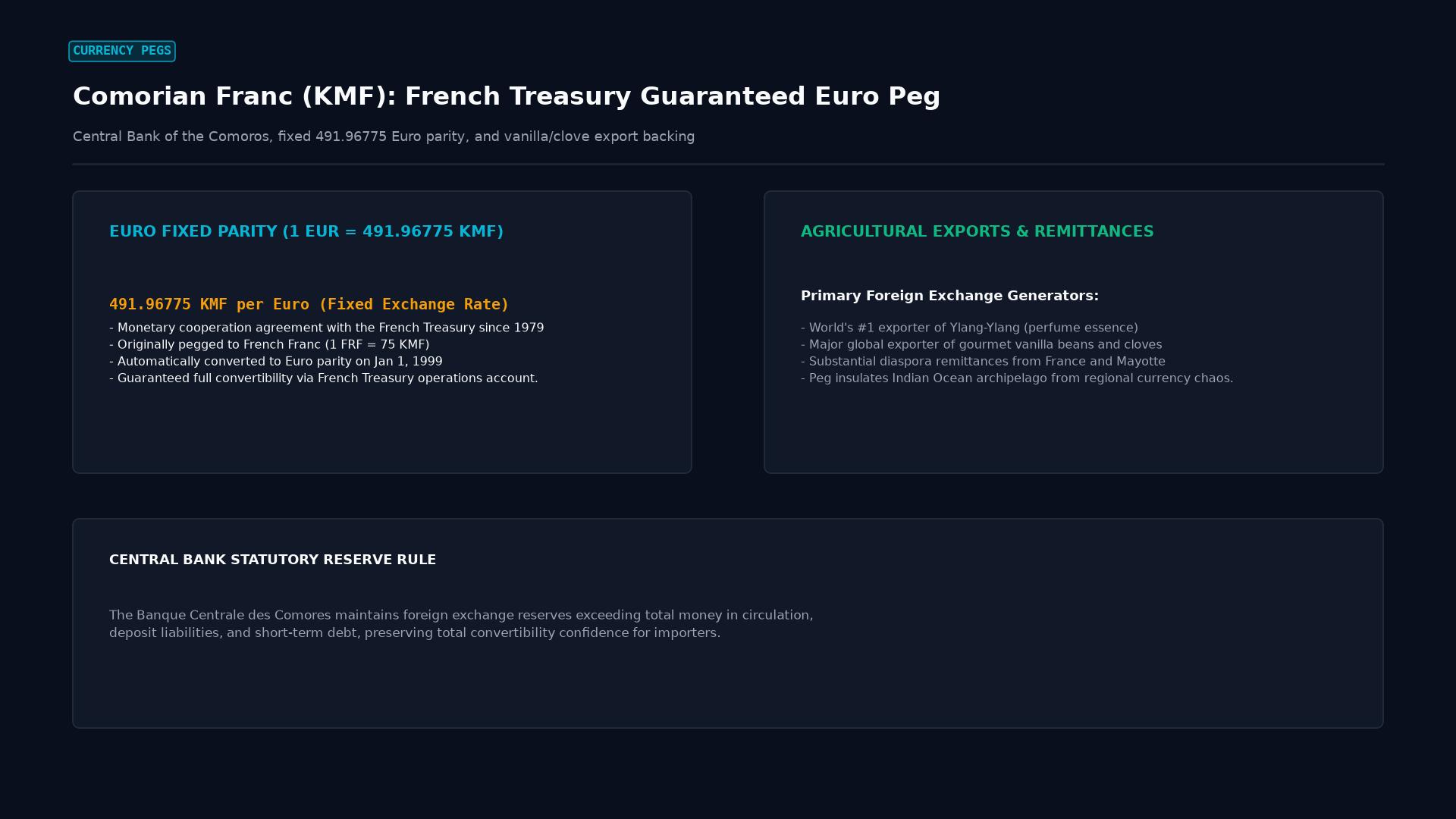 Figure: Central Bank of the Comoros, fixed 491.96775 Euro parity, and vanilla/clove export backing
The French Monetary Cooperation Agreement
The institutional foundation of the KMF is defined by the Monetary Cooperation Agreement signed between the French Republic and the newly independent Islamic Federal Republic of the Comoros in November 1979.
While the Comoros chose political independence from France in 1975 (with the neighboring island of Mayotte voting to remain a French territory), it elected to maintain monetary ties to the Franc Zone. This cooperation framework rests on four foundational pillars:
1. The Fixed Exchange Rate Peg
From 1979 until 1994, the Comorian Franc was pegged to the French Franc (FRF) at a fixed parity of 1 FRF = 50 KMF. In January 1994, when the African CFA Franc currencies underwent a dramatic 50% devaluation, the Comorian Franc was devalued by only 33.3%, shifting the parity to 1 FRF = 75 KMF.
When France adopted the Euro on January 1, 1999, at a fixed conversion rate of 1 EUR = 6.55957 French Francs, the Comorian Franc’s peg seamlessly translated into its modern mathematical parity:
1 EUR = 75 * 6.55957 = 491.96775 KMF2. The French Treasury Operations Account (Compte d’Opérations)
Unlike a standard currency board that must independently accumulate foreign exchange reserves, the BCC holds a specialized Operations Account directly with the French Treasury in Paris. In exchange for the French government guaranteeing unlimited, two-way convertibility between the KMF and the Euro, the BCC is legally required to deposit at least 50% of its total foreign exchange reserves into this Paris account.
3. Unlimited Convertibility Guarantee
If the Comoros experiences a catastrophic balance of payments deficit (such as a total collapse of global spice harvests), the French Treasury provides overdraft facilities in the Operations Account, ensuring that commercial banks in Moroni can continue converting KMF into Euros without defaulting on international trade obligations.
4. French Representation on the Central Bank Board
To ensure prudent risk management, the governance structure of the Banque Centrale des Comores includes representatives appointed by the French government who sit on the BCC Board of Directors, exercising oversight over monetary expansion and foreign reserve management.
Macroeconomic Drivers of the Comorian Economy
Because the exchange rate is fixed by international treaty, the real purchasing power and economic stability of the KMF depend on cross-border real economic flows:
| Economic Driver | Mechanism | Impact on Balance of Payments |
|---|---|---|
| Diaspora Remittances | Cash transfers sent by the substantial Comorian community residing in France (particularly in Marseille, Paris, and Lyon) | Massive stabilizing pillar; remittances routinely generate 20% to 25% of national GDP |
| Ylang-Ylang Extraction | Distillation of yellow floral blossoms into essential perfume oils; Comoros supplies roughly 70% of global demand for luxury French perfumery | Major source of private commercial hard currency export earnings |
| Vanilla and Cloves | Agricultural harvests of bourbon vanilla beans and aromatic spice cloves | High price volatility; dependent on weather conditions and competition from Madagascar |
| Food and Fuel Imports | Structural deficits in domestic grain, rice, and meat production, combined with 100% dependency on imported petroleum | Creates chronic merchandise trade deficits that require continuous remittance replenishment |
| Foreign Aid and Grants | Official development assistance from France, the European Union, the World Bank, and Gulf Cooperation Council states | Supplies essential capital expenditure funding for transport ports and electrical grids |
Monetary Policy and Inflation Transmission
Maintaining a fixed peg to the Euro shields the Comoros from the destructive hyperinflationary cycles experienced by several neighboring African economies.
Because the KMF cannot be devalued unilaterally without consultations under the treaty framework, domestic inflation tracks Eurozone inflation closely, adjusted for shipping freight costs and local food availability. The BCC cannot recklessly monetize government budget deficits; domestic commercial banks must maintain statutory liquidity reserves, and the state’s borrowing from the central bank is strictly capped as a percentage of prior-year fiscal revenues.
However, the fixed peg creates economic tradeoffs. When the Euro appreciates strongly against the United States Dollar, the KMF appreciates alongside it. This strengthens the purchasing power of Comorian consumers buying imported electronics and fuel, but it makes Comorian agricultural exports (such as vanilla and cloves, which are quoted globally in US dollars) more expensive and less competitive on world markets.
FX Trading Realities and Capital Controls
For international financial institutions and cross-border traders, the KMF presents distinct operational conditions:
- Non-Tradable on Global Spot Platforms: The Comorian Franc does not trade on electronic interbank foreign exchange networks like EBS or Refinitiv. It is an illiquid frontier currency traded primarily within regional commercial banking corridors in East Africa and France.
- Convertibility Corridors: Deliverable conversions pass almost exclusively through correspondent banking relationships between commercial banks in Moroni (such as BIC-Comores, Exim Bank Comores, and BDC) and their European correspondent institutions in Paris.
- Exchange Regulations: Outward foreign exchange transfers exceeding statutory limits require documentary justification (commercial trade invoices, university tuition bills, or medical travel receipts) to comply with central bank capital account monitoring.
Key Takeaways
- The KMF (Comorian Franc) is the national currency of the Union of the Comoros, administered by the Banque Centrale des Comores (BCC).
- The currency is anchored to the Euro at a rigid parity of 1 EUR = 491.96775 KMF through a formal monetary cooperation agreement with the French Republic.
- The French Treasury provides an unconditional convertibility guarantee supported by an Operations Account in Paris, where the BCC deposits a minimum of 50% of its foreign reserves.
- The balance of payments relies heavily on diaspora remittances from France (20% to 25% of GDP) and agricultural exports of ylang-ylang perfume essence, vanilla, and cloves.
- The peg eliminates currency volatility against the Euro and suppresses hyperinflation, but ties domestic export competitiveness to the movements of the Euro in global markets.
Frequently Asked Questions
What is the relationship between the Comorian Franc and the CFA Franc?
Both the Comorian Franc and the CFA Franc (XOF and XAF) participate in monetary cooperation agreements with the French Treasury backed by Operations Accounts. However, the Comorian Franc is an independent currency with its own central bank, pegged at 491.96775 KMF per Euro, whereas the CFA Franc is pegged at 655.957 CFA per Euro.
Why is ylang-ylang so important to the Comorian currency?
Ylang-ylang is a tropical floral tree cultivated extensively on the islands of Anjouan and Grande Comore. The Comoros produces roughly 70% of the world’s supply of ylang-ylang essential oil, which forms the base note for iconic luxury fragrances like Chanel No. 5. It is the nation’s most dependable commercial agricultural export.
Can an investor exchange KMF outside of the Comoros?
Exchanging physical Comorian Franc banknotes outside the Comoros is virtually impossible except at specialized airport exchange bureaus in France. International transactions are conducted electronically via commercial banks with correspondent accounts in Paris, settling at the official Euro peg rate.
Ready to trade forex?
Open a free demo account with a regulated broker. Practice with virtual funds before risking real money.