Knock for knock
Knock for knock is a contractual risk-allocation and reciprocal indemnity regime used in maritime, offshore energy, and motor insurance where each party absorbs damage to its own property and personnel while waiving subrogation claims against the other, irrespective of fault or negligence.
What Is Knock for Knock?
Knock for knock is an institutional risk-allocation doctrine and contractual indemnification framework widely adopted in high-hazard commercial environments, including offshore oil and gas exploration, maritime chartering, construction engineering, and motor vehicle insurance. Under a knock-for-knock agreement, each contracting party legally agrees to bear the financial risk of loss or damage to its own property, and injury or death to its own employees, completely releasing and indemnifying the counterparty from legal liability, regardless of who caused the incident or whether negligence was involved.
In standard common law tort systems, liability follows fault: if a contractor drops a steel girder damaging an operator’s drilling equipment, the operator sues the contractor for negligence. In complex multi-party operations where dozens of specialized subcontractors work simultaneously on a single offshore production platform, litigating fault after every industrial accident creates catastrophic legal expenses, protracted court battles, and redundant insurance premiums.
The knock-for-knock regime eliminates fault-finding entirely, establishing an operational boundary where each entity insures its own risk pool.
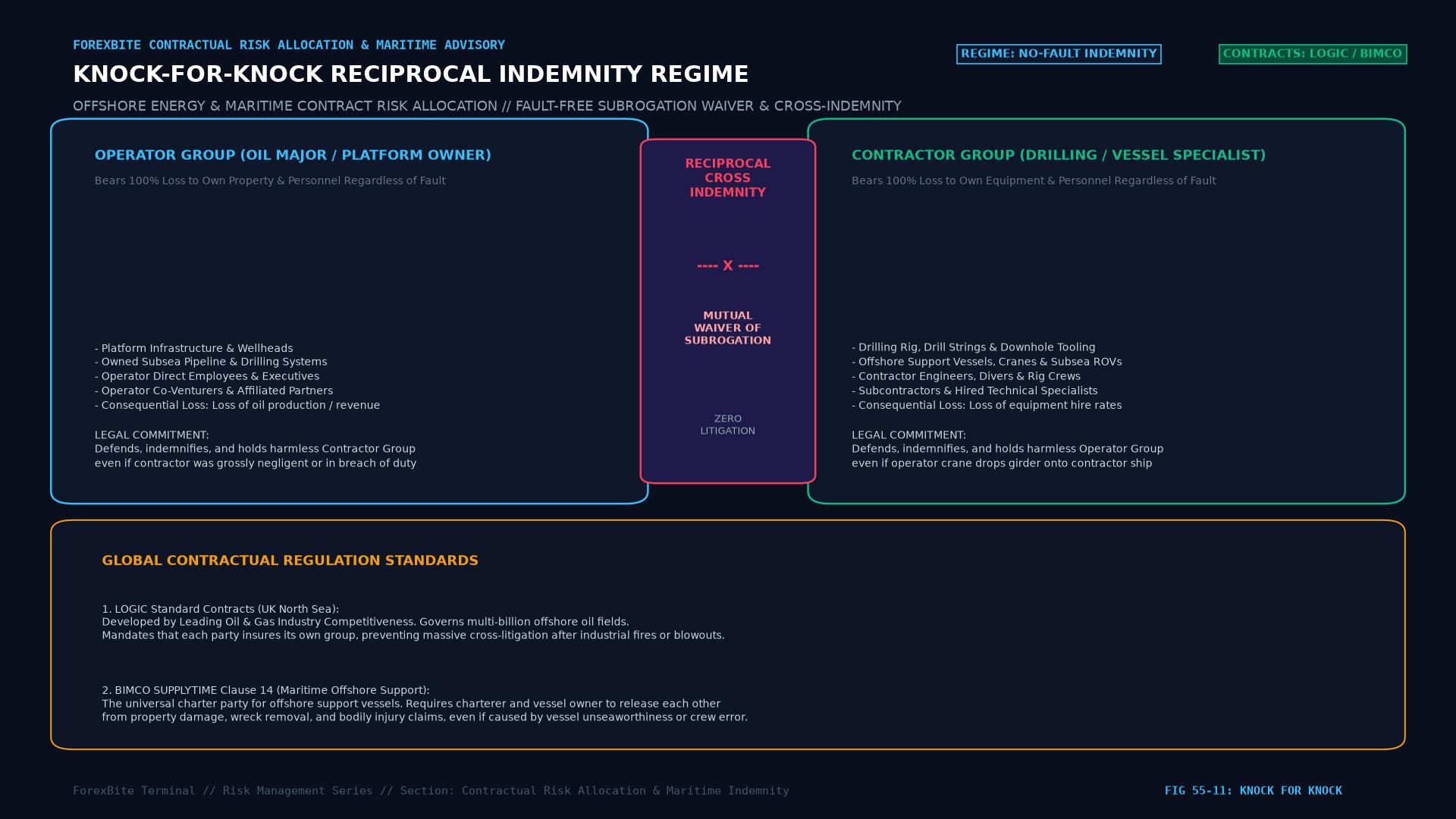 Figure: The knock-for-knock reciprocal indemnity regime showing mutual waiver of subrogation between operator and contractor groups regardless of fault.
Offshore Energy and Maritime Contracting Standards
The most advanced implementation of the knock-for-knock doctrine occurs in offshore energy and maritime logistics. Standardized international contract forms govern these multi-billion-dollar arrangements:
1. LOGIC Contracts (UK North Sea)
In the United Kingdom continental shelf, the offshore energy industry operates under standard contracts developed by LOGIC (Leading Oil & Gas Industry Competitiveness). These templates incorporate reciprocal indemnity clauses that shield contractors from platform-wide damage claims while requiring contractors to defend and hold harmless the operator against claims originating from contractor crew members.
2. BIMCO Standard Maritime Charters
In global shipping, the Baltic and International Maritime Council (BIMCO) embeds knock-for-knock principles into standard vessel charter agreements, such as SUPPLYTIME (the premier time charter party for offshore support vessels). Under SUPPLYTIME Clause 14, charterers and vessel owners agree that each side covers its own hull, cargo, and personnel losses, even if the loss resulted from the unseaworthiness of the vessel or the direct negligence of the charterer’s crane operators.
The Architecture of “Groups” in Mutual Indemnities
A robust knock-for-knock agreement protects more than just the two corporate signatories. Contracts construct extensive legal umbrellas known as the Operator Group and the Contractor Group:
OPERATOR GROUP = Operator + Parent Companies + Subsidiaries + Affiliates + Co-Venturers + Other Contractors + Respective Employees & Officers

CONTRACTOR GROUP = Contractor + Subcontractors + Affiliates + Equipment Vendors + Respective Employees & Officers
By defining both groups broadly, the contract prevents end-run litigation. If an injured employee of a third-tier electrical subcontractor attempts to sue the primary oil platform operator for negligence, the primary contractor must step in, defend the lawsuit, and pay any resulting settlement or judgment under its contractual indemnity obligations.
Comparison: Common Law Fault Liability vs Knock for Knock
| Dimension | Common Law Tort (Fault-Based) | Knock-for-Knock Regime |
|---|---|---|
| Liability Assignment | Party at fault pays all damages | Each party pays for its own losses |
| Role of Negligence | Essential to prove negligence or breach | Completely irrelevant; applies even in gross negligence |
| Legal Expenses | Protracted, multi-year court discovery | Minimized; disputes settled by contract terms |
| Insurance Cost | Redundant; multiple policies cover same risk | Efficient; each party insures known asset values |
| Operational Harmony | Parties turn hostile during accident audits | Collaborative focus on safety rather than assigning blame |
Permitted Carve-Outs and Legal Enforceability
While knock-for-knock agreements are broad, courts in major maritime jurisdictions (including England, Singapore, and United States federal admiralty courts) enforce boundaries to prevent corporate recklessness:
1. Willful Misconduct and Intentional Harm
Parties cannot legally contract out of liability for deliberate harm, fraud, or criminal acts. If a contractor intentionally sabotages platform machinery, knock-for-knock indemnity clauses are void as a matter of public policy.
2. Gross Negligence Carve-Outs
In many civil law jurisdictions (such as France and Norway), indemnifying a counterparty against its own gross negligence (faute lourde) is legally unenforceable. In English law, knock-for-knock indemnities can legally cover gross negligence, but only if the contract uses explicit, unambiguous language stating that “gross negligence” is covered. If the agreement merely references “negligence”, courts interpret the clause as excluding gross negligence.
3. Environmental and Reservoir Pollution
Standard offshore contracts divide environmental liability based on origin:
- Surface Spills: The contractor remains liable for fuels and lubricants leaking directly from its own vessels or machinery above the waterline.
- Subsurface / Well Blowouts: The operator assumes 100% liability for reservoir contamination, blowout containment, and deep-sea crude pollution, as exemplified by the financial liabilities following the 2010 Macondo Deepwater Horizon disaster.
Insurance Integration: The Waiver of Subrogation
For a knock-for-knock regime to function, it must be integrated with the corporate insurance policies of all participating entities.
Under normal insurance law, when an insurance company pays a property claim to its insured client, the insurer acquires the legal right of subrogation: the right to sue the third party who caused the accident to recoup its payout.
If an insurer exercised subrogation on an offshore rig, it would sue the contractor, triggering the contractor’s indemnity obligations, which would circle back to the operator, destroying the entire knock-for-knock framework.
To prevent this circular breakdown, commercial contracts legally mandate that both parties obtain a formal Waiver of Subrogation endorsement on all Commercial General Liability (CGL), Hull and Machinery, and Workers’ Compensation policies. The insurer expressly waives any right to seek recovery against any member of the counterparty’s group.
Retail Motor Insurance Knock-for-Knock Treaties
Outside the maritime and energy sectors, knock-for-knock historically functioned as an administrative treaty between retail automobile insurance companies.
In jurisdictions like the United Kingdom and Commonwealth nations, competing motor insurers signed bilateral agreements stipulating that following a two-car collision, each insurer would pay for the physical repairs to its own insured driver’s vehicle without litigating fault or seeking subrogation against the other driver’s policy. While modern computerized claims systems have replaced many formal motor treaties, the administrative principle of avoiding litigation overhead over minor property damage remains influential across retail insurance operations.
Key Takeaways
- Knock for knock is a contractual risk-allocation model where each party absorbs damage to its own property and personnel, waiving claims against the counterparty regardless of fault.
- The regime is standard in offshore energy (LOGIC templates), maritime chartering (BIMCO SUPPLYTIME), and commercial insurance treaties.
- By defining broad Operator Groups and Contractor Groups, the agreement eliminates multi-party tort litigation and duplicate insurance overhead.
- Contracts require formal Waivers of Subrogation from commercial insurers to prevent third-party recovery lawsuits.
- Legal enforceability typically excludes intentional misconduct and gross negligence unless explicitly drafted under applicable maritime law.
Frequently Asked Questions
Why do companies prefer knock for knock over traditional liability insurance?
Traditional liability requires expensive forensic investigations and multi-year lawsuits to prove fault before an insurer pays. Knock for knock provides immediate certainty: each party repairs its own property and cares for its own workers using its own first-party insurance, allowing dangerous operations to resume without legal gridlock.
Does a knock-for-knock agreement protect against catastrophic oil spills?
No. Offshore contracts carve out subsea environmental pollution. The platform operator (oil major) universally assumes sole responsibility for deep-sea well blowouts, subsea crude leaks, and shoreline cleanup costs, while contractors are liable only for surface spills directly from their own vessel fuel tanks.
What is a Waiver of Subrogation in a knock-for-knock contract?
A Waiver of Subrogation is a contractual endorsement where an insurer agrees not to pursue legal action against the counterparty who caused the insured loss. Without this waiver, an insurance company could sue the at-fault contractor, undermining the mutual hold-harmless protection negotiated in the contract.
Ready to trade forex?
Open a free demo account with a regulated broker. Practice with virtual funds before risking real money.