Labor
Labor is a primary factor of production representing the human physical, cognitive, and entrepreneurial effort applied to produce goods and services, functioning as a vital macroeconomic driver of wage inflation, aggregate demand, and central bank monetary policy.
What Is Labor in Economics?
In macroeconomic theory and corporate production, labor represents one of the four foundational factors of production, alongside capital, land (natural resources), and entrepreneurship. Labor encompasses the entire spectrum of human physical, intellectual, technical, and creative effort dedicated to the creation of marketable goods, digital assets, and professional services.
Labor is not merely an operational cost line on a corporate income statement; it is the primary engine of aggregate consumer demand. In modern developed economies such as the United States, Japan, and the Eurozone, consumer spending accounts for roughly 65% to 70% of total Gross Domestic Product (GDP). Because household consumption depends directly on employment security and wage growth, conditions in the labor market dictate corporate earnings trajectories, sovereign tax revenues, and central bank interest rate decisions.
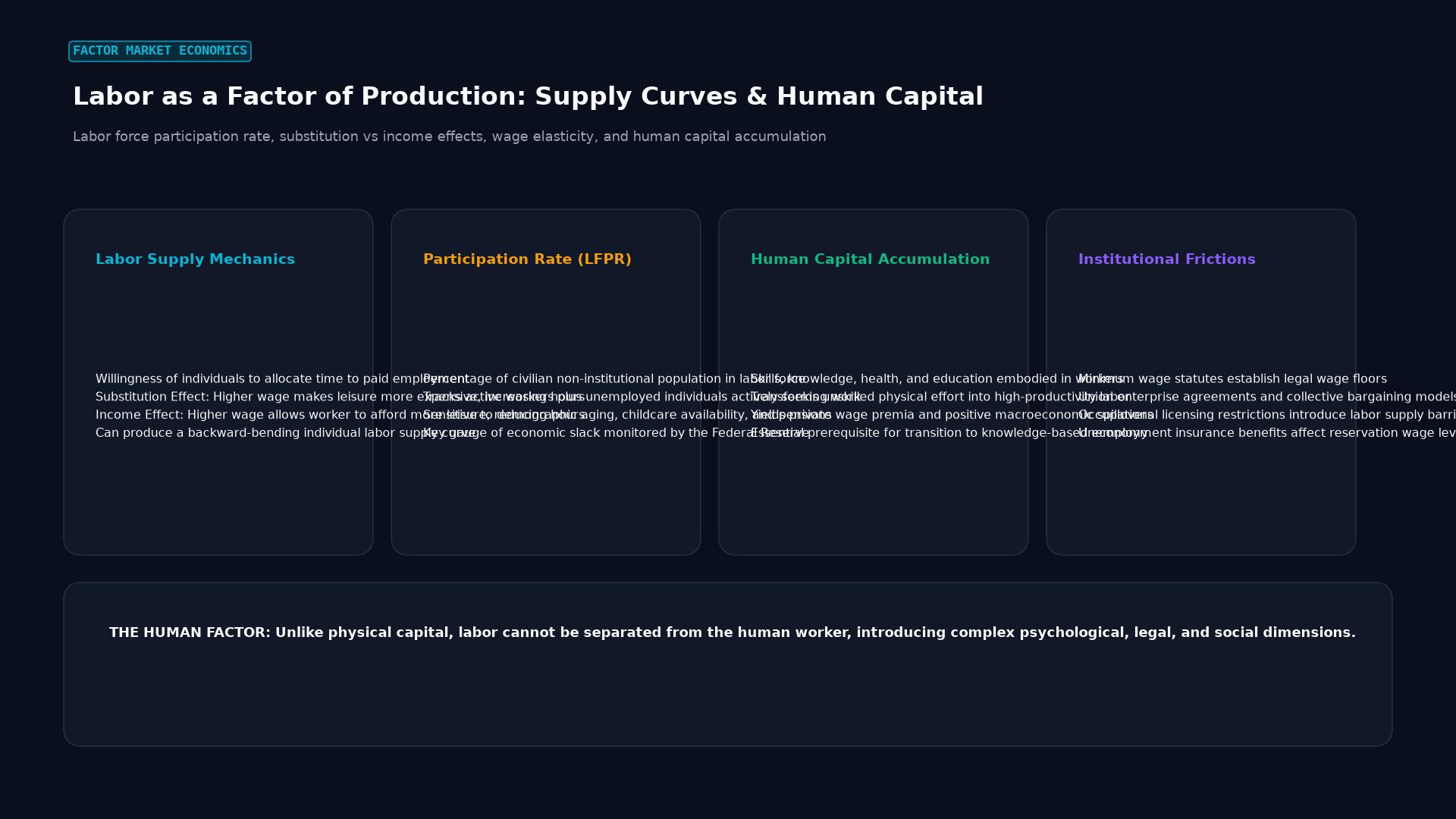 Figure: Labor force participation rate, substitution vs income effects, wage elasticity, and human capital accumulation
The Production Function and Marginal Productivity
Neoclassical economic models formalize the role of labor through aggregate production functions, most famously the Cobb-Douglas production function:
Y = A * K^alpha * L^(1 - alpha)Where:
- $Y$ represents total economic output (Real GDP)
- $A$ represents Total Factor Productivity (technological innovation and organizational efficiency)
- $K$ represents physical capital stock (factories, computers, machinery)
- $L$ represents total labor input (hours worked or employment headcount)
- $\alpha$ and $1 - \alpha$ represent the output elasticities of capital and labor, respectively
The Law of Diminishing Marginal Returns
The Marginal Product of Labor ($MP_L$) measures the additional output generated by adding one incremental unit of labor while holding capital constant:
        delta Y
MP_L = ---------
        delta L
Economic theory dictates that labor is subject to diminishing marginal returns. When a software engineering team or automobile factory adds more workers without expanding workstation capacity, server infrastructure, or machinery, each new worker contributes less incremental output than the worker hired before them.
In a competitive market equilibrium, employers hire workers up to the point where the real wage ($W/P$) equals the marginal product of labor:
  W
 --- = MP_L
  P
If real wages rise faster than labor productivity, corporate operating margins compress, forcing firms to either raise finished product prices (generating consumer inflation) or lay off staff to restore profitability.
Critical Labor Market Indicators
Economists, central bankers, and institutional foreign exchange traders track specific statistical releases to gauge the health of the labor market:
| Indicator | Source | Economic Meaning | Market Sensitivity |
|---|---|---|---|
| Nonfarm Payrolls (NFP) | US Bureau of Labor Statistics (BLS) | Net change in total paid workers across commercial and government sectors (excluding farm staff) | Highest; triggers immediate multi-pip volatility across global forex pairs |
| U-3 Unemployment Rate | BLS Household Survey | Percentage of the active civilian labor force currently jobless and actively seeking work | High; primary benchmark for central bank full-employment mandates |
| U-6 Underemployment Rate | BLS Household Survey | Comprehensive metric including discouraged workers, marginally attached individuals, and involuntary part-time staff | High; reveals hidden slack beneath the headline U-3 rate |
| Labor Force Participation Rate (LFPR) | BLS Household Survey | Proportion of the civilian non-institutional working-age population (16+) currently working or looking for work | Medium-High; signals demographic changes, retirement waves, and structural labor capacity |
| JOLTS Quits Rate | BLS Job Openings Survey | Percentage of employees voluntarily resigning from jobs | High; direct barometer of worker confidence and wage leverage |
| Employment Cost Index (ECI) | BLS Quarterly Report | Independent measure of total employer labor costs (wages plus healthcare, pensions, and payroll taxes) | Extreme; preferred wage inflation gauge utilized by the Federal Reserve |
Labor Market Tightness and the Phillips Curve
The interaction between labor market conditions and consumer price inflation is modeled by the Phillips Curve, which posits an inverse relationship between unemployment and wage inflation.
When unemployment falls below the Non-Accelerating Inflation Rate of Unemployment (NAIRU), employers face acute labor scarcity. To attract and retain qualified workers, companies bid up hourly wages. Workers, flush with higher disposable earnings, increase household spending, bidding up consumer goods prices.
This triggers a potential wage-price spiral: workers demand higher wages to compensate for rising living costs, and employers raise product prices to offset escalating payrolls. Central banks combat this phenomenon by raising policy interest rates, which tightens corporate credit, slows capital expansion, and deliberately cools labor demand.
Impact on Foreign Exchange (Forex) Markets
For currency traders, monthly labor data represents the single most volatile recurring catalyst on the economic calendar.
The release of the US Employment Situation report on the first Friday of every month at 8:30 AM Eastern Time illustrates this direct transmission mechanism:
- Upside Surprise (Hot Jobs Data): If Nonfarm Payrolls expand by 350,000 against a consensus forecast of 180,000, and average hourly earnings climb 0.5% month-over-month, markets interpret the data as signaling persistent domestic demand. Bond yields jump as traders price in Federal Reserve rate hikes or delayed rate cuts. The US Dollar surges against low-yielding currencies (such as the EUR, JPY, and CHF).
- Downside Surprise (Weak Jobs Data): If payrolls miss expectations and unemployment ticks higher, traders anticipate an imminent economic slowdown. Expectations for central bank monetary easing surge, Treasury yields collapse, and the currency depreciates as capital flows toward foreign alternatives.
Labor vs Capital Substitution and Modern Automation
The macroeconomic role of labor is undergoing structural shifts driven by automation, artificial intelligence, and demographic aging:
- Capital-Labor Substitution: As robotics, software automation, and machine learning decline in cost relative to human wages, corporations substitute capital for labor across routine cognitive and manual tasks.
- Labor’s Share of National Income: In most developed economies, the proportion of national income paid out to workers in wages and benefits (the labor share) has exhibited a multi-decade structural decline, dropping from over 65% in the 1970s to roughly 58% to 60% today, with capital owners capturing an expanding share of economic rents.
- Demographic Contraction: Aging populations in Japan, South Korea, Germany, and China are shrinking the raw supply of working-age labor, forcing economies to achieve higher technological productivity to prevent GDP stagnation.
Key Takeaways
- Labor is a foundational factor of production that represents human physical, technical, and cognitive effort dedicated to economic output.
- Labor earnings drive household consumption, which accounts for roughly two-thirds of aggregate GDP in developed consumer economies.
- Neoclassical economics models output using production functions, where employers hire labor until the real wage equals the marginal product of labor.
- Central banks monitor labor slack (unemployment rates, wage growth, JOLTS quits) to anticipate wage-push inflation under the Phillips Curve.
- High-impact labor releases like the US Nonfarm Payrolls report generate substantial immediate volatility across global currency and bond markets.
Frequently Asked Questions
What is the difference between the U-3 and U-6 unemployment rates?
The U-3 rate is the official headline unemployment rate, counting only jobless individuals who are actively looking for work. The U-6 rate is a much broader measure that includes discouraged workers who stopped looking, marginally attached workers, and individuals working part-time because they cannot find full-time positions.
Why does wage growth matter so much to central banks?
Wage growth is the largest component of production costs in service-oriented economies. When wages climb significantly faster than labor productivity, corporations pass those payroll costs onto consumers, embedding inflation into the core economy and forcing central banks to maintain tight monetary policy.
How does labor productivity influence a nation’s standard of living?
Labor productivity (output produced per hour worked) is the primary determinant of long-term real wage growth. An economy can sustainably increase living standards, real wages, and consumption without causing inflation only if worker productivity expands through better technology, education, and capital equipment.
Ready to trade forex?
Open a free demo account with a regulated broker. Practice with virtual funds before risking real money.