Laissez-faire economics
Laissez-faire economics is a free-market doctrine advocating minimal government intervention, deregulation, low taxation, and private property rights, positing that self-regulating market price signals optimize resource allocation more efficiently than state planning.
What Is Laissez-Faire Economics?
Laissez-faire economics is an economic doctrine originating in 18th-century Europe that advocates for the complete or near-complete absence of government intervention in commercial markets. Derived from the French phrase laissez faire, laissez passer (loosely translated as “let it be, let it pass”), the philosophy asserts that competitive market forces, private ownership, and voluntary contractual exchange generate greater societal prosperity and technological innovation than state-directed planning or regulatory mandates.
At its theoretical core, laissez-faire rests on the belief that economic systems possess an inherent capacity for spontaneous self-regulation. When individuals are permitted to pursue their enlightened self-interest without bureaucratic price controls, subsidies, or protective tariffs, the price mechanism coordinates supply and demand with an efficiency no centralized planning committee could ever replicate.
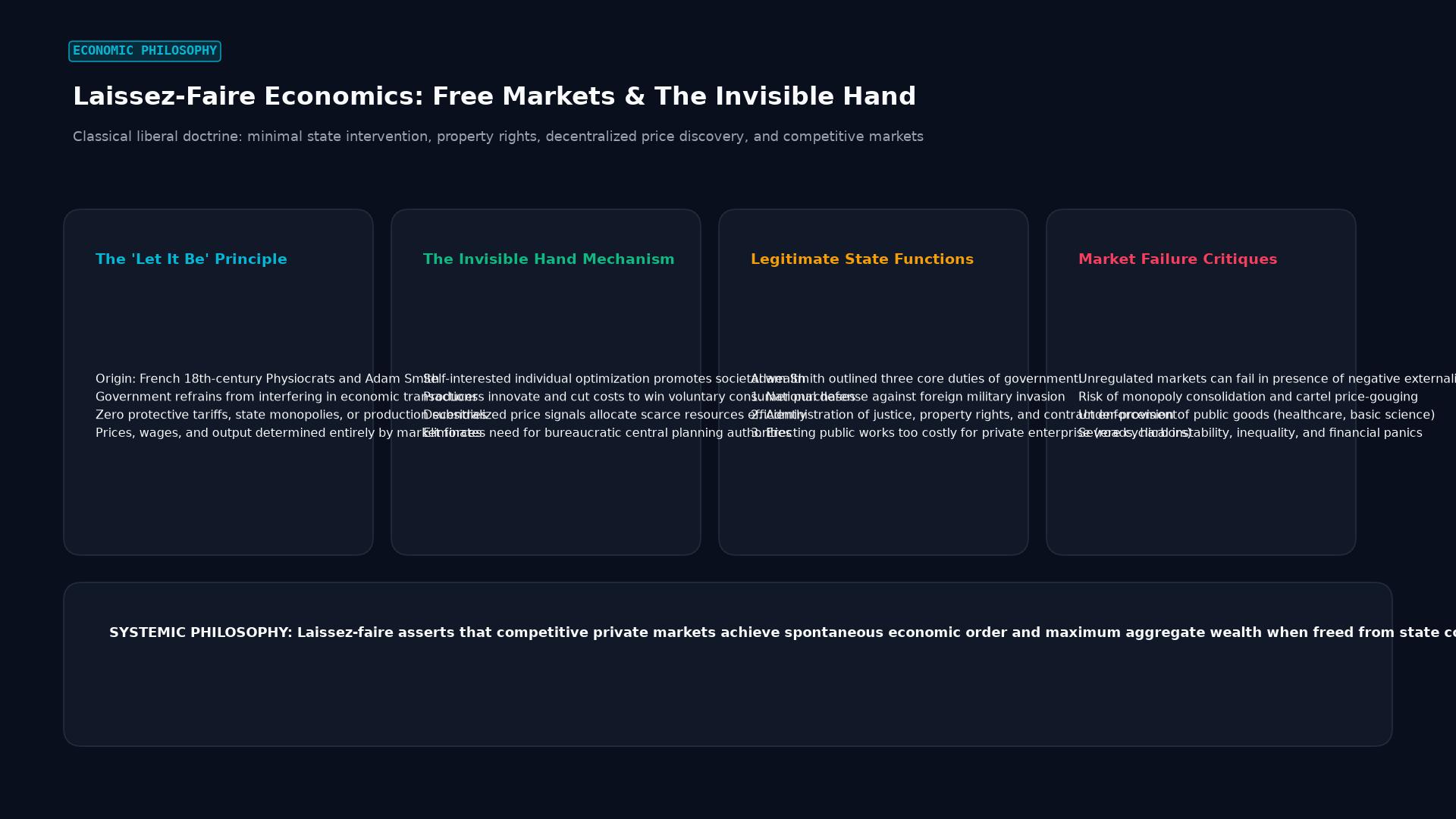 Figure: Classical liberal doctrine: minimal state intervention, property rights, decentralized price discovery, and competitive markets
Historical Origins and Philosophical Foundations
The intellectual pedigree of laissez-faire developed through distinct philosophical movements:
1. The French Physiocrats (18th Century)
The phrase emerged in 1750s France among the Physiocrats, led by François Quesnay and Vincent de Gournay. The Physiocrats opposed the prevailing economic orthodoxy of Mercantilism, which held that national wealth required strict state monopolies, bullion hoarding, and punitive import tariffs. The Physiocrats argued that economic activity followed natural laws that governments disrupted at their peril.
2. Adam Smith and the Invisible Hand (1776)
Scottish philosopher Adam Smith formalized classical market liberalism in his landmark 1776 treatise, The Wealth of Nations. Smith articulated the concept of the invisible hand:
“It is not from the benevolence of the butcher, the brewer, or the baker that we expect our dinner, but from their regard to their own self-interest.”
Smith observed that in a competitive market, individuals seeking private profit are guided to satisfy the needs of others. The baker does not bake bread out of charity; he bakes bread to feed his family. To maximize profits, he must bake delicious, high-quality bread at a price consumers are willing to pay. Market competition aligns private ambition with public welfare.
3. The Austrian and Chicago Schools (20th Century)
During the 20th century, as command economies and Keynesian state interventions spread globally, economists like Friedrich Hayek and Ludwig von Mises (the Austrian School), and Milton Friedman (the Chicago School) mounted a vigorous revival of laissez-faire principles:
- The Knowledge Problem (Hayek): Hayek demonstrated that economic information (individual consumer preferences, local resource scarcities, and shifting production costs) is fragmented across millions of minds. No central planning bureau can collect or process this dispersed data. Floating market prices act as decentralized telecommunications signals that coordinate global trade effortlessly.
- Monetarism and Free Choice (Friedman): Friedman argued that government regulations, occupational licensing, and central bank discretionary fine-tuning frequently create the very economic instability they claim to cure, advocating for deregulation, school choice vouchers, and floating foreign exchange rates.
Core Pillars of a Laissez-Faire Economic System
A pure laissez-faire regime operates upon distinct structural pillars:
| Structural Pillar | Institutional Mechanism | Economic Objective |
|---|---|---|
| Private Property Rights | Legal protection of physical, financial, and intellectual assets | Incentivizes long-term capital investment and wealth preservation |
| Voluntary Contract Law | Impartial judicial enforcement of commercial agreements | Eliminates counterparty uncertainty and fosters cross-border trade |
| Free Price Discovery | Zero price ceilings, price floors, or government rationing | Ensures immediate market clearing without shortages or gluts |
| Free Trade & Open Borders | Elimination of tariffs, import quotas, and export bans | Maximizes comparative advantage and global consumer purchasing power |
| Sound Money | Money backed by real assets or predictable algorithmic supply | Prevents arbitrary inflation tax and preserves capital calculation |
| The Night-Watchman State | Government role limited strictly to defense, police, and courts | Minimizes rent-seeking, corporate lobbying, and regulatory capture |
Comparative Economic Systems
Modern nations exist along a continuous spectrum between unfettered free markets and totalitarian state command:
+-------------------------------------------------------------------------+
|                  ECONOMIC SYSTEMS COMPARISON MATRIX                     |
+-------------------------------------------------------------------------+
|                                                                         |
|  SYSTEM              OWNERSHIP OF CAPITAL   RESOURCE ALLOCATION         |
|                                                                         |
|  Laissez-Faire       100% Private           Decentralized Price Signals |
|  Free Market         (Individuals & Corps)  (Supply & Demand Curves)    |
|                                                                         |
|  Keynesian / Mixed   Predominantly Private  Market Prices with Fiscal   |
|  Social Democracy    with State Utilities   Stimulus & Welfare Nets     |
|                                                                         |
|  State Capitalism    Hybrid (Sovereign      Market Mechanisms Directed  |
|  (Mercantilism)      Funds & State Giants)  Toward Strategic State Goals|
|                                                                         |
|  Command Economy     100% State-Owned       Central Five-Year Plans     |
|  (Marxist-Leninist)  (Collectivized)        Set by Government Bureaus   |
|                                                                         |
+-------------------------------------------------------------------------+
Classical Critiques and Market Failures
While laissez-faire economics champions efficiency and liberty, modern economic science recognizes critical failure modes where unfettered markets break down:
1. Externalities and Environmental Costs
Arthur Pigou demonstrated that free markets fail when third parties suffer uncompensated costs. If a chemical refinery dumps toxic effluents into a public river to lower its production costs, market prices do not reflect the true environmental damage. Without state environmental standards or corrective Pigouvian taxes, the free market overproduces pollution.
2. Natural Monopolies and Cartels
In industries with massive fixed infrastructure costs (such as electrical grids, railway tracks, or telecommunications fiber), natural monopolies emerge. In the absence of antitrust enforcement (such as the Sherman Antitrust Act), dominant monopolies can crush competition, restrict supply, and extract predatory monopoly rents from consumers.
3. Public Goods and Free-Rider Problems
Public goods (such as national defense, lighthouses, clean air, and basic scientific research) are non-excludable (one cannot stop non-payers from benefiting) and non-rival (one person’s use does not diminish another’s). Private firms cannot profitably monetize these assets, requiring state funding through general taxation.
4. Asymmetric Information and Adverse Selection
George Akerlof and Joseph Stiglitz proved that when sellers possess critical information hidden from buyers (such as in health insurance, used cars, or complex structured derivatives), markets can collapse into adverse selection spirals, necessitating mandatory statutory disclosures like SEC Form 10-K filings and consumer safety rules.
Key Takeaways
- Laissez-faire economics is a classical doctrine advocating minimal government intervention, deregulation, low taxes, and private property rights.
- The philosophy originated with 18th-century French Physiocrats and was formalized in Adam Smith’s concept of the self-regulating invisible hand.
- Free-market prices act as decentralized information carriers that coordinate supply and demand without central planning.
- The night-watchman state model limits sovereign authority strictly to national defense, domestic police, and contract law enforcement.
- Recognized market failures including environmental externalities, natural monopolies, and asymmetric information justify targeted regulatory interventions in modern mixed economies.
Frequently Asked Questions
Has a pure laissez-faire economy ever existed in modern history?
The closest historical approximations occurred during the 19th-century Industrial Revolution in Great Britain and the United States (the Gilded Age). Even then, governments levied import tariffs, granted land subsidies to transcontinental railroads, and enforced patent laws. Today, virtually all developed economies operate as mixed economies.
How does laissez-faire differ from modern libertarianism?
Laissez-faire is strictly an economic theory concerning commercial markets, production, and trade. Libertarianism is a broader political philosophy that incorporates laissez-faire economics while extending the principle of individual autonomy to civil liberties, free speech, privacy, and foreign policy non-intervention.
Why do free-market economists oppose government price controls?
When governments impose price ceilings (capping prices below equilibrium), producers cut output while consumer demand surges, generating chronic shortages, long lines, and black markets. When governments impose price floors (such as agricultural price supports), supply outstrips demand, creating wasteful surpluses that must be subsidized by taxpayers.
Ready to trade forex?
Open a free demo account with a regulated broker. Practice with virtual funds before risking real money.