Loans from Co-operative Bank
Loans from cooperative banks are credit facilities disbursed by member-owned financial cooperatives to finance agriculture, rural development, micro-enterprises, and retail borrowers under cooperative principles and dual regulatory oversight.
What Are Loans from Co-operative Banks?
Loans from cooperative banks represent specialized credit facilities advanced by member-owned, democratic financial institutions operating on the foundational principle of mutual self-help: “one member, one vote”. Unlike traditional commercial banks that are structured as joint-stock corporations driven to maximize shareholder return on equity, cooperative banks are established to provide affordable credit, capital mobilization, and banking services to their member-borrowers.
Cooperative banking systems are particularly prominent across developing and emerging economies, including India, Germany (the Genossenschaftsbanken / Volksbanken network), Japan (the Norinchukin and Shinkin bank networks), and the United Kingdom. In these markets, cooperative bank loans serve as the lifeblood of rural agriculture, smallholder farming communities, cottage industries, and urban micro-enterprises that traditional multinational commercial banks often overlook due to high administrative servicing costs and lack of formal corporate collateral.
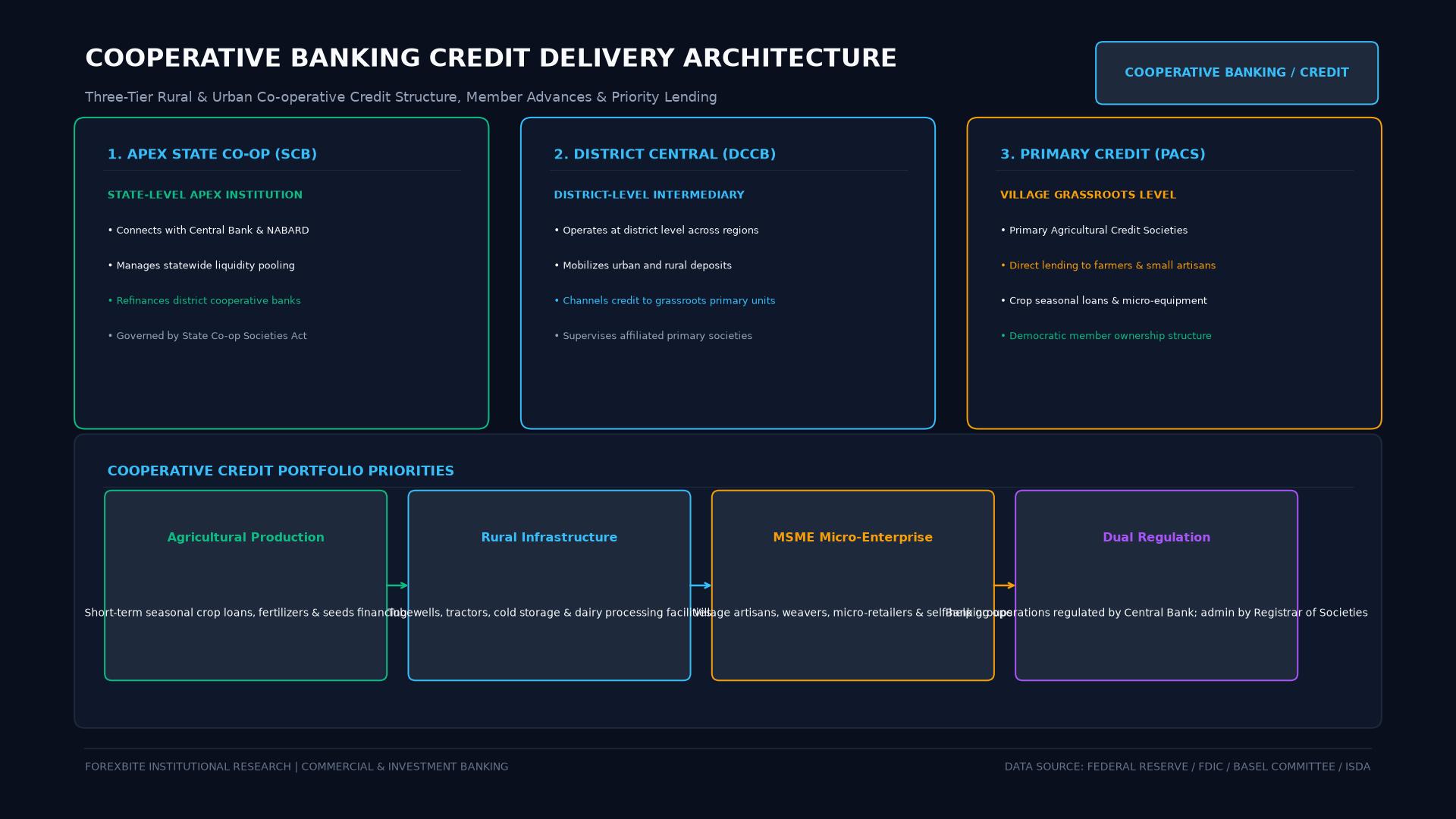 Figure: Member-owned co-operative credit model: mutual capital pooling, subsidized agricultural and community lending, and tiered governance.
The Structural Hierarchy of Cooperative Lending
In extensive jurisdictions like India, cooperative credit is organized into two distinct operational streams: rural credit and urban credit.
1. The Three-Tier Short-Term Rural Credit Structure
Rural agricultural lending functions through an interconnected three-tier pyramid:
- State Cooperative Banks (StCBs): The apex institutional body at the state level. It interfaces directly with the central monetary authority and agricultural development banks (such as NABARD), mobilizing wholesale refinancing funds and balancing liquidity across district banks.
- District Central Cooperative Banks (DCCBs): Operating at the district level, DCCBs function as federations of primary societies. They supervise rural credit societies, accept municipal deposits, and channel funds to village units.
- Primary Agricultural Credit Societies (PACS): The grassroots, village-level institutions directly accessible to rural farmers. PACS disburse seasonal crop loans, provide subsidized agricultural inputs (such as fertilizers and seeds), and collect repayments following harvest cycles.
2. Urban Cooperative Banks (UCBs)
Urban Cooperative Banks operate as single-tier or multi-branch financial entities in metropolitan, municipal, and semi-urban centers. They extend retail credit, including home purchase loans, education loans, gold loans, and working capital lines to urban micro, small, and medium enterprises (MSMEs).
Primary Types of Cooperative Bank Loans
Cooperative banks structure their loan portfolios around specialized socio-economic needs:
| Loan Category | Target Recipient | Typical Structure & Collateral | Primary Purpose |
|---|---|---|---|
| Short-Term Crop Loans | Cultivators and tenant farmers | Repayable post-harvest; secured by anticipated crop yield | Seeds, fertilizers, diesel, pesticides, and seasonal labor |
| Medium-Term Farm Loans | Agriculturalists and dairy farmers | 3 to 5 year amortization; secured by land mortgage or equipment | Purchase of tractors, drip irrigation pumps, and livestock |
| Gold Loans | Rural and semi-urban households | Short tenor (6 to 12 months); secured by physical gold jewelry | Emergency liquidity, medical bills, or working cash flow |
| MSME Micro-Loans | Traders, artisans, small shopkeepers | Cash credit facilities or overdrafts secured by inventory | Inventory replenishment and commercial receivables |
| Self-Help Group (SHG) Loans | Women’s microfinance collectives | Group liability; peer-guaranteed without physical collateral | Micro-entrepreneurship, sewing centers, food processing |
Priority Sector Lending (PSL) Mandates
Cooperative bank loans are heavily conditioned by sovereign Priority Sector Lending (PSL) regulations. Central monetary authorities mandate that financial institutions direct a predetermined percentage of their lending to vulnerable economic sectors.
For instance, the Reserve Bank of India (RBI) mandates that Urban Cooperative Banks allocate up to 75% of their Adjusted Net Bank Credit (ANBC) or credit-equivalent amount of off-balance-sheet exposure to priority sectors, including:
- Small and marginal agriculture
- Micro, small, and medium enterprises (MSMEs)
- Affordable housing for low-income segments
- Education and clean social infrastructure
This high PSL allocation ensures that cooperative bank deposits remain invested directly in local community development rather than being drained into speculative financial market instruments.
Comparison: Cooperative Bank Loans vs Commercial Bank Loans
| Dimension | Cooperative Bank Loans | Commercial Joint-Stock Bank Loans |
|---|---|---|
| Institutional Governance | Democratic member control (one member, one vote) | Corporate equity control (votes proportional to shares) |
| Primary Mandate | Socio-economic development of members | Shareholder profit maximization and return on equity |
| Underwriting Philosophy | Community relationships, peer knowledge, local collateral | Algorithmic credit scoring, audited corporate financials |
| Interest Rate Structure | Often subsidized by state programs or capped by policy | Market-driven risk-adjusted pricing models |
| Customer Accessibility | Deep presence in remote rural and small-town areas | Concentrated in major urban and industrial centers |
Regulatory Oversight and the Dual-Control Challenge
Historically, cooperative banks faced a significant structural vulnerability known as the dual-regulation problem:
- Registrars of Cooperative Societies (RCS): State government departments governed the incorporation, registration, board elections, management audits, and liquidation of cooperative banks.
- Central Monetary Authorities (e.g., Central Banks): Regulated banking licenses, interest rate guidelines, capital adequacy norms, and statutory liquidity requirements.
This division of authority frequently led to political interference, regulatory arbitrage, delayed supervisory interventions, and loan-waiver expectations that damaged asset quality. In response, modern financial reforms (such as the Banking Regulation (Amendment) Act in India) have transferred sweeping supervisory powers over Urban Cooperative Banks directly to central banks, granting authorities the legal power to supersede corrupt management boards, enforce prompt corrective action (PCA) frameworks, and mandate rigorous Non-Performing Asset (NPA) provisioning rules.
Key Takeaways
- Loans from cooperative banks are credit facilities extended by member-owned financial cooperatives governed by democratic principles.
- Lending is structured through tiered rural architectures (PACS, DCCBs, StCBs) for agriculture and Urban Cooperative Banks (UCBs) for small businesses.
- Loan offerings center on short-term crop loans, agricultural machinery financing, MSME working capital, and gold loans.
- Cooperative banks operate under strict Priority Sector Lending (PSL) quotas, often allocating up to 75% of credit to community development.
- Ongoing regulatory reforms are eliminating dual-control loopholes, bringing cooperative credit under standardized central bank prudential oversight.
Frequently Asked Questions
Must a borrower become a member of a cooperative bank to get a loan?
Yes, in the vast majority of jurisdictions, borrowing from a cooperative bank requires obtaining membership. Borrowers purchase a nominal share or pay an entrance fee to become a member or nominal member, which grants them borrowing rights and voting participation in annual general meetings.
What is a Kisan Credit Card (KCC) loan?
A Kisan Credit Card loan is a specialized revolving agricultural credit facility offered extensively by cooperative banks. It provides farmers with a pre-approved credit limit on a debit card, allowing them to draw funds flexibly for seasonal crop seeds, fertilizer, and harvest expenses at concessional interest rates.
What happens if an agricultural borrower defaults on a cooperative loan due to drought?
When natural disasters or severe droughts strike, cooperative banks, under government guidelines, typically execute loan restructuring. Short-term crop loans are converted into medium-term loans spread across three to five years, interest payments are temporarily deferred, and fresh working capital credit lines are extended for the subsequent planting season.
Ready to trade forex?
Open a free demo account with a regulated broker. Practice with virtual funds before risking real money.