Loans
A loan is a legally binding debt contract where a lender disburses a defined principal amount to a borrower, who commits to repaying the principal alongside interest, finance charges, and fees according to a structured amortization schedule.
What Is a Loan?
A loan is a formal contractual debt agreement in which one party (the lender or creditor) transfers a specific principal sum of money or economic assets to another party (the borrower or debtor). In exchange for immediate purchasing power, the borrower enters into a legally enforceable obligation to repay the principal amount over a designated maturity term, along with interest, administrative finance charges, and operational fees that compensate the creditor for time preference, inflation erosion, and default risk.
Loans form the bedrock of the global fractional-reserve banking system. Commercial banks, credit unions, institutional direct lenders, and sovereign export credit agencies expand money supply and drive real economic activity by evaluating creditworthiness, pricing borrower default risk, and allocating loan capital across consumer, commercial, and sovereign sectors.
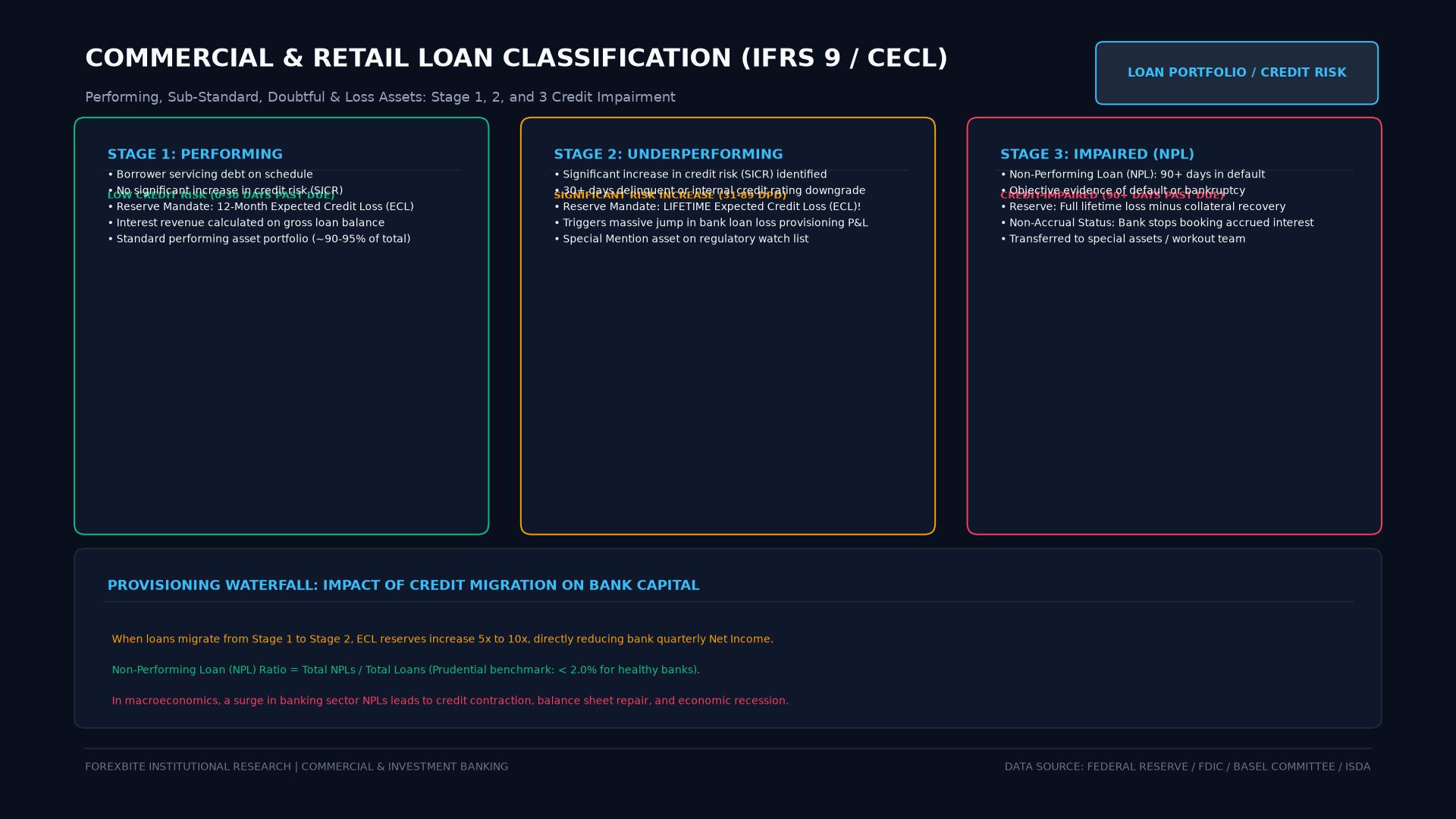 Figure: Banking credit classification taxonomy: secured vs unsecured loans, revolving vs non-revolving credit, repayment waterfalls, and credit risk rating tiers.
Essential Anatomical Components of a Loan Contract
Every institutional loan contract is constructed upon foundational contractual building blocks:
1. Principal Amount
The principal represents the face value of the loan disbursed to the borrower, excluding accrued interest and origination fees. It establishes the baseline debt balance upon which periodic interest charges are calculated.
2. Interest Rate Structure
Interest constitutes the rent paid on borrowed money:
- Fixed-Rate Loans: The nominal interest rate remains static for the entire duration of the loan tenor, shielding the borrower from interest rate hikes but preventing savings if central bank rates drop.
- Floating-Rate (Variable) Loans: The interest rate adjusts periodically based on a benchmark interbank reference rate plus an agreed credit risk margin (such as SOFR + 275 basis points or Euribor + 300 basis points).
3. Tenor and Maturity Date
The tenor defines the total operational lifespan of the credit agreement, concluding at the maturity date when all remaining principal and outstanding interest must be fully satisfied. Tenors range from overnight facilities in commercial paper markets to 30-year residential mortgage bonds.
4. Amortization Schedule
The repayment mechanism dictates how cash flows are distributed over time:
- Fully Amortizing: Regular periodic payments cover both accrued interest and a portion of principal, completely reducing the loan balance to zero at final maturity.
- Balloon (Bullet) Repayment: Periodic payments cover interest only (or modest partial amortization), leaving a large principal “balloon” due in full on the final maturity date.
Classification by Collateral and Priority
Loans occupy distinct positions across the risk spectrum based on collateral security and insolvency priority:
| Loan Classification | Collateral / Backing | Priority in Liquidation | Typical Pricing (Yield) |
|---|---|---|---|
| Senior Secured Loans | First-lien pledge on physical assets, inventory, or receivables | First priority claim; paid first from asset liquidation | Lowest risk spread (SOFR + 150 to 350 bps) |
| Second-Lien Debt | Subordinated pledge on the same collateral pool | Paid only after first-lien obligations are 100% satisfied | Moderate spread (SOFR + 500 to 750 bps) |
| Unsecured Commercial Debt | General corporate creditworthiness; no specific asset lien | General unsecured creditor standing in bankruptcy | Higher fixed coupons or wider floating spreads |
| Mezzanine / Subordinated | Subordinated debt, often bundled with equity warrants | Junior to all secured and general senior creditors | High blended yield (12% to 18% total IRR) |
| Consumer Signature Loans | Personal income and credit score (unsecured) | Subordinated to secured mortgages and auto liens | Highest risk-adjusted retail interest rates |
Loan Covenants: Risk Protection Mechanisms
Institutional credit agreements enforce protective contractual boundaries known as covenants to ensure the borrower maintains financial health throughout the life of the loan:
1. Affirmative Covenants
Mandatory operational obligations that the borrower must perform, such as maintaining commercial property insurance, remitting corporate taxes, complying with environmental laws, and submitting quarterly audited financial statements (Form 10-Q / 10-K).
2. Negative Covenants
Contractual prohibitions that restrict management actions without prior lender approval. Common negative covenants include limits on incurring additional indebtedness, restrictions on selling core business assets, prohibitions against issuing cash dividends to shareholders, and caps on annual corporate mergers and acquisitions.
3. Financial Maintenance Covenants
Quantitative balance sheet ratios that the borrower must maintain at each quarterly fiscal testing date:
- Debt Service Coverage Ratio (DSCR): Typically requires Net Operating Income to exceed total debt service by at least 1.25x:
        Net Operating Income (NOI)
DSCR = ---------------------------- >= 1.25
Principal + Interest Payments- Leverage Ratio: Mandates that Total Debt divided by EBITDA cannot exceed an agreed ceiling (such as 4.50x).
Breaching a financial covenant constitutes a technical event of default, empowering the lender to freeze credit drawdowns, raise interest margins, or accelerate the note to demand immediate full repayment.
Regulatory Capital and Basel III Credit Risk Weighting
Under global banking regulations established by the Basel Committee on Banking Supervision (Basel III and Basel 3.1), commercial banks cannot issue loans without holding designated regulatory capital buffers.
Banks calculate their Credit Risk-Weighted Assets (RWA) to determine how much Tier 1 Common Equity (CET1) capital must be reserved against their loan portfolios. Under the Internal Ratings-Based (IRB) approach, institutions calculate expected credit losses using quantitative probability models:
Expected Loss (EL) = PD * LGD * EADWhere:
- Probability of Default (PD): The statistical likelihood that the borrower will default over a one-year economic horizon.
- Loss Given Default (LGD): The percentage of the loan balance that the bank expects to lose if default occurs, accounting for collateral recovery and liquidation costs.
- Exposure at Default (EAD): The gross dollar amount of credit expected to be drawn at the exact moment of borrower default.
Higher-risk unsecured consumer loans carry risk weights of 100% to 150%, demanding substantial capital reserves, whereas conservative first-lien residential mortgages carry lower risk weights of 20% to 35%, encouraging banks to maintain high allocations to secured real estate lending.
Key Takeaways
- A loan is a legally binding contract where a creditor disburses principal in exchange for structured repayment of principal and interest.
- Loans range from senior secured first-lien bank debt to unsecured credit lines and deeply subordinated mezzanine facilities.
- Credit agreements protect lenders through affirmative covenants, negative covenants, and quantitative financial maintenance ratios like DSCR.
- Basel III standards require banks to hold regulatory Tier 1 capital proportional to risk-weighted assets derived from Expected Loss modeling ($EL = PD \times LGD \times EAD$).
- Commercial bank loan creation acts as the primary transmission mechanism for monetary policy and economic capital formation.
Frequently Asked Questions
What is the difference between a term loan and a revolving line of credit?
A term loan disburses a lump sum of principal upfront that the borrower amortizes over a fixed multi-year period without the ability to re-borrow repaid principal. A revolving line of credit (such as a corporate revolver or credit card) allows the borrower to draw funds, repay balances, and draw again repeatedly up to a pre-approved credit ceiling.
What is an acceleration clause in a loan agreement?
An acceleration clause is a contractual provision that gives the lender the legal right to demand immediate, full repayment of the entire outstanding loan principal and accrued interest if the borrower triggers a material event of default, such as missing scheduled payments or filing for bankruptcy.
How does loan syndication work in corporate finance?
In syndicated lending, a lead investment bank (the administrative agent) structures a massive loan facility (often $500 million to several billion dollars) for a major corporation or private equity buyout. The lead bank syndicates slices of the loan to dozens of participating commercial banks, institutional collateralized loan obligations (CLOs), and pension funds, dispersing credit risk across global capital markets.
Ready to trade forex?
Open a free demo account with a regulated broker. Practice with virtual funds before risking real money.