Long
A long position refers to the purchase of a financial instrument, currency, or derivative contract with the anticipation that its market value will appreciate, allowing the trader to liquidate the asset at a higher price to realize a profit.
What Is a Long Position?
In financial markets, holding a long position (or going long) represents an ownership or speculative commitment entered into by purchasing an asset with the expectation that its price will rise over time. Whether investing in equities, commodities, or bonds, an investor with a long position possesses positive market exposure (positive delta), realizing capital gains when prices ascend and incurring losses when prices decline.
In the foreign exchange (Forex) market, where currencies are quoted in pairs ($\text{Base Currency} / \text{Quote Currency}$), a long position has a dual nature:
- When you execute a “Buy” order on EUR/USD, you are simultaneously going long the base currency (Euro) and going short the quote currency (U.S. Dollar).
- You profit if the Euro strengthens relative to the Dollar, or if the Dollar weakens relative to the Euro.
- Conversely, if you expect the U.S. Dollar to strengthen against the Euro, you would not buy EUR/USD; you would sell it (going short the pair).
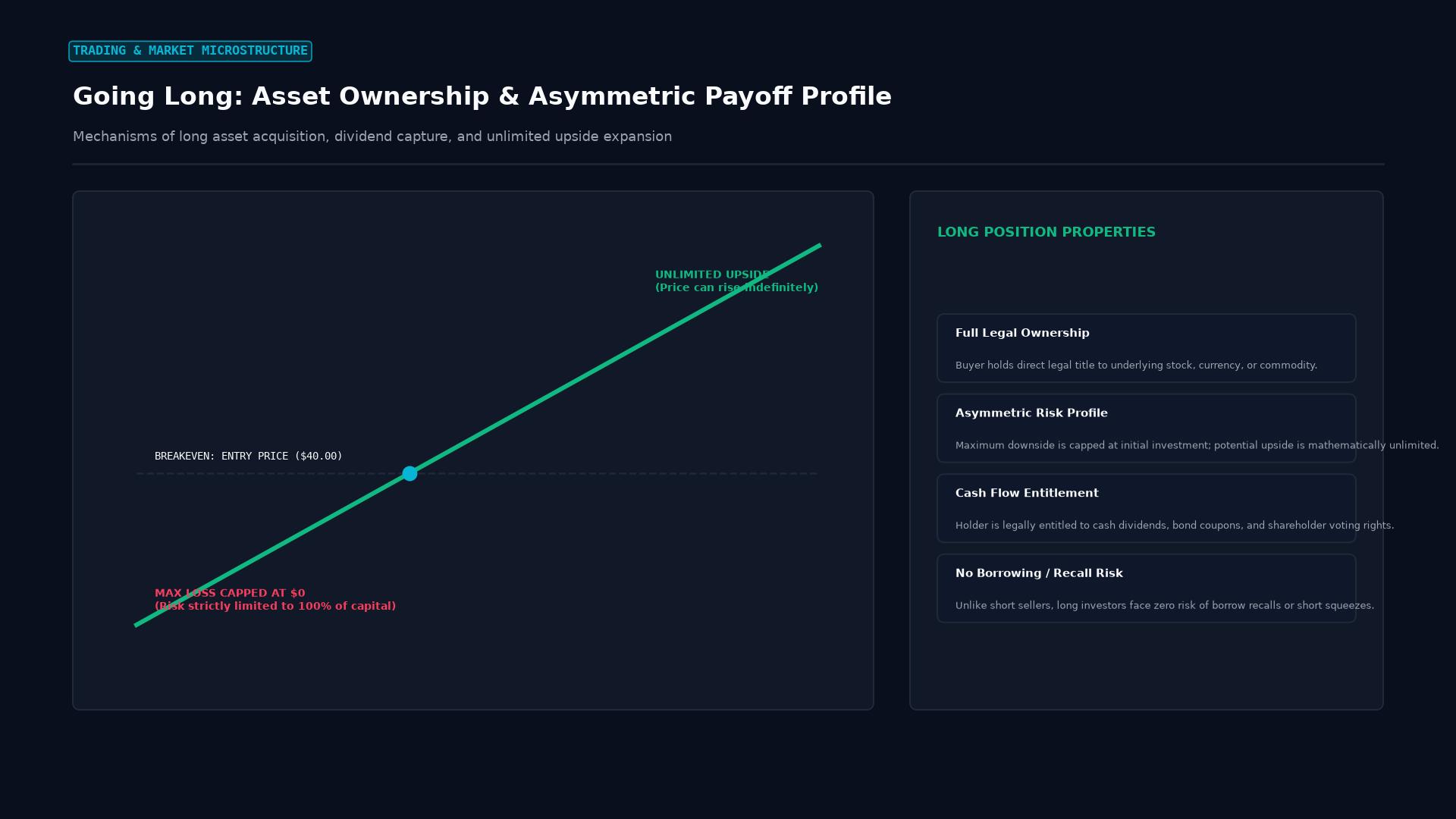 Figure: Financial payoff architecture of a long asset position: linear capital upside, downside risk limited to capital, and carry yield dynamics.
Key Takeaways
- Directional Bias: A long position reflects a bullish market sentiment toward the underlying asset or base currency.
- Base/Quote Mechanics: Buying a currency pair always means purchasing the base currency (left) by borrowing or exchanging the quote currency (right).
- Profit & Loss Formula: In linear cash and spot markets, P&L is calculated as $\text{P&L} = (\text{Exit Price} - \text{Entry Price}) \times \text{Position Size}$.
- Carry & Rollover Swaps: Holding a long forex position overnight incurs or earns a daily financing swap, determined by the central bank interest rate differential between the base and quote currencies.
- Asymmetric Risk Profile (Spot vs. Derivatives): In physical equity or cash asset ownership, maximum downside risk is mathematically capped at 100% (the asset price cannot drop below $0.00), while upside potential is theoretically infinite. In leveraged margin trading, however, losses can exceed deposited capital if not managed with stop-losses.
Comparative Taxonomy: Long vs. Short Positioning
| Trading Dimension | Long Position (Buy) | Short Position (Sell) |
|---|---|---|
| Market Outlook | Bullish (expecting prices to rise) | Bearish (expecting prices to fall) |
| Forex Action (Base/Quote) | Buy Base / Sell Quote | Sell Base / Buy Quote |
| Order Execution | Executed at the Ask (Offer) price | Executed at the Bid price |
| Position Liquidation | Closed by selling at the Bid | Closed by buying at the Ask |
| Positive Carry Condition | Base interest rate > Quote interest rate | Quote interest rate > Base interest rate |
| Theoretical Risk (Unleveraged) | Capped at 100% of invested capital | Theoretically infinite (no ceiling on price) |
Practical Application: The Long Carry Trade
A prominent institutional application of long positioning in foreign exchange is the Currency Carry Trade.
- Macro Setup: The Reserve Bank of Australia (RBA) sets interest rates at 4.35%, while the Bank of Japan (BOJ) maintains near-zero rates at 0.10%.
- Execution: An institutional fund goes Long AUD/JPY by purchasing AUD 10,000,000 against Japanese Yen at 98.00.
- The Dual Profit Engine:
- Capital Appreciation: If global risk appetite expands and the AUD appreciates against the Yen toward 102.00, the fund captures substantial capital gains.
- Positive Swap Yield: Every day at the 5:00 PM EST interbank rollover cut, the fund collects the positive interest rate differential (approximately 4.25% annualized net yield), credited directly to the account balance.
- Exit: After 180 days, the fund liquidates the long AUD/JPY position at 101.50, realizing both a 350-pip spot profit and over $200,000 in accrued carry interest.
Critical Risk Considerations for Long Positions
- Overnight Swap Drag (Negative Carry): If you hold a long position in a currency pair where the base currency pays a significantly lower interest rate than the quote currency (e.g., Long EUR/USD when USD rates are 5.25% and EUR rates are 3.75%), your account balance will be debited daily for financing costs. Over months, negative carry can erase profits from a correct directional trade.
- Bear Market Drawdowns: In prolonged macro downtrends, attempting to “catch a falling knife” by entering long positions without technical confirmation can lead to compounding margin calls.
- Execution Spread Cost: Long positions must cross the bid-ask spread at entry, buying at the higher Ask quote. A trade begins with an immediate floating loss equal to the broker’s spread.
Frequently Asked Questions (FAQ)
Can I go long on a currency if I only have USD in my account?
Yes. Modern forex brokers utilize automated margin systems. If your trading account is denominated in USD and you buy GBP/JPY, the broker automatically handles the internal currency conversions and margin calculations behind the scenes.
What is the difference between going long a stock and going long a currency pair?
When you go long a stock, you purchase an absolute equity share in a single corporation. When you go long a forex pair, you are executing a relative trade: buying one country’s currency while simultaneously selling another country’s currency.
How do I close a long position?
To close a long position, you execute a sell transaction for the identical volume of the open contract. In modern trading software, this is performed by clicking “Close Position” or by hitting an automated Take-Profit or Stop-Loss order.
Ready to trade forex?
Open a free demo account with a regulated broker. Practice with virtual funds before risking real money.