Bull Market
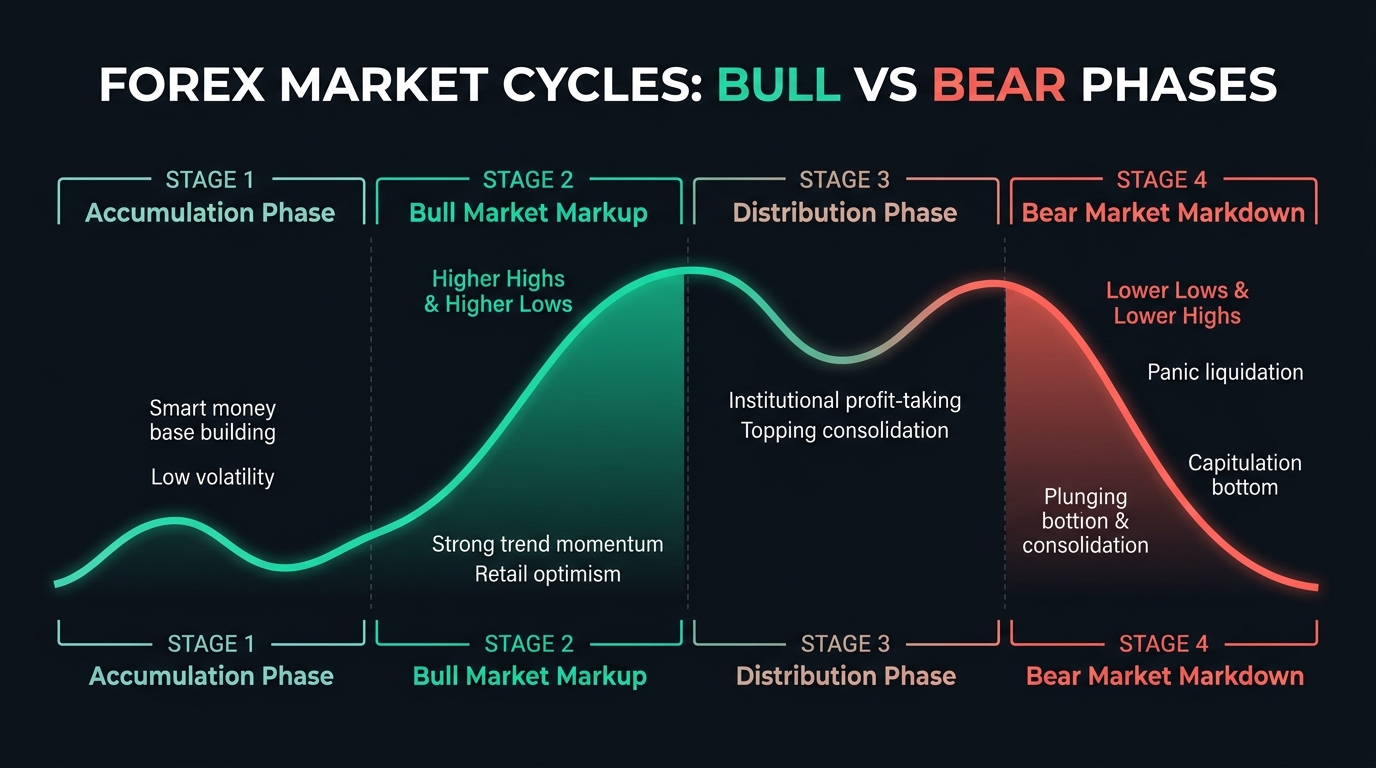
A bull market is a sustained period of rising prices characterized by increasing demand, positive sentiment, and a series of higher highs and higher lows on the price chart. In forex, the term applies to individual currency pairs — a bullish EUR/USD environment means the euro is consistently strengthening against the dollar over weeks or months, driven by fundamental or technical tailwinds.
What Makes a Forex Market Bullish
Bull markets in forex are not about the market as a whole — they’re about specific currency relationships. EUR/USD can be in a sustained bull market (euro strengthening) while GBP/USD is flat or declining. This pair-specific nature requires traders to identify which currencies are trending strongly rather than making broad pronouncements about market direction.
The driving forces behind sustained currency bull markets are fundamentally the same in every cycle, though the mix varies:
Rate advantage: The most consistent driver. When one central bank is raising rates faster than another, capital flows toward the higher-yielding currency. The dollar’s 2022-2023 bull run against most peers was almost entirely explained by the Fed’s aggressive hiking cycle creating an overwhelming yield advantage.
Strong growth differentials: A country whose economy is growing significantly faster than its trading partners tends to see its currency strengthen as investment flows in to capture better returns.
Risk appetite: In “risk-on” environments — when investors are confident and seeking yield — higher-yielding currencies (AUD, NZD, emerging market currencies) tend to rally against safe havens (USD, CHF, JPY). Global equity bull markets often coincide with weakness in safe-haven forex.
Commodity price cycles: For commodity-linked currencies (AUD for iron ore and coal; CAD for oil; NOK for oil; NZD for agricultural commodities), a sustained rally in the underlying commodity creates a structural tailwind for the currency.
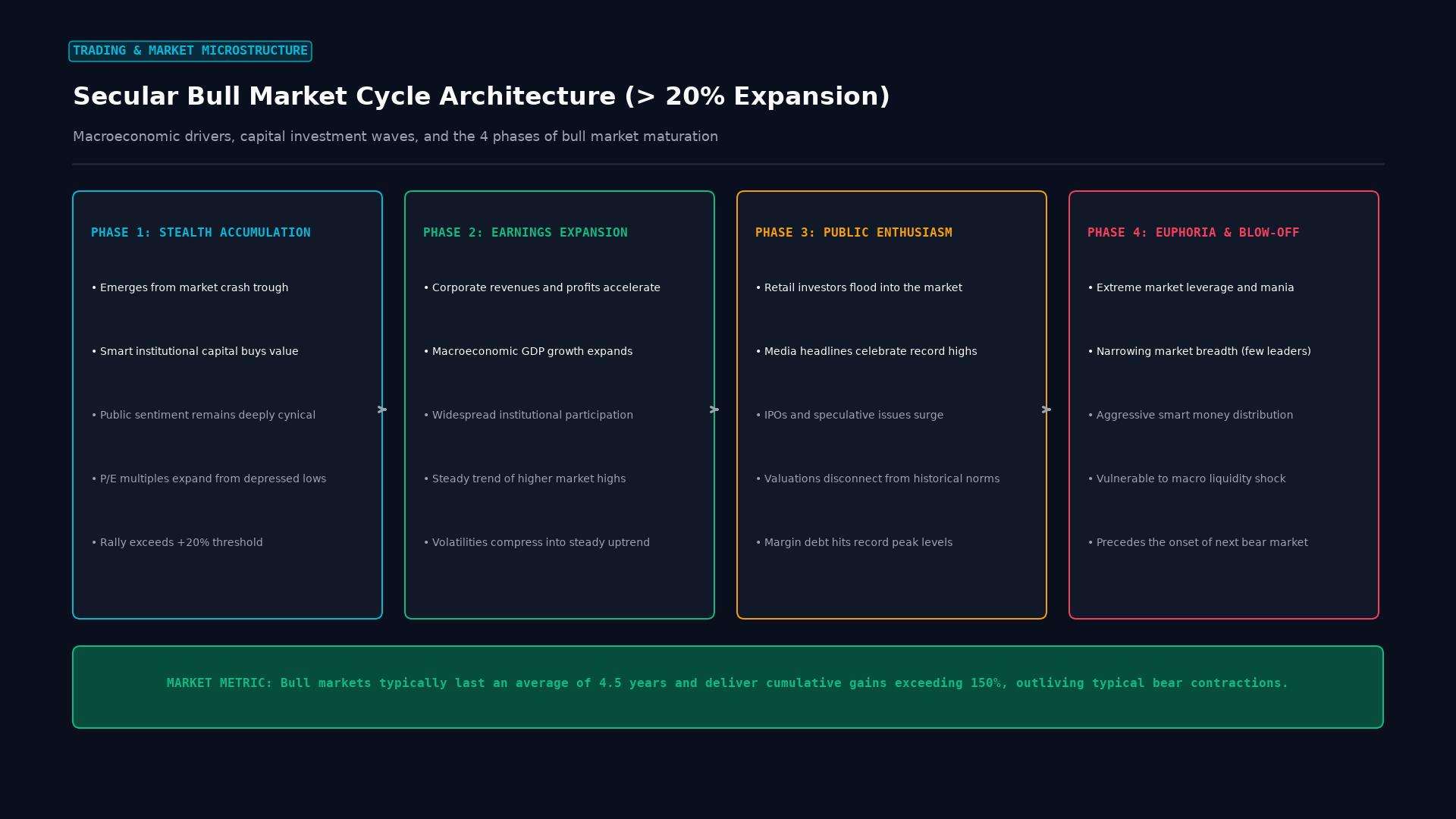 Figure: The four evolutionary stages of a macro bull market: stealth accumulation, corporate earnings expansion, public retail participation, and euphoric blow-off top.
The Chart Anatomy of a Forex Bull Market
A genuine bull market has a recognizable structure visible on higher timeframe charts (daily and weekly):
Higher highs: Each new peak in price exceeds the previous peak.
Higher lows: Each pullback holds above the previous pullback low. This is the crucial confirmation — a bull market without higher lows is simply choppy noise.
Moving average alignment: The 20 EMA is above the 50 SMA, which is above the 200 SMA, and all three are pointing upward. When all three moving averages align in sequence, the trend across short, intermediate, and long-term horizons is unified.
Pullbacks to support hold: Dips to the 20 EMA or prior breakout levels are bought. The market absorbs selling and resumes higher. Each successful support test reinforces the bull trend.
How to Trade a Forex Bull Market
The cardinal rule: trade in the direction of the trend. Countertrend shorts in a strong bull market is one of the most reliable ways to lose money consistently.
The optimal strategy: identify the trend, wait for a pullback, and buy the dip at a support level.
Specific entries:
- Moving average pullback: Price pulls back to the rising 20 EMA or 50 SMA, shows a bullish reversal candlestick (hammer, bullish engulfing), then enter long with stop below the candle low
- Broken resistance retested as support: After a significant breakout, wait for price to pull back to the broken level and confirm it’s now holding as support before entering
- Fibonacci retracement buys: In a strong uptrend, pullbacks often find support at the 38.2% or 50% retracement of the prior swing — entry there with stop below the 61.8%
Bull Market Sentiment Signals
Beyond price structure, sentiment indicators can confirm a bull market’s health:
Commitment of Traders (COT) report: Large speculator positioning in futures markets (published weekly by the CFTC) shows whether institutional money is net-long a currency — a key bull market confirmation.
Carry trade demand: Active carry trade interest (borrowing low-yield currencies to buy high-yield) indicates market confidence and is itself a self-reinforcing positive for the carry currency.
Consumer/business confidence: Bull markets in the domestic economy (high consumer confidence, rising PMI) tend to reinforce currency bull markets through their impact on central bank policy expectations.
Key Takeaways
- Forex bull markets are pair-specific — identify which currencies are trending, not the whole market
- Structural confirmation: higher highs AND higher lows, moving average alignment upward
- Primary drivers: interest rate advantage, growth differentials, risk-on flows, commodity cycles
- Best strategy: buy pullbacks at support in the direction of the established trend
- Trade with the trend — countertrend shorts in a strong bull market are consistently unprofitable
FAQ
How do I know when a bull market is ending? Watch for: the first significant lower high (breaking the uptrend structure), bearish divergence on weekly RSI or MACD, a breakdown below the rising 200 SMA, and a shift in central bank language from hawkish to neutral. No single signal is definitive — look for confluence of multiple warnings.
Can a currency pair be bullish on one timeframe and bearish on another? Yes, absolutely. EUR/USD might be in a bearish daily trend (lower highs, lower lows over 3 months) while showing a bullish 4-hour trend within a corrective rally. Multi-timeframe analysis is the tool for reconciling these apparent contradictions — the higher timeframe trend takes precedence for trade direction bias.
Ready to trade forex?
Open a free demo account with a regulated broker. Practice with virtual funds before risking real money.