LTL
LTL is the historical ISO 4217 currency code for the Lithuanian Litas, the official currency of Lithuania until January 1, 2015, when it was replaced by the Euro at a fixed rate of 1 EUR = 3.45280 LTL following two decades of a currency board regime.
What Was the LTL?
The LTL is the three-letter ISO 4217 currency code for the Lithuanian Litas (plural: litai or litų), the sovereign currency of the Republic of Lithuania from June 1993 until January 1, 2015. Subdivided into 100 centas, the litas was issued and governed by the Bank of Lithuania (Lietuvos bankas), the country’s central bank based in Vilnius.
In European monetary history, the Lithuanian Litas is celebrated for its steadfast operation under a rigid Currency Board Arrangement (CBA) for over twenty years. Despite enduring the 1998 Russian financial crisis and the severe 2008–2009 global financial crash, Lithuanian monetary authorities never devalued the litas. Instead, the country defended its peg through rigorous fiscal discipline and internal economic adjustment, successfully culminating in Lithuania’s entry into the Eurozone on January 1, 2015, as its 19th member state.
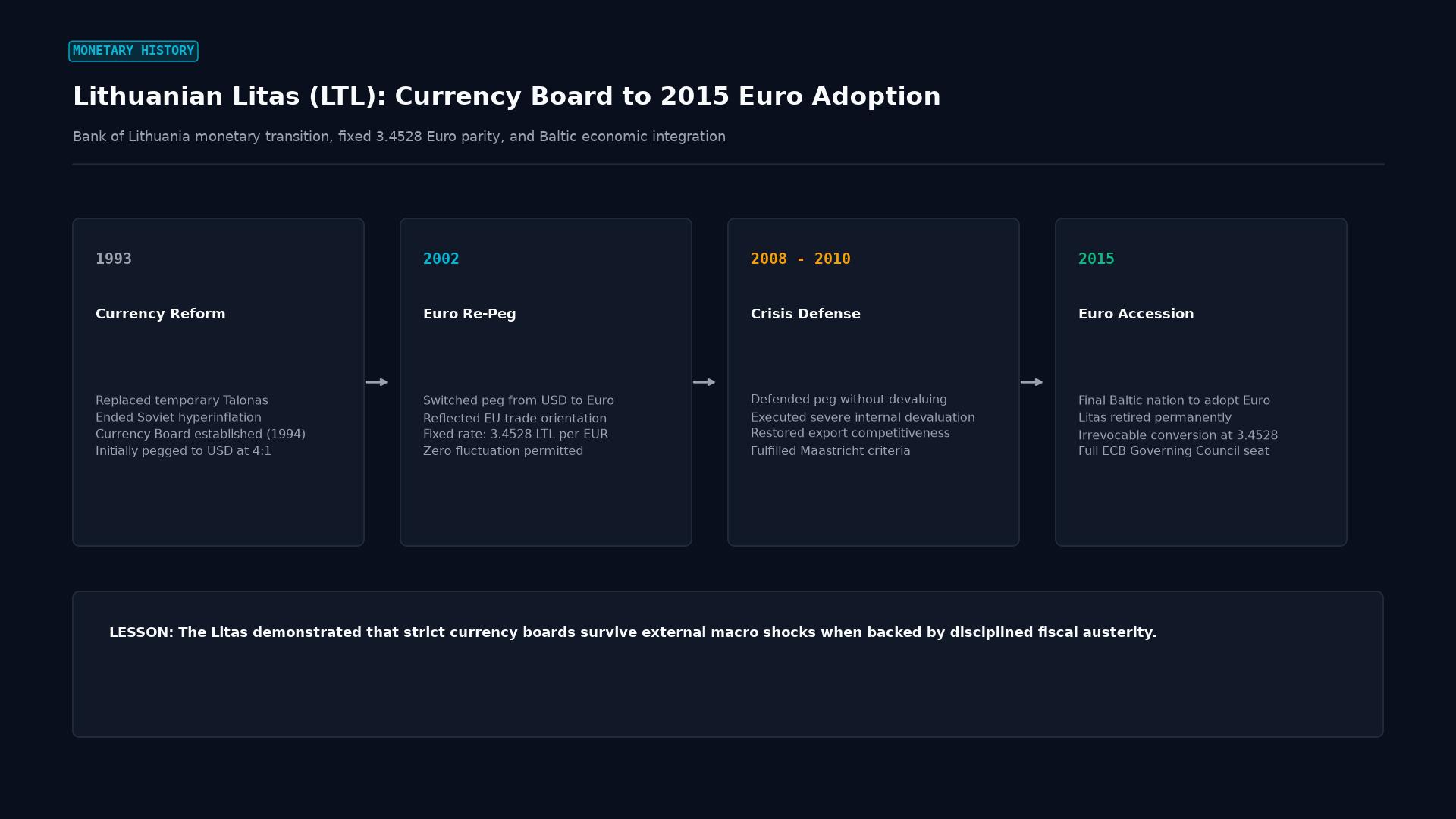 Figure: Bank of Lithuania monetary transition, fixed 3.4528 Euro parity, and Baltic economic integration
The Currency Board Arrangement (1994–2015)
Following the restoration of Lithuanian independence in 1990, the young republic suffered severe hyperinflation originating from the collapsing Soviet ruble zone. After introducing temporary coupons (talonas) to achieve monetary separation, the Bank of Lithuania reintroduced the historical Litas in June 1993.
To eliminate political interference and establish instant monetary credibility, the Lithuanian parliament enacted the Law on the Credibility of the Litas in April 1994, establishing a formal Currency Board Arrangement:
1. Mandatory 100% Foreign Reserve Backing
By statutory mandate, every litas issued into circulation (both physical cash and commercial bank reserve balances held at the central bank) was backed by more than 100% in foreign hard currency reserves and sovereign gold holdings. The Bank of Lithuania was legally forbidden from printing money to finance government budget deficits or extending unsecured emergency credit to private corporations.
2. The US Dollar Peg Era (1994–2002)
From April 1994 until February 2002, the litas was pegged directly to the United States Dollar at a fixed rate of:
1 USD = 4.0000 LTLThis arrangement provided an unshakeable nominal anchor that crushed domestic inflation, reduced commercial borrowing costs, and stimulated foreign direct investment into Lithuanian manufacturing, transportation, and port infrastructure.
3. The Euro Repegging (February 2002)
As Lithuania advanced toward European Union membership, its trade and financial links shifted decisively toward Western Europe. On February 2, 2002, the Bank of Lithuania executed a flawless technical repegging, transitioning the anchor currency from the US Dollar to the Euro at the prevailing market cross-rate:
1 EUR = 3.45280 LTLThis exact parity remained unaltered for the subsequent thirteen years, through EU accession in May 2004 and the global financial crisis, serving as the official conversion rate upon Eurozone accession.
The 2008–2009 Crisis and Internal Devaluation
The supreme test of the Lithuanian Litas occurred during the global financial crisis of 2008–2009.
Following years of rapid credit expansion fueled by Nordic commercial banks (such as SEB and Swedbank), the Baltic regional economy overheated. When global liquidity froze following the Lehman Brothers collapse, real Gross Domestic Product in Lithuania contracted by an extraordinary 14.8% in 2009.
International hedge funds and macro analysts predicted that Lithuania would be forced to break the currency board and devalue the litas by 30% to 50% to restore export competitiveness. A currency devaluation, however, would have bankrupted hundreds of thousands of Lithuanian households and businesses whose mortgages and commercial debt were denominated in Euros.
The government of Prime Minister Andrius Kubilius and the Bank of Lithuania chose the path of internal devaluation:
- Rather than devaluing the nominal exchange rate, the government slashed public sector nominal wages by 20% to 30%.
- Pensions and public operating expenditures were aggressively curtailed.
- Private sector wages adjusted downward flexibly, and domestic consumer prices declined.
Through painful domestic austerity, unit labor costs dropped, restoring international export competitiveness without breaking the 3.45280 Euro peg. By 2011, Lithuania returned to robust, export-led economic expansion, validating the endurance of its currency board framework.
ERM II Convergence and Euro Adoption
Lithuania entered the European Exchange Rate Mechanism (ERM II) in June 2004, maintaining its unilateral commitment to a zero fluctuation band around the 3.45280 parity.
Lithuania famously attempted to adopt the Euro on January 1, 2007, but was rejected by the European Commission by a margin of just 0.1% because its twelve-month average inflation rate was 2.7% against a Maastricht threshold limit of 2.6%.
Following the post-crisis stabilization, Lithuania met all Maastricht convergence criteria:
- Low sovereign debt-to-GDP (under 40%)
- Controlled fiscal deficits
- Stable long-term interest rates
- Complete exchange rate stability for over a decade
On July 23, 2014, the Council of the European Union granted formal approval. On January 1, 2015, Lithuania adopted the Euro. A two-week dual circulation window concluded on January 15, 2015, after which the litas ceased to be legal tender.
Legacy and Redemption Mechanics
For historians, collectors, and financial institutions holding legacy Lithuanian currency:
- Perpetual Central Bank Redemption: The Bank of Lithuania provides free, unlimited, and perpetual redemption of all authentic litas banknotes and coins at its cash offices in Vilnius and Kaunas at the official conversion rate of 3.45280 LTL = 1 EUR.
- Historical Significance: The litas remains a symbol of national sovereignty and fiscal resilience. It successfully carried Lithuania through post-communist transition, geopolitical integration with the West, and into the core of the European monetary union.
Key Takeaways
- The LTL (Lithuanian Litas) was the sovereign currency of Lithuania until its replacement by the Euro on January 1, 2015.
- Lithuania operated a strict Currency Board Arrangement from 1994 to 2015, maintaining 100%+ foreign reserve backing for all base money.
- The litas was initially pegged to the US Dollar at 1 USD = 4.0000 LTL (1994–2002) before repegging to the Euro at 1 EUR = 3.45280 LTL in February 2002.
- During the 2008–2009 crisis, Lithuania defended the peg through an internal devaluation, slashing nominal wages and fiscal outlays rather than devaluing the currency.
- Authentic legacy litas banknotes can be exchanged indefinitely at the Bank of Lithuania with zero fees at the official parity rate.
Frequently Asked Questions
Why did Lithuania choose a currency board instead of a standard central bank?
In 1994, Lithuania was recovering from Soviet-era hyperinflation and lacked institutional credibility. A currency board legally bound the central bank to print money only when backed by matching hard currency reserves, eliminating political deficit financing and reassuring international investors.
What was the internal devaluation strategy used by Lithuania in 2008?
Internal devaluation involves lowering a country’s unit labor costs and prices through domestic wage cuts, government spending reductions, and productivity gains rather than devaluing the nominal exchange rate. This preserved the value of euro-denominated debt held by citizens while restoring export competitiveness.
Can old Lithuanian Litas banknotes still be exchanged for Euros today?
Yes. The Bank of Lithuania (Lietuvos bankas) continues to exchange genuine litas banknotes and coins for Euros indefinitely and free of charge at the fixed rate of 3.45280 litas per 1 euro at its headquarters in Vilnius and branch in Kaunas.
Ready to trade forex?
Open a free demo account with a regulated broker. Practice with virtual funds before risking real money.