LVL
LVL is the historical ISO 4217 currency code for the Latvian Lats, the national currency of Latvia from 1993 until January 1, 2014, when it was replaced by the Euro at a fixed conversion rate of 1 EUR = 0.702804 LVL.
What Was the LVL?
The LVL is the three-letter ISO 4217 currency code for the Latvian Lats (plural: lati or latu), the official currency of the Republic of Latvia from March 1993 until January 1, 2014. Subdivided into 100 santīmi, the lats was issued and regulated by the Bank of Latvia (Latvijas Banka), headquartered in Riga.
In modern currency history, the Latvian Lats was famous for two structural attributes: its extraordinary nominal unit value and its historic defense during the 2008–2010 economic crisis. During its circulation, one lats was worth roughly 1.90 US dollars and 1.42 euros, making it the highest-valued nominal currency unit in Europe and the fourth most valuable in the world (surpassed only by the Kuwaiti, Bahraini, and Omani dinars). Latvia’s defense of the lats during the deepest peacetime economic contraction in modern European history also established the economic playbook for “internal devaluation” within fixed exchange rate regimes.
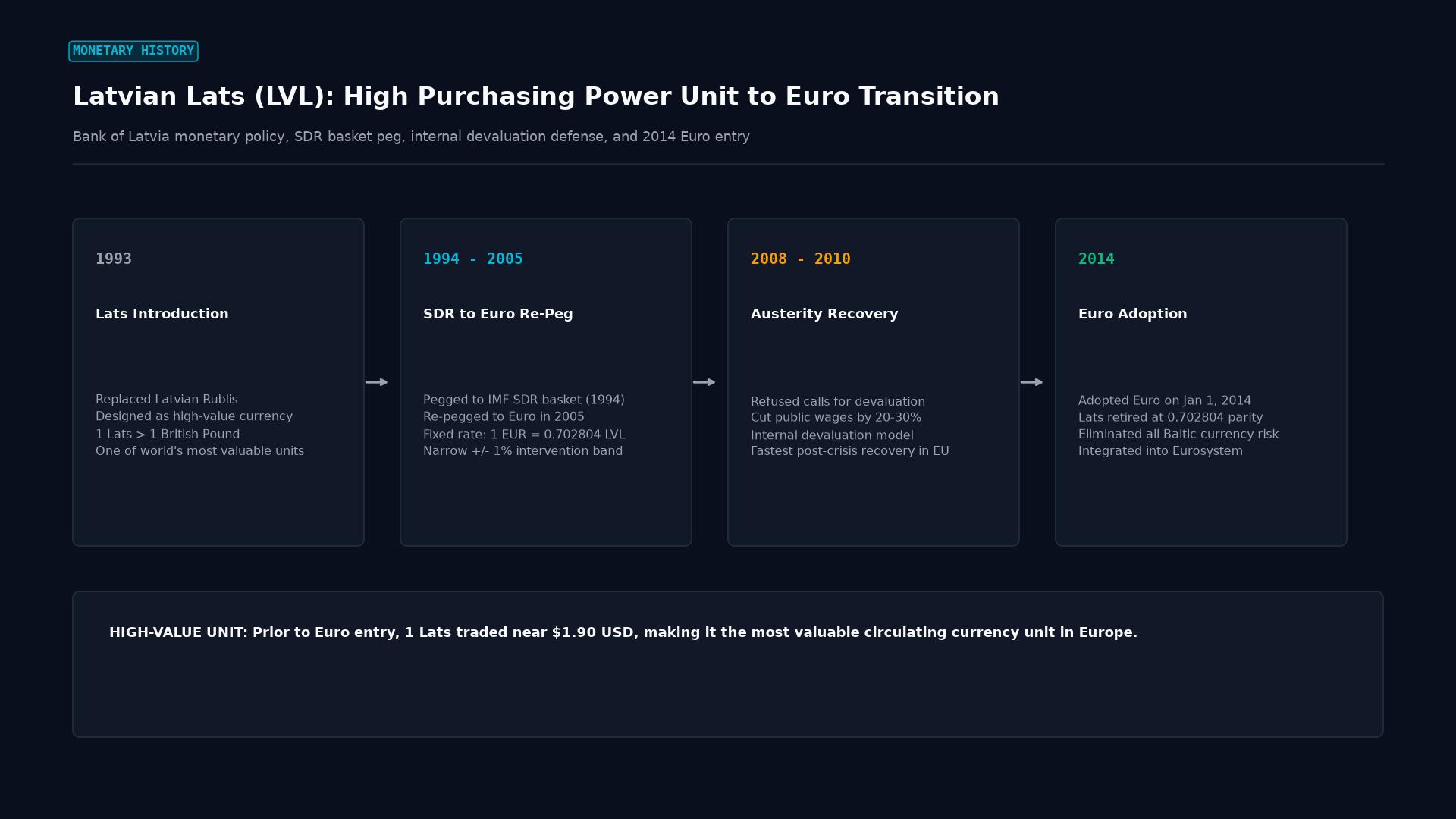 Figure: Bank of Latvia monetary policy, SDR basket peg, internal devaluation defense, and 2014 Euro entry
Monetary Evolution: From the Rublis to the Euro
Latvia’s path to monetary independence involved methodical, disciplined phases:
1. The Transitional Rublis and 1993 Restoration
After declaring independence from the Soviet Union in 1991, Latvia was flooded with rapidly depreciating paper rubles issued by the Russian central bank. In May 1992, the Bank of Latvia issued the Latvian Rublis (LVR) as an interim transitional currency to insulate the domestic economy. Once monetary stability was established, the Bank of Latvia began reintroducing the historical pre-war Latvian Lats in March 1993 at a conversion rate of 1 lats for 200 rublis.
2. The IMF SDR Basket Peg (1994–2004)
In February 1994, the Bank of Latvia pegged the lats to the Special Drawing Right (SDR) basket computed by the International Monetary Fund at a fixed rate of 1 SDR = 0.7997 LVL. Because the SDR basket included the US Dollar, Deutsche Mark, Japanese Yen, British Pound, and French Franc, this diversified peg provided an effective shock absorber against unilateral swings in any single foreign currency.
3. The Euro Peg and ERM II Accession (2005)
In anticipation of full integration into the European Union, Latvia transitioned from the SDR basket to a direct peg with the Euro on January 1, 2005:
1 EUR = 0.702804 LVL <---> 1 LVL = 1.42287 EURIn May 2005, the lats joined the European Exchange Rate Mechanism (ERM II). While standard ERM II rules allow a broad fluctuation corridor of +/- 15%, the Bank of Latvia made a unilateral, binding commitment to restrict exchange rate movements within a razor-thin corridor of just +/- 1% around the 0.702804 central parity.
The 2008 Financial Crash and the Internal Devaluation Feat
Between 2004 and 2007, Latvia experienced an extraordinary economic boom powered by massive capital inflows from Nordic banking subsidiaries (such as Swedbank, SEB, and Nordea). Cheap foreign credit fueled an immense commercial real estate bubble and double-digit wage growth that far outstripped labor productivity gains.
When global wholesale funding froze in late 2008, the bubble burst with catastrophic force:
1. The Collapse of Parex Banka
In late 2008, a systemic bank run struck Parex Banka, Latvia’s second-largest financial institution and the largest domestic-owned commercial bank. Parex relied heavily on non-resident deposits from high-net-worth clients across Russia and the Commonwealth of Independent States (CIS). As capital fled, the Latvian government was forced to nationalize the institution, expending hundreds of millions of euros in emergency liquidity guarantees that threatened sovereign solvency.
2. The Great Economic Contraction
Between 2008 and 2010, Latvia experienced the most severe economic contraction recorded in any sovereign nation during modern peacetime:
- Real Gross Domestic Product plummeted by more than 25% over two years.
- The national unemployment rate surged from under 6% to over 20%.
- Real estate prices collapsed by 50% to 70%.
3. The Devaluation Debate vs Internal Devaluation
Prominent international economists (including Nobel laureate Paul Krugman) argued vigorously that Latvia should immediately abandon the 0.702804 peg and devalue the lats by 30% to 40% to jumpstart export demand.
However, because more than 85% of private household and commercial debt in Latvia was denominated in Euros, devaluing the lats would have caused mass loan defaults, destroyed the banking system, and forced national bankruptcy.
Under the leadership of Prime Minister Valdis Dombrovskis, Latvia signed a €7.5 billion emergency stabilization package with the European Commission, the IMF, and Scandinavian governments, committing to an unprecedented internal devaluation:
- Public sector nominal wages were cut by up to 25% to 35%.
- More than 30% of civil service positions were eliminated.
- Dozens of public hospitals and rural schools were consolidated or closed.
- Real unit labor costs plummeted, restoring manufacturing export competitiveness without touching the exchange rate peg.
By 2011–2012, Latvia’s export sector rebounded dramatically. The nation recorded some of the highest GDP growth rates in the European Union, proving that a determined sovereign state could successfully maintain an exchange rate peg through internal price adjustments.
Eurozone Accession and Redemption
Having successfully stabilized its economy and satisfied all five Maastricht convergence criteria, Latvia received formal approval from the European Council in July 2013 to join the Eurozone.
On January 1, 2014, Latvia officially adopted the Euro as its sovereign currency, becoming the 18th member of the Euro area. A standard two-week dual-circulation period concluded on January 14, 2014, marking the official retirement of the lats from daily retail circulation.
For institutional holders, collectors, and corporate treasuries:
- Bank of Latvia Perpetual Guarantee: Authentic Latvian Lats banknotes and coins can be exchanged for Euros indefinitely, in unlimited quantities, and completely free of commission at the cash offices of the Bank of Latvia in Riga.
- Official Fixed Rate: Conversions are executed at the statutory parity of 1 EUR = 0.702804 LVL (or roughly 1 LVL = 1.42 EUR).
Key Takeaways
- The LVL (Latvian Lats) was the sovereign currency of Latvia from 1993 until Euro adoption on January 1, 2014.
- During its circulation, the lats was the highest-valued nominal currency unit in Europe, with 1 lats worth approximately 1.90 USD and 1.42 EUR.
- The currency transitioned from an IMF SDR basket peg (1994–2004) to a fixed Euro peg at 0.702804 LVL per Euro within ERM II.
- During the 2008–2010 crisis, Latvia endured a 25% GDP contraction and defended its peg through an internal devaluation rather than a currency devaluation.
- Old Latvian Lats banknotes and coins retain permanent convertibility at the Bank of Latvia with zero time expiration.
Frequently Asked Questions
Why was one Latvian Lats worth more than the British Pound and the Euro?
The high nominal value of the Latvian Lats was an arbitrary historical artifact of its 1993 monetary conversion. When the Bank of Latvia replaced the transitional Latvian Rublis at 1:200, it deliberately chose a strong base unit value to symbolize national monetary sovereignty and purchasing power stability.
What is the difference between an external devaluation and an internal devaluation?
An external devaluation occurs when a central bank formally lowers the exchange value of its currency against foreign currencies. An internal devaluation keeps the exchange rate fixed while cutting domestic wages, government expenditures, and operating costs to restore international competitiveness.
Can travelers still exchange leftover Latvian Lats coins and notes today?
Yes. Commercial banks no longer process the currency, but the Bank of Latvia (Latvijas Banka) in Riga exchanges authentic lats banknotes and santīmi coins for Euros at the official rate of 0.702804 lats per euro with no expiration deadline.
Ready to trade forex?
Open a free demo account with a regulated broker. Practice with virtual funds before risking real money.