M3
M3 is the broadest measure of total monetary supply and systemic financial liquidity, combining all of M2 with large-denomination time deposits, institutional money market funds, term repurchase agreements, and offshore eurodollar liabilities.
What Is M3?
M3 is the most comprehensive and expansive macroeconomic measure of total money supply tracked in modern financial economics. While narrower aggregates like M1 focus on physical cash and checking deposits, and M2 incorporates household savings accounts and retail certificates of deposit, M3 expands the monetary boundary to include large-scale wholesale liquidity and institutional funding instruments used by multinational corporations, investment banks, and institutional asset managers.
Because M3 captures both retail balances and wholesale interbank liabilities, it serves as the ultimate barometer of total systemic credit creation. In modern financial architecture, institutional liquidity moves not through consumer bank branches, but across short-term repurchase agreements (repos), institutional money market funds, and offshore Eurodollar clearing networks. Consequently, tracking M3 provides a clear picture of balance sheet leverage and liquidity risk across the global financial system.
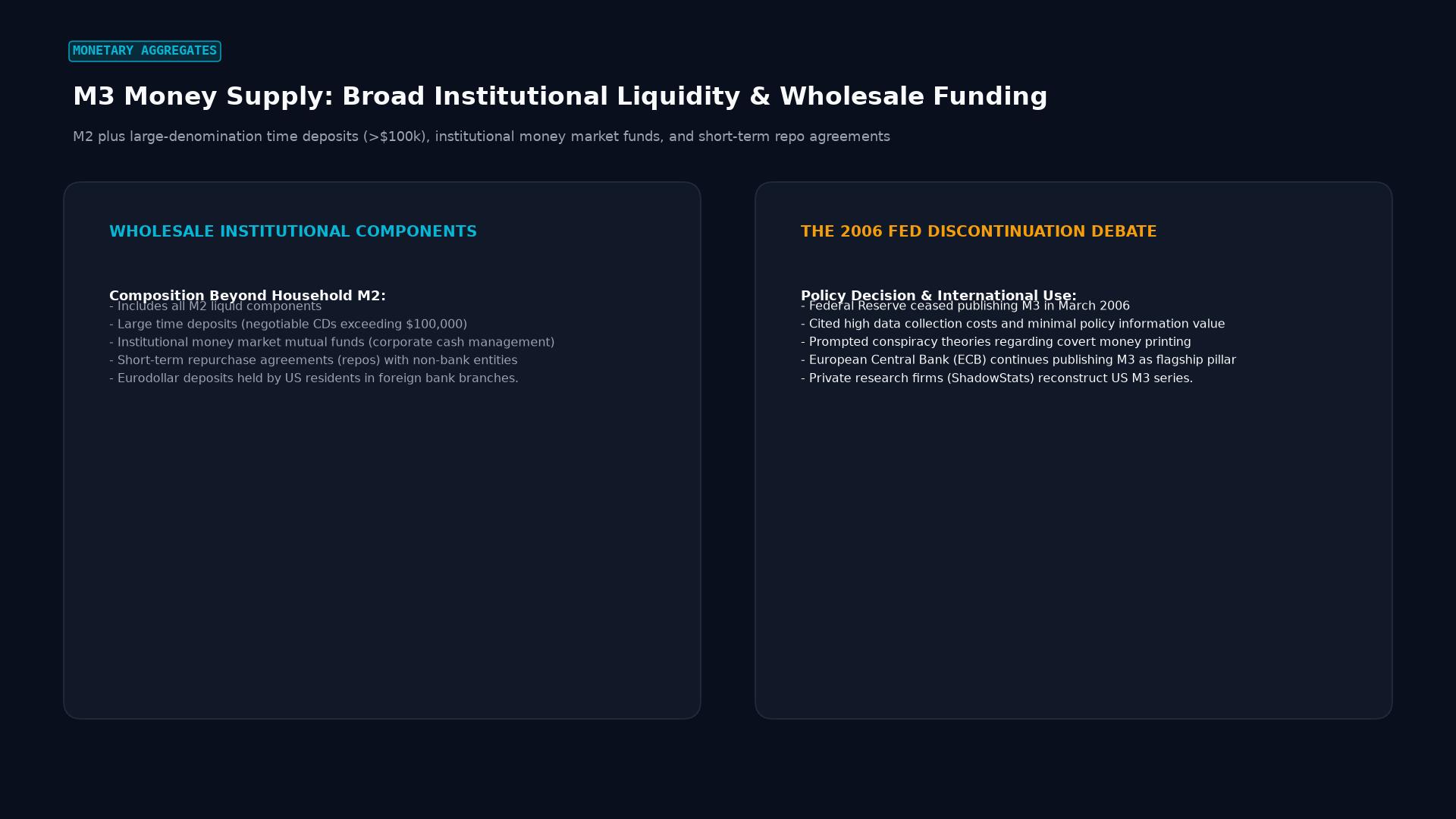 Figure: M2 plus large-denomination time deposits (>$100k), institutional money market funds, and short-term repo agreements
The Mathematical Composition of M3
In institutional economic accounting, the formulation of M3 aggregates retail liquidity with wholesale institutional funding lines:
M3 = M2 + Large Time Deposits + Institutional Money Market Funds + Term Repos + Eurodollar Liabilities1. The Full M2 Foundation
M3 incorporates 100% of M2, including physical currency in public circulation, demand deposits, consumer savings accounts, retail money market funds, and small-denomination retail certificates of deposit under $100,000.
2. Large-Denomination Time Deposits
Fixed-term wholesale certificates of deposit issued by commercial banks with denominations of $100,000 or greater. These negotiable instruments are held primarily by corporate treasuries, insurance companies, university endowments, and municipal bond funds seeking predictable, short-term yields on idle operating cash.
3. Institutional Money Market Mutual Funds
Wholesale money market funds that cater exclusively to institutional investors, with minimum account balances often starting at $1 million or $10 million. These funds invest in commercial paper, sovereign Treasury bills, and asset-backed securities.
4. Term Repurchase Agreements (Repos)
Short-term collateralized lending agreements between commercial banks and primary dealers with maturities exceeding one day. In a repo transaction, a dealer sells Treasury securities to a corporate treasurer or money manager with a binding contractual agreement to repurchase them at a higher price on a specified future date.
5. Eurodollar Deposits
United States Dollar-denominated deposits held in commercial banks outside the United States (primarily in London, Frankfurt, Tokyo, and Zurich). Because Eurodollars operate outside the direct regulatory oversight of the Federal Reserve, they represent an immense pool of cross-border wholesale dollar liquidity.
The Controversial March 2006 Federal Reserve Decision
A defining milestone in the history of monetary measurement occurred on March 23, 2006, when the Board of Governors of the Federal Reserve announced that it would cease compiling and publishing M3 data.
The Federal Reserve’s Official Rationale
The Fed justified terminating M3 publication by asserting that the aggregate had lost its practical usefulness for conducting monetary policy:
- Cost vs Benefit: The central bank stated that collecting weekly survey data from thousands of depository institutions on large time deposits and term repos imposed heavy administrative costs on the banking system that were not justified by the marginal analytical value of the data.
- Adequacy of M2: Officials maintained that M2 adequately captured the core relationship between money supply and consumer price inflation.
- Availability of Alternative Data: The Fed noted that core components of M3, such as commercial bank credit and primary dealer repo activity, would continue to be tracked through other specialized Federal Reserve statistical releases.
Market Criticism and the Shadow Banking Controversy
The decision sparked intense controversy across Wall Street, academic economics, and private market research desks.
Critics, including Austrian School economists and independent research firms like Shadow Government Statistics (ShadowStats), argued that terminating M3 was a grave policy error. They pointed out that by ending M3 tracking in early 2006, the Federal Reserve blinded itself and the public to the explosive, unregulated expansion of wholesale liquidity, mortgage-backed repo financing, and off-balance-sheet shadow banking liabilities that ultimately triggered the catastrophic 2007–2008 Global Financial Crisis.
When the wholesale credit markets froze in August 2007, the collapse occurred precisely in the non-M2 components of M3: institutional money market funds broke the buck, and term repo markets ground to a halt.
Global Central Banking Perspectives: The ECB vs The Fed
While the Federal Reserve retired M3, other premier central banks continue to treat M3 as a cornerstone of their monetary policy frameworks.
Most notably, the European Central Bank (ECB) places M3 at the center of its famous “Two-Pillar” monetary policy strategy:
+-------------------------------------------------------------------------+
|                  THE EUROPEAN CENTRAL BANK (ECB) TWO PILLARS            |
+-------------------------------------------------------------------------+
|                                                                         |
|  PILLAR 1: ECONOMIC ANALYSIS            PILLAR 2: MONETARY ANALYSIS     |
|  - Real GDP growth                      - Comprehensive M3 Aggregate    |
|  - Employment & wage costs              - Bank credit to private sector |
|  - Energy & commodity prices            - Loans to non-financial corps  |
|  - Consumer confidence indices          - Cross-border capital flows    |
|                 \                                     /                 |
|                  \                                   /                  |
|                   v                                 v                   |
|  +-------------------------------------------------------------------+  |
|  | ECB GOVERNING COUNCIL RATE DECISIONS                              |  |
|  | Cross-checks economic indicators against broad M3 credit growth   |  |
|  +-------------------------------------------------------------------+  |
|                                                                         |
+-------------------------------------------------------------------------+
The ECB publishes detailed monthly M3 reports for the Eurozone, categorizing liquid money into:
- M1 (currency plus overnight deposits)
- M2 (M1 plus deposits with agreed maturity up to two years and deposits redeemable at notice up to three months)
- M3 (M2 plus repurchase agreements, money market fund shares, and debt securities with maturity up to two years)
By monitoring Eurozone M3 growth against a formal reference value (historically 4.5% per annum), the ECB assesses medium-term systemic inflation risks and monitors the health of commercial bank lending channels across member states.
Wholesale Funding Fragility and Systemic Banking Runs
In modern financial market microstructure, banking crises do not look like 1930s retail depositors lining up on sidewalks to withdraw paper cash from checking accounts (M1).
Instead, systemic panics occur in the wholesale funding tiers tracked by M3:
- The Run on Repo: During the 2008 financial crisis, institutional lenders refused to roll over overnight and term repo loans backed by private mortgage collateral, demanding massive haircuts and forcing investment banks like Bear Stearns and Lehman Brothers into insolvency within days.
- The Institutional MMF Run: Following the Lehman bankruptcy, the Reserve Primary Fund (a major institutional money market fund holding Lehman commercial paper) suffered catastrophic redemption requests, forcing its net asset value below $1.00 (“breaking the buck”). Corporate treasuries panicked, pulling hundreds of billions of dollars from institutional MMFs until the US Treasury established an emergency temporary guarantee program.
These episodes demonstrated that wholesale institutional liquidity operates with immense speed and systemic leverage, underscoring why macro analysts continue to reconstruct synthetic M3 data.
Key Takeaways
- M3 is the broadest measure of the money supply, incorporating all of M2 plus large institutional time deposits, institutional money market funds, term repos, and offshore Eurodollars.
- It captures total systemic liquidity across both retail banking and wholesale institutional capital markets.
- In March 2006, the US Federal Reserve controversially ceased publishing official M3 data, citing administrative collection costs.
- The European Central Bank maintains active monthly M3 reporting as a primary pillar of its monetary policy analysis.
- Modern financial crises originate primarily in the wholesale funding channels measured by M3 rather than in retail checking deposits.
Frequently Asked Questions
Why did the Federal Reserve stop publishing M3 in 2006?
The Federal Reserve stated that collecting data on large CDs, term repos, and Eurodollars from thousands of banks was expensive and provided minimal additional insight beyond what was already captured by M2 and other economic indicators.
How can investors track US M3 today if the Fed no longer publishes it?
Private macroeconomic research firms, financial analytics platforms, and independent organizations (such as Shadow Government Statistics and the OECD) calculate reconstructed synthetic M3 data by aggregating Federal Reserve data releases on commercial bank balance sheets, primary dealer repos, and institutional fund holdings.
Why is M3 important for understanding systemic financial risk?
M3 tracks wholesale institutional funding channels, including repurchase agreements and institutional money market funds. These markets fund the shadow banking system and investment bank trading desks; when liquidity dries up in these wholesale tiers, systemic credit crunches and banking crises erupt rapidly.
Ready to trade forex?
Open a free demo account with a regulated broker. Practice with virtual funds before risking real money.