Maastricht Treaty
The Maastricht Treaty, formally known as the Treaty on European Union, is the foundational 1992 accord that established the European Union, paved the way for the single currency (the Euro), and mandated the fiscal convergence criteria.
What Is the Maastricht Treaty?
The Maastricht Treaty, officially titled the Treaty on European Union (TEU), is the landmark international agreement that established the European Union and laid the legal, institutional, and economic foundations for the creation of the single European currency, the Euro. Signed on February 7, 1992, in the Dutch city of Maastricht by the member states of the European Communities, the treaty entered into full legal force on November 1, 1993, following contentious national ratifications and referendums.
In international macroeconomics, the Maastricht Treaty represents the most ambitious integration of sovereign financial systems in modern history. Beyond establishing the three-pillar governance architecture of the European Union, the treaty created the Economic and Monetary Union (EMU), mandated the creation of the European Central Bank (ECB), and established the strict economic and fiscal convergence criteria that sovereign states were legally required to satisfy before abandoning their historical national currencies in favor of the Euro.
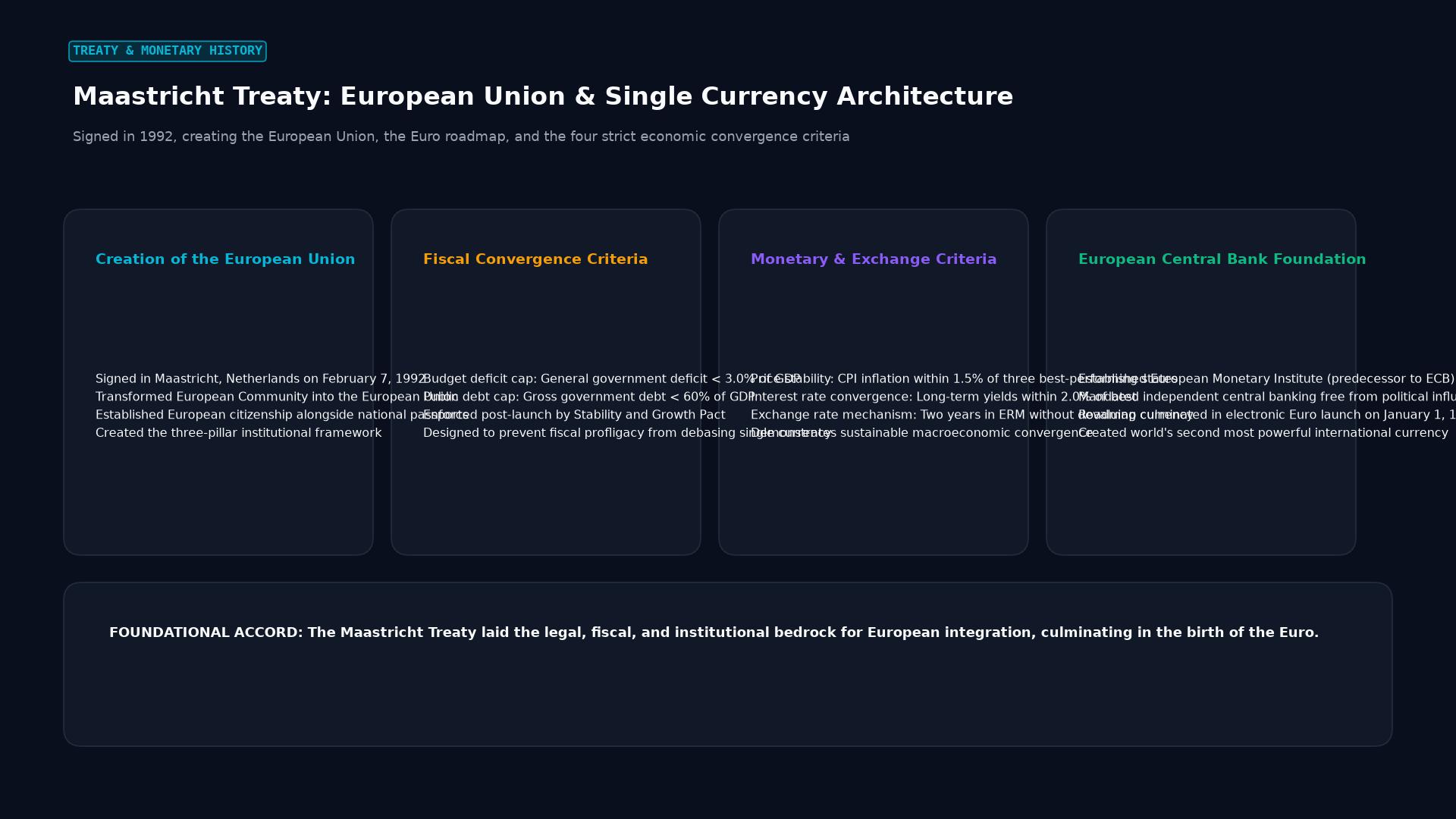 Figure: Signed in 1992, creating the European Union, the Euro roadmap, and the four strict economic convergence criteria
The Five Maastricht Convergence Criteria
To prevent fiscal instability in one sovereign nation from spilling over into neighboring economies, Article 121(1) of the treaty established five quantitative economic conditions (the Maastricht Convergence Criteria). Any member state seeking to adopt the Euro had to prove sustainable economic discipline across five metrics:
1. Price Stability (Inflation Ceiling)
A candidate country’s average consumer price inflation rate, measured over the preceding twelve months, could not exceed by more than 1.5 percentage points the inflation rate of the three best-performing member states in terms of price stability.
2. Government Budget Deficit (Fiscal Discipline)
The annual general government budget deficit could not exceed 3.0% of Gross Domestic Product (GDP) at the end of the preceding fiscal year, unless the ratio had declined substantially and continuously toward the reference benchmark.
3. Gross Sovereign Debt Ceiling
Total outstanding gross general government debt could not exceed 60.0% of GDP, unless the debt ratio was sufficiently diminishing and approaching the 60% threshold at a satisfactory pace.
4. Exchange Rate Stability (ERM II Participation)
The candidate nation was required to participate in the Exchange Rate Mechanism (ERM II) of the European Monetary System for at least two consecutive years without severe currency tensions, and without devaluing its central exchange rate against any other member state’s currency.
5. Convergence of Long-Term Interest Rates
The average nominal long-term interest rate on benchmark 10-year sovereign government bonds, observed over a twelve-month period, could not exceed by more than 2.0 percentage points the bond yields of the three best-performing member states in terms of price stability.
+-------------------------------------------------------------------------+
|                  MAASTRICHT CONVERGENCE BENCHMARKS SUMMARY              |
+-------------------------------------------------------------------------+
|                                                                         |
|  ECONOMIC METRIC             STATUTORY TREATY CEILING                   |
|                                                                         |
|  Consumer Inflation          <= Best 3 States Average + 1.5%            |
|  Annual Budget Deficit       <= 3.0% of National GDP                    |
|  Gross Sovereign Debt        <= 60.0% of National GDP                   |
|  Exchange Rate Fluctuation   2 Years in ERM II without Devaluation      |
|  10-Year Bond Yields         <= Best 3 States Average + 2.0%            |
|                                                                         |
+-------------------------------------------------------------------------+
Institutional Innovations: The ECB and European Central Bank System
The Maastricht Treaty engineered the legal transfer of sovereign monetary independence from national central banks (such as the German Bundesbank and Bank of France) to a newly created supranational authority: the European Central Bank (ECB), headquartered in Frankfurt, Germany.
The treaty granted the ECB statutory political independence, legally insulating its Governing Council members from taking instructions from European Union institutions or national governments. The primary mandate of the ECB was codified as the maintenance of price stability (subsequently defined as maintaining inflation below, but close to, 2.0% over the medium term).
National central banks were reorganized into the European System of Central Banks (ESCB), retaining operational execution of domestic currency distribution and banking supervision while subordinating monetary policy decisions to Frankfurt.
The Stability and Growth Pact (SGP) and Enforcement Challenges
To ensure that member states maintained fiscal rectitude after adopting the Euro, the provisions of the Maastricht Treaty were reinforced in 1997 through the Stability and Growth Pact (SGP).
The SGP introduced two operational arms:
- Preventive Arm: Mandated that member states submit annual stability programs targeting medium-term budgetary balance.
- Corrective Arm (Excessive Deficit Procedure - EDP): Empowered the European Commission to initiate disciplinary sanctions, issuing formal policy warnings and potentially levying financial fines of up to 0.5% of GDP on nations that persistently breached the 3% deficit ceiling.
In practice, the enforcement of these fiscal rules proved politically fraught. In 2003, when France and Germany (the two largest economies in the bloc) breached the 3% deficit ceiling, European finance ministers voted to suspend disciplinary sanctions, diluting the deterrent power of the pact and foreshadowing the fiscal imbalances that later fueled the 2010 European sovereign debt crisis.
National Opt-Outs and Geopolitical Compromises
Achieving unanimous agreement on the Maastricht Treaty required diplomatic compromises and formal legal carve-outs:
| Country | Treaty Opt-Out Concession | Long-Term Sovereign Outcome |
|---|---|---|
| United Kingdom | Protocol on opt-out from the third stage of EMU (adopting the Euro) and the Social Chapter | Retained the British Pound (GBP) and independent monetary policy; eventually exited the EU in 2020 (Brexit) |
| Denmark | Opt-out from the single currency (Euro) and European common defense policies | Retained the Danish Krone (DKK), maintaining an ERM II central peg to the Euro without full currency adoption |
| Sweden | Did not negotiate a formal treaty opt-out, but deliberately stayed out of ERM II | Successfully avoided mandatory Euro adoption by intentionally failing the exchange rate stability criterion |
Key Takeaways
- The Maastricht Treaty (Treaty on European Union), signed in February 1992, founded the European Union and paved the path for the single currency (the Euro).
- The accord established the Three Pillars of European governance: European Communities, Common Foreign and Security Policy, and Justice and Home Affairs.
- Five mandatory convergence criteria governed Euro accession: inflation controls, a 3% budget deficit cap, a 60% debt-to-GDP ceiling, two years in ERM II, and long-term interest rate alignment.
- The treaty created the European Central Bank (ECB) as a politically independent supranational monetary authority dedicated to price stability.
- Disparate enforcement of the Stability and Growth Pact and national opt-outs (UK, Denmark) highlighted the structural challenge of pairing a unified monetary policy with decentralized national fiscal budgets.
Frequently Asked Questions
Why was the city of Maastricht selected for signing the treaty?
Maastricht, located in the southern Netherlands near the borders of Belgium and Germany, was selected as a geographic and historical symbol of European unity. The Dutch government held the rotating Presidency of the Council of the European Union during the critical concluding negotiations in late 1991.
What is the difference between the Maastricht Treaty and the Schengen Agreement?
The Maastricht Treaty established the European Union, the single currency, and fiscal convergence frameworks. The Schengen Agreement, signed earlier in 1985 and later incorporated into EU law via the Treaty of Amsterdam, abolished internal border passport checks, creating the passport-free Schengen travel zone.
What happened to countries that breached the 60% debt-to-GDP ratio?
Several founding Eurozone nations, including Italy and Belgium, entered the monetary union in 1999 with debt-to-GDP ratios exceeding 100%. The European Council admitted these countries under a treaty clause permitting accession if the gross debt ratio was deemed to be diminishing at a satisfactory pace toward the 60% threshold.
Ready to trade forex?
Open a free demo account with a regulated broker. Practice with virtual funds before risking real money.