Macaroni defense
The macaroni defense is an anti-takeover strategy where a target company issues a massive volume of corporate bonds with mandatory redemption covenants that force an immediate, premium cash buyout of the debt if a hostile acquisition occurs.
What Is the Macaroni Defense?
In corporate finance, mergers and acquisitions (M&A), and hostile takeover defense, the macaroni defense is a specialized capital structure maneuver deployed by a target company’s board of directors to repel an unwanted corporate suitor. Under this strategy, the target company issues a substantial volume of corporate bonds containing a restrictive change-of-control covenant. This covenant dictates that if a hostile acquirer succeeds in acquiring a controlling interest in the target company, the bonds must be redeemed immediately at a punitive, exorbitant premium above par value.
The vivid culinary metaphor derives from how macaroni pasta behaves when cooked: just as dry macaroni expands rapidly in volume when immersed in boiling water, the target company’s debt burden and required cash redemption outlays expand enormously the moment the “heat” of a hostile takeover bid is applied. By artificially expanding the cash required to consummate the acquisition, the target company forces the hostile bidder to abandon its pursuit.
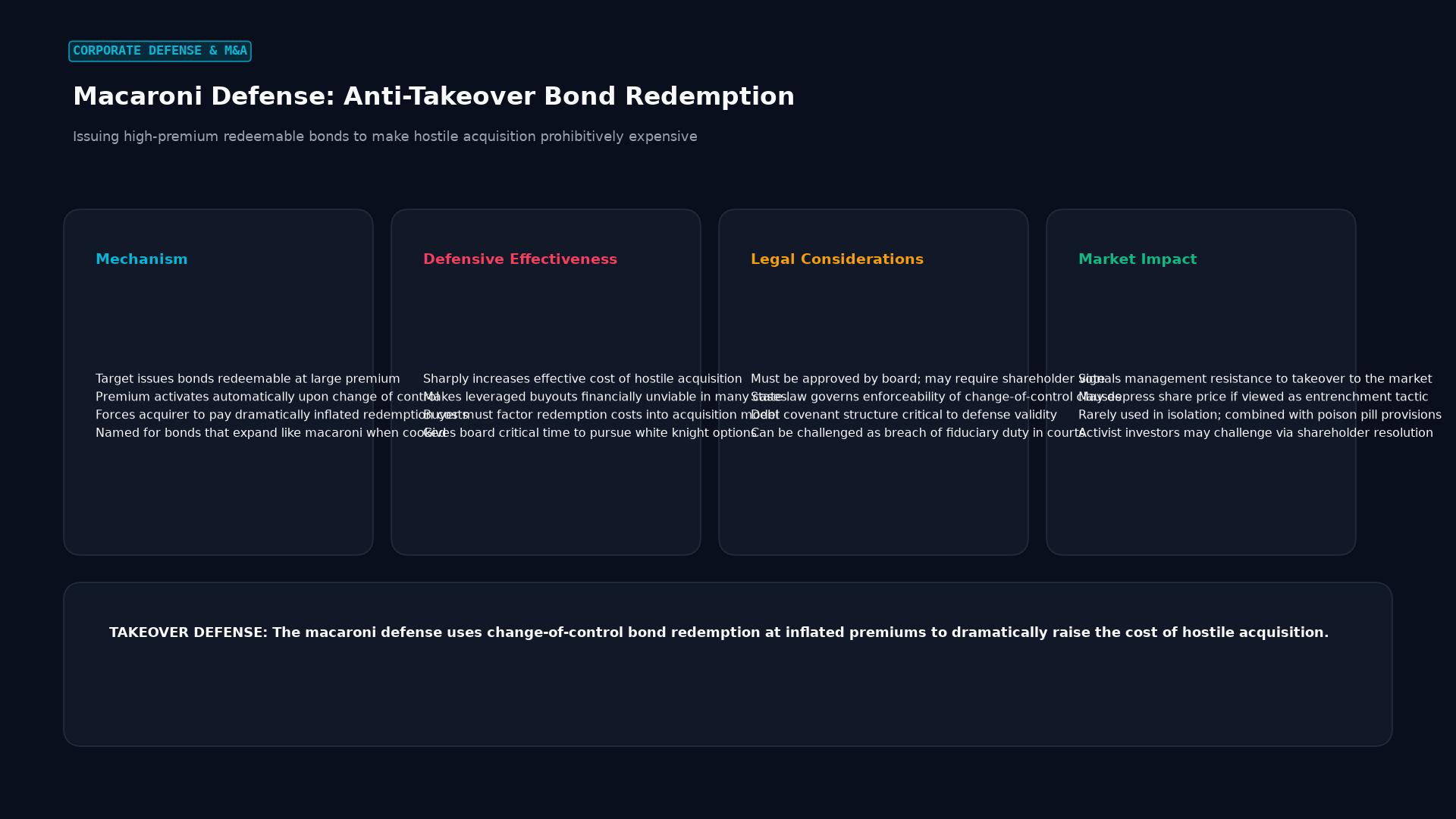 Figure: Issuing high-premium redeemable bonds to make hostile acquisition prohibitively expensive
Contractual Mechanics: The “Poison Put” Covenant
The legal foundation of the macaroni defense is built around an aggressive debt covenant known as a poison put.
When the target company sells bonds in the capital markets, the indenture agreement includes explicit covenants triggered by a “Change of Control Event”, defined as:
- The accumulation by an unapproved entity of a designated percentage of voting equity (typically 20% to 50%)
- A successful proxy fight that replaces the majority of the sitting board of directors
- A statutory merger executed without the affirmative recommendation of the incumbent board
The Mandatory Redemption Multiplier
In standard corporate bond indentures, a change-of-control clause typically allows bondholders to put the debt back to the company at par (100%) or a modest premium (such as 101% of face value) to protect against credit downgrades.
In a macaroni defense, the redemption price is intentionally structured at a punitive premium: 150%, 175%, or even 200% of par value.
If the target company issued $1 billion in bonds, an acquirer who completes a hostile takeover is legally forced to disburse $1.75 billion in immediate cash to retire the debt. This cash requirement is in addition to the billions of dollars already paid to purchase the target’s common equity shares.
Impact on the Hostile Acquirer
The macaroni defense destroys the economic viability of a hostile corporate takeover through several financial channels:
1. Liquidity Destruction in Leveraged Buyouts (LBOs)
Hostile takeovers and private equity buyouts rely heavily on debt financing. Acquirers pledge the target company’s cash flow to service the new acquisition loans. Forcing an immediate $1.75 billion cash outflow drains the target’s treasury, leaving zero liquidity to service the acquirer’s own acquisition loans and collapsing the LBO’s financial model.
2. Violating Acquirer Credit Covenants
The sudden, mandatory absorption of billions of dollars in expanded debt can trigger cross-default clauses across the acquirer’s existing credit facilities. Acquirers risk violating their own maximum leverage ratios (Debt-to-EBITDA covenants), prompting their syndication banks to revoke funding lines.
3. Destruction of Enterprise Value Synergies
The premium paid to bondholders represents pure economic leakage. The $750 million premium does not buy new factories, fund software engineering, or purchase inventory; it is transferred directly to bondholders, destroying the projected operational synergies that justified the merger in the first place.
Corporate Tradeoffs and Balance Sheet Risks
While the macaroni defense can successfully repel corporate raiders, it imposes severe risks and long-term costs on the target company and its shareholders:
| Risk Category | Operational Impact on Target Company | Long-Term Strategic Consequence |
|---|---|---|
| Debt Overhang | Massive increase in outstanding liabilities on the corporate balance sheet | Limits future borrowing capacity for organic research, capital investments, and acquisitions |
| High Interest Drag | Ongoing coupon payments must be serviced out of regular operating cash flows | Compresses net earnings per share (EPS) and lowers return on equity (ROE) |
| Credit Rating Downgrades | Rating agencies (Moody’s, S&P, Fitch) view sudden debt spikes as credit-negative | Increases ongoing borrowing costs across all commercial paper and revolving credit lines |
| Fiduciary Litigation | Shareholders may sue the board under state corporate law (e.g., Delaware Chancery Court) | Directors risk personal liability if the defense is proven to entrench management rather than serve shareholders |
Comparison: Macaroni Defense vs Other Anti-Takeover Tactics
Corporate boards maintain an arsenal of structural defenses to thwart unsolicited bids:
+-------------------------------------------------------------------------+
|                  TAKEOVER DEFENSE METHODOLOGY COMPARISON                |
+-------------------------------------------------------------------------+
|                                                                         |
|  DEFENSE MECHANISM    CORE STRATEGY          PRIMARY ASSET AFFECTED     |
|                                                                         |
|  Macaroni Defense     Issues bonds with      Corporate Debt Structure   |
|                       punitive cash buyout   (Expands debt obligations) |
|                                                                         |
|  Poison Pill          Floods market with     Common Equity Structure    |
|  (Shareholder Rights) discounted shares to   (Dilutes hostile bidder)   |
|                                                                         |
|  Pac-Man Defense      Target launches a      Corporate Treasury Cash    |
|                       counter-takeover bid   (Buys bidder shares)       |
|                                                                         |
|  Crown Jewel Defense  Sells most valuable    Core Intellectual Property |
|                       operating subsidiary   or Strategic Business Unit |
|                                                                         |
+-------------------------------------------------------------------------+
While a poison pill dilutes the hostile bidder’s equity ownership percentage, the macaroni defense directly attacks the bidder’s balance sheet liquidity and credit capacity. Often, target companies deploy both defenses in tandem to create an impenetrable barrier.
Legal and Judicial Standards: The Unocal and Revlon Tests
In the United States, corporate takeover defenses are evaluated under stringent judicial standards developed by the Delaware Supreme Court:
- The Unocal Standard (Unocal Corp. v. Mesa Petroleum Co.): When a board implements defensive tactics like the macaroni defense, directors do not receive the traditional protection of the Business Judgment Rule. Instead, the board must satisfy a two-prong test: they must prove they had reasonable grounds for believing the hostile bid posed a genuine threat to corporate policy, and the defensive response (the debt expansion) was reasonable and proportional to that threat.
- The Revlon Duty (Revlon, Inc. v. MacAndrews & Forbes Holdings): If it becomes inevitable that the company will be sold or broken up, the board’s duty fundamentally shifts. Directors can no longer deploy defenses to keep the company independent; their sole fiduciary obligation becomes acting as auctioneers to extract the highest possible cash price per share for stockholders.
Key Takeaways
- The macaroni defense is an anti-takeover maneuver where a target firm issues corporate bonds with covenants requiring immediate, premium redemption upon an unapproved change of control.
- The name reflects how corporate debt obligations expand dramatically like cooking macaroni when a hostile takeover is initiated.
- The tactic deters acquirers by draining cash, triggering cross-defaults, and destroying leveraged buyout economic models.
- The strategy carries severe operational risks, including heavy debt overhang, interest expense drag, credit rating downgrades, and potential board litigation.
- In legal reviews, courts evaluate the macaroni defense under the Unocal proportionality standard to ensure directors are not merely entrenching themselves at the expense of shareholder value.
Frequently Asked Questions
What is the difference between a poison pill and a macaroni defense?
A poison pill (shareholder rights plan) dilutes the bidder’s voting equity by allowing existing shareholders to purchase newly issued common shares at a massive discount. A macaroni defense alters the target’s debt structure, forcing an acquirer to immediately disburse billions of dollars in cash to redeem bonds at an inflated premium.
Who benefits from a macaroni defense?
The primary beneficiaries are bondholders, who receive contractually guaranteed windfall profits (such as a 150% to 200% payout of par value) if a takeover occurs. Incumbent management also benefits temporarily by deterring suitors and preserving executive employment, though shareholders often suffer from long-term debt drag.
Is the macaroni defense commonly used today?
Pure macaroni defenses with extreme 200% redemption premiums are rare today because institutional proxy advisory firms (like ISS and Glass Lewis) and Delaware courts view them as entrenchment mechanisms. Modern credit agreements typically use standardized change-of-control puts at 101% of par value rather than punitive macaroni multipliers.
Ready to trade forex?
Open a free demo account with a regulated broker. Practice with virtual funds before risking real money.