Macau Pataca
The Macau Pataca (MOP) is the official currency of the Macau Special Administrative Region of China, governed under a strict currency board arrangement that pegs it to the Hong Kong Dollar at 1 HKD = 1.03 MOP.
What Is the Macau Pataca?
The Macau Pataca (currency code: MOP, symbol: MOP$ or 圓) is the official legal tender of the Macau Special Administrative Region (SAR) of the People’s Republic of China. Subdivided into 100 avos (with intermediate 10-avo units known locally as ho), the currency is administered and regulated by the Monetary Authority of Macao (Autoridade Monetária de Macau - AMCM), the territory’s de facto central banking entity.
In global foreign exchange and macroeconomics, the Macau Pataca operates within a specialized, highly disciplined Currency Board Arrangement (CBA). Rather than pegging directly to the currency of mainland China (the Chinese Yuan or Renminbi) or the United States Dollar, the Pataca is pegged by statutory law directly to the neighboring Hong Kong Dollar (HKD). This unique monetary architecture provides monetary stability to an economy renowned as the gaming and hospitality capital of the world.
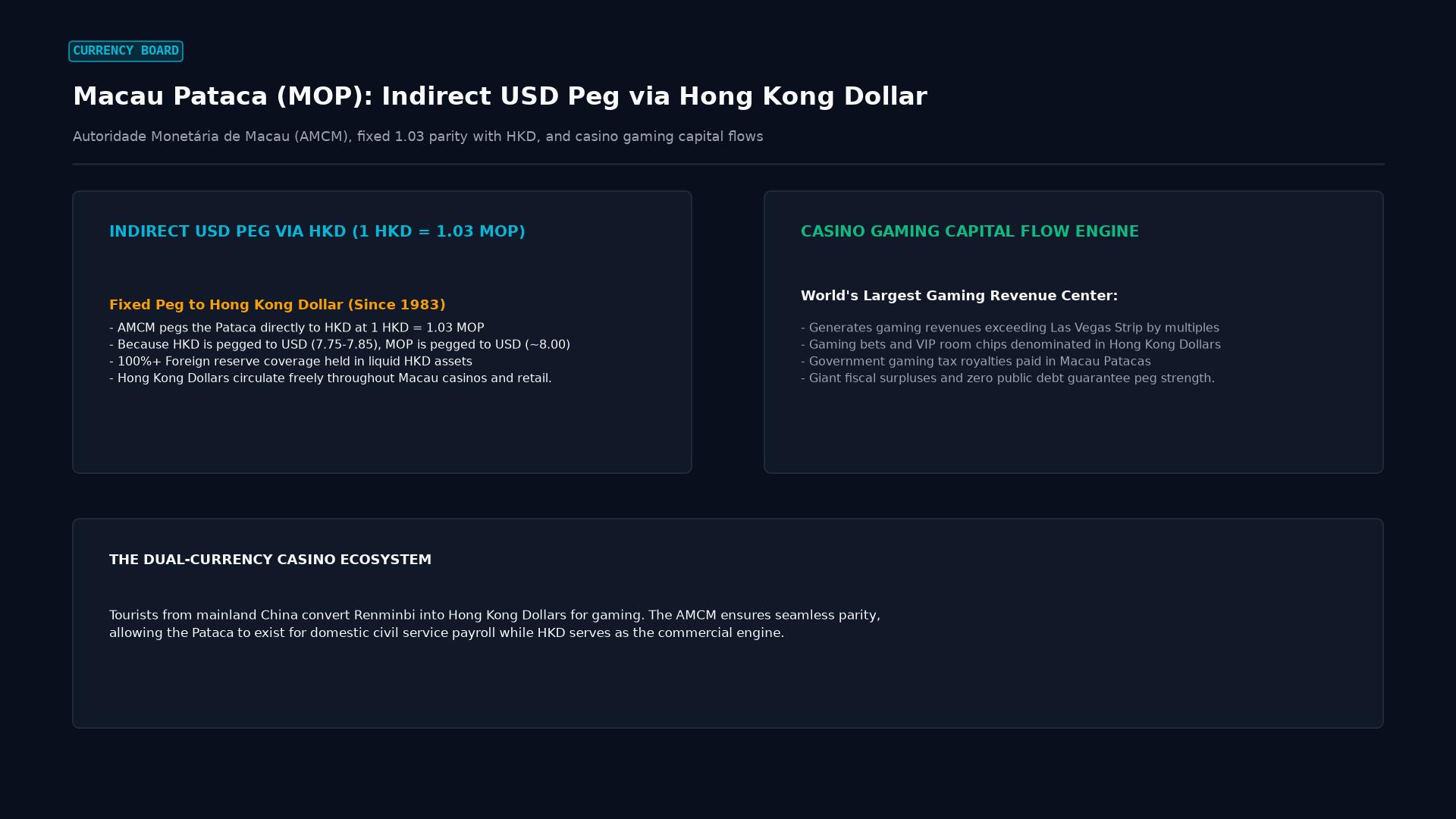 Figure: Autoridade Monetária de Macau (AMCM), fixed 1.03 parity with HKD, and casino gaming capital flows
The Currency Board Mechanism and the Hong Kong Dollar Peg
The legal foundation of Macau’s monetary system is governed by Decree-Law No. 39/95/M. Under this statutory currency board regime:
1. The 1:1.03 Exchange Parity
By law, the Macau Pataca is pegged to the Hong Kong Dollar at the exact fixed rate of:
1 HKD = 1.03 MOP <---> 100 HKD = 103 MOPBecause the Hong Kong Monetary Authority (HKMA) maintains its own Linked Exchange Rate System pegging the HKD to the US Dollar within a strict band of 7.75 to 7.85, the Macau Pataca is indirectly anchored to the US Dollar at roughly:
1 USD ≈ 8.03 MOP2. Mandatory 100% Foreign Exchange Reserve Backing
Every pataca issued into circulation must be backed by more than 100% in liquid foreign exchange reserves, held primarily in Hong Kong Dollar cash deposits, high-grade sovereign Treasury bills, and HKMA exchange fund paper.
The AMCM is legally prohibited from monetizing government expenditures or printing money unbacked by foreign exchange assets. If domestic public demand for patacas expands, the issuing authorities can release new notes only upon receiving an equivalent amount of Hong Kong Dollars.
3. Dual Commercial Banknote Issuers
Unlike countries where a state-owned central bank prints physical paper currency, Macau employs a commercial dual-issuance model similar to Hong Kong:
- Banco Nacional Ultramarino (BNU): A commercial subsidiary of Portugal’s state-owned bank, Caixa Geral de Depósitos, which has issued currency in Macau since 1906.
- Bank of China (Macau Branch): Commenced note issuance alongside BNU in October 1995 leading up to the December 1999 handover of administrative sovereignty from Portugal to China.
Both institutions issue distinct banknote designs under the strict supervision of the AMCM, which holds the underlying foreign exchange reserve certificates.
Multi-Currency Dynamics in the World’s Gaming Capital
Macau’s economy is uniquely defined by its status as the world’s most lucrative casino gambling hub, generating gross gaming revenues that routinely eclipse the combined revenues of the Las Vegas Strip and Atlantic City. This commercial structure fosters a dynamic multi-currency ecosystem:
| Currency | Daily Role in Macau Economy | Market Acceptance & Regulatory Rules |
|---|---|---|
| Hong Kong Dollar (HKD) | Dominant commercial currency; standard denomination for casino chips and luxury trade | Universally accepted across all businesses at 1:1 face value parity, despite the official 3% peg differential |
| Macau Pataca (MOP) | Statutory legal tender; domestic retail commerce and civil administration | Mandatory currency for government taxes, public utility bills, municipal transit, and local residential leasing |
| Chinese Yuan (CNY) | Mainland tourist spending currency | Accepted widely at retail merchants via digital mobile payment platforms (Alipay, WeChat Pay) with real-time conversion |
| United States Dollar (USD) | International corporate reserve and wholesale banking settlement | Held in commercial banking deposits; utilized for multinational hotel and resort supply contracts |
The “One-to-One” Retail Custom (Sap Sam)
A fascinating operational reality for travelers and merchants in Macau is the informal retail practice known colloquially as Sap Sam.
Although the statutory exchange rate is 1 HKD = 1.03 MOP, the vast majority of local retail shops, street markets, taxis, and restaurants accept Hong Kong Dollars at a 1:1 parity with the Pataca. Consumers paying with Hong Kong cash voluntarily forfeit the 3% premium for the convenience of immediate payment, and change is often returned in local Patacas.
However, in the multi-billion-dollar casino gaming concessions (operated by global giants like Sands China, Wynn Macau, and SJM Holdings), gaming chips, table minimums, and VIP junket settlements are transacted almost exclusively in Hong Kong Dollars, insulating casino operators from cross-currency translation friction.
Macroeconomic Drivers and Fiscal Reserves
Macau’s sovereign balance sheet is among the strongest and most resilient in the global economy:
1. Direct Gaming Tax Receipts
The Macau SAR government levies a statutory gross gaming tax of roughly 39% to 40% on all casino gross gaming revenues. During economic expansion phases, these tax revenues generate massive sovereign budget surpluses, allowing the administration to fund generous social welfare programs and distribute annual universal cash dividends (Wealth Partaking Scheme) directly to permanent residents.
2. Zero Sovereign Debt
The government of Macau maintains zero sovereign debt. It does not issue public government bonds to finance state expenditures. Instead, accumulated fiscal windfalls are channeled into the sovereign Macau Fiscal Reserve, managed by the AMCM.
3. Monetary Policy Subordination
Under the economic trilemma, because Macau maintains open capital mobility and fixes the Pataca to the Hong Kong Dollar (which is tied to the US Dollar), the AMCM has zero independent monetary policy discretion.
When the US Federal Reserve alters the federal funds rate, the Hong Kong Monetary Authority adjusts the Base Rate on its discount window, and the AMCM must immediately adjust its own Base Rate to match. Interest rates on mortgages, corporate loans, and savings deposits in Macau reflect decisions made in Washington and Hong Kong rather than local economic conditions.
Foreign Exchange Microstructure and Convertibility
For global financial institutions, currency traders, and corporate treasuries:
- Absence of Speculative Spot Markets: The Pataca is an illiquid frontier currency that does not trade on mainstream interbank electronic forex platforms (such as EBS or Refinitiv). Speculative trading volume on USD/MOP is virtually non-existent.
- Convertibility Channels: Deliverable conversions pass through onshore commercial banks in Macau and Hong Kong. Because of the currency board’s hard reserve backing, commercial banks execute conversions between HKD and MOP without exchange restrictions or sovereign transfer delays.
- Economic Integration with the Greater Bay Area: Ongoing financial initiatives within China’s Guangdong-Hong Kong-Macau Greater Bay Area are streamlining cross-border digital yuan (e-CNY) pilots and multi-currency mobile clearing, integrating Macau’s financial system deeper with the mainland Chinese economy.
Key Takeaways
- The Macau Pataca (MOP) is the official currency of the Macau Special Administrative Region, regulated by the Monetary Authority of Macao (AMCM).
- The currency operates under a strict currency board pegged to the Hong Kong Dollar at 1 HKD = 1.03 MOP, indirectly tying it to the US Dollar at ~8.03 MOP.
- Physical banknotes are issued under a commercial dual-issuance model by Banco Nacional Ultramarino (BNU) and Bank of China.
- The domestic economy operates as a multi-currency environment: the HKD dominates casino gaming and wholesale trade, while the MOP governs civic administration and local retail.
- Supported by a 40% tax on gross gaming revenues, Macau carries zero sovereign debt and maintains substantial foreign exchange and fiscal reserve buffers.
Frequently Asked Questions
Can a visitor use Hong Kong Dollars everywhere in Macau?
Yes. Hong Kong Dollars are accepted by virtually all merchants, restaurants, transport providers, and casinos throughout Macau. While retail shops often accept HKD at 1:1 parity (giving up the 3% difference), casino gaming tables strictly require Hong Kong Dollars for purchasing chips.
Why is the Macau Pataca pegged to the Hong Kong Dollar instead of the Chinese Yuan?
Historically, Hong Kong became the financial, logistics, and trading center of Southern China long before the modern opening of mainland China’s economy. Macau’s tourism and gaming sectors were founded on visitors and capital from Hong Kong, making the HKD the most practical, stable, and liquid regional anchor.
What is the origin of the word “Pataca”?
The word “Pataca” derives from the Portuguese word for a silver coin previously used in Asian and American trade (the Spanish-Portuguese eight-real coin or pataca mexicana). The currency unit was formally established in Portuguese Macau in 1901 to replace the circulating silver Mexican dollar coins.
Ready to trade forex?
Open a free demo account with a regulated broker. Practice with virtual funds before risking real money.