Macaulay Duration
Macaulay duration is a fixed-income risk metric that measures the weighted average time until a bond's cash flows are received, weighting each period by the present value of that cash flow relative to the bond's market price.
What Is Macaulay Duration?
Macaulay duration is a foundational risk metric in fixed-income portfolio management that calculates the weighted average maturity of a bond’s expected cash flows, expressed in years. Introduced in 1938 by Canadian economist Frederick Macaulay in his landmark National Bureau of Economic Research study, the metric transformed how institutional investors analyze debt securities by moving beyond simplistic contractual maturity dates to capture the true economic lifespan of an income-producing asset.
A 10-year corporate bond that distributes a high 9% annual coupon returns substantial cash flow to the investor in years one through nine, meaning the investor recovers their invested capital far faster than a 10-year bond paying a 2% coupon. Macaulay duration quantifies this economic reality: it calculates the exact balance point in time where the present value of received cash flows equals the present value of remaining future cash flows.
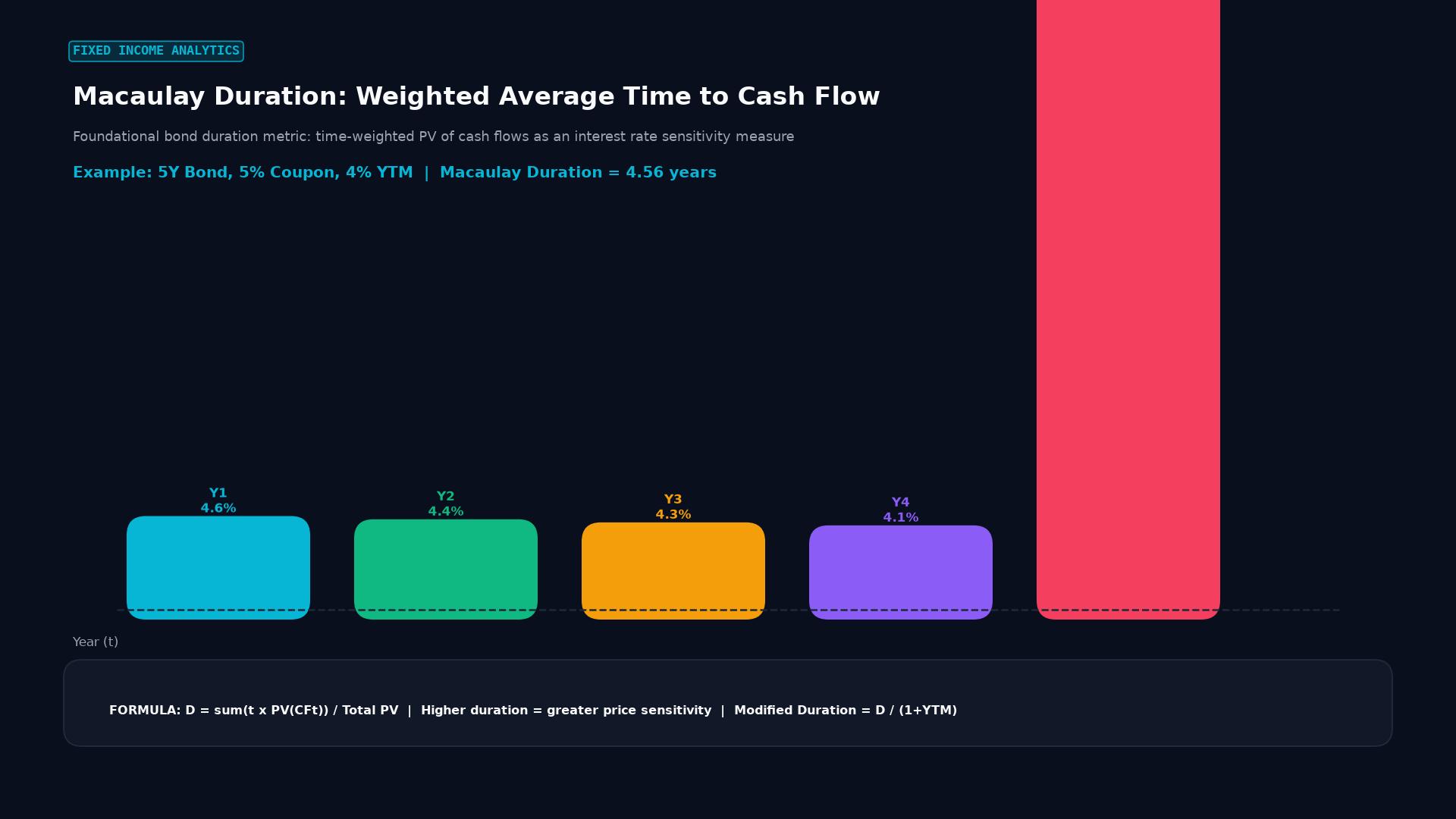 Figure: Foundational bond duration metric: time-weighted PV of cash flows as an interest rate sensitivity measure
The Mathematical Formula for Macaulay Duration
Macaulay duration weights each time interval ($t$) by the present value of the cash flow received at that time, divided by the total clean market price of the bond ($P$):
       sum_{t=1}^n [ t * CF_t / (1 + y)^t ]
MacD = ------------------------------------
                       P
Where:
- $t$ represents the period in which the cash flow is received (expressed in years or fractional years)
- $CF_t$ represents the contractual cash flow received at time $t$ (coupon payments $C$, plus the par value $M$ at maturity)
- $y$ represents the bond’s Yield to Maturity (YTM) per compounding period
- $(1 + y)^t$ represents the discount factor converting future nominal dollars into present value
- $P$ is the current market price of the bond, which equals the sum of the present values of all future cash flows:
P = sum_{t=1}^n [ CF_t / (1 + y)^t ]When evaluating a semi-annual bond (the standard format for US Treasuries and corporate debt), the formula computes duration in semi-annual periods, which must then be divided by 2 to express Macaulay duration in annualized calendar years.
The Core Axioms of Macaulay Duration
Fixed-income traders rely on several mathematical relationships that govern how duration interacts with bond characteristics:
1. The Zero-Coupon Bond Axiom
For any zero-coupon bond, Macaulay duration equals its exact term to maturity:
MacD_zero = Maturity (n)Because a zero-coupon bond distributes no intermediate cash payments along the way, 100% of its economic present value is delivered at the final maturity date. A 10-year zero-coupon Treasury bond has a Macaulay duration of exactly 10.0 years.
2. The Coupon Rate Inverse Relationship
As a bond’s coupon rate increases, its Macaulay duration decreases. Higher coupon distributions deliver cash flow to the investor earlier in the bond’s life cycle, shifting the present value weight forward and reducing sensitivity to subsequent interest rate shifts.
3. The Yield to Maturity Inverse Relationship
As prevailing market yields ($y$) increase, Macaulay duration decreases. Higher discount rates diminish the present value of distant future cash flows (such as the final principal repayment) more aggressively than near-term coupon payments, shortening the weighted average time horizon.
4. The Maturity Relationship
For bonds trading at par or a premium, an increase in contractual maturity produces an increase in Macaulay duration. However, duration increases at a decreasing rate, eventually approaching an asymptotic ceiling for ultra-long-dated bonds.
From Macaulay Duration to Modified Duration
While Macaulay duration measures time in years, institutional traders and risk managers require a metric that directly translates interest rate changes into percentage price sensitivity.
This led to the creation of Modified Duration (ModD), which adjusts Macaulay duration by the bond’s periodic yield:
                MacD
Modified Dur = --------
               1 + (y/k)
Where:
- $MacD$ is the Macaulay duration in years
- $y$ is the annual yield to maturity
- $k$ is the number of compounding payments per year (e.g., $k=2$ for semi-annual coupons)
Modified duration provides a linear first-order derivative estimate of a bond’s price response to interest rate fluctuations:
Percentage Price Change (Delta P / P) ≈ - Modified Duration * Delta yFor example, if a corporate bond exhibits a Macaulay duration of 7.35 years and a YTM of 5.0% compounded semi-annually, its Modified Duration is:
ModD = 7.35 / (1 + 0.05/2) = 7.35 / 1.025 = 7.17 YearsIf market interest rates rise by 100 basis points (+1.00%), the bond’s market price will drop by approximately 7.17%.
Comparative Duration Matrix
| Bond Structure | Coupon Rate | Yield to Maturity | Maturity | Macaulay Duration | Modified Duration |
|---|---|---|---|---|---|
| 5-Year Zero-Coupon | 0.00% | 4.00% | 5.0 Years | 5.00 Years | 4.81 Years |
| 5-Year Treasury Note | 3.50% | 4.00% | 5.0 Years | 4.54 Years | 4.45 Years |
| 5-Year Corporate Bond | 7.00% | 4.00% | 5.0 Years | 4.21 Years | 4.13 Years |
| 10-Year Treasury Note | 3.50% | 4.00% | 10.0 Years | 8.12 Years | 7.96 Years |
| 30-Year Treasury Bond | 3.50% | 4.00% | 30.0 Years | 17.65 Years | 17.30 Years |
Asset-Liability Management (ALM) and Portfolio Immunization
The primary institutional application of Macaulay duration is portfolio immunization in pension funds, life insurance companies, and commercial bank treasury desks.
Defined-benefit corporate pension funds carry legally binding future liabilities: they must disburse retirement annuities to pensioners decades into the future. If interest rates drop, the present value of those pension liabilities surges, threatening fund solvency.
Under Classical Immunization Theory (developed by Frank Redington in 1952), a portfolio manager can eliminate interest rate risk by matching the Macaulay duration of the asset portfolio to the Macaulay duration of the future liabilities:
MacD_Assets = MacD_LiabilitiesWhen asset duration equals liability duration:
- If interest rates fall, capital gains on the bond portfolio offset the increased present value of the liabilities.
- If interest rates rise, reinvestment income earned on cash coupons at the new higher rates offsets the capital loss suffered on bond prices.
By maintaining duration matching and rebalancing periodically, the fund ensures it will possess the exact liquidity required to satisfy its obligations regardless of interest rate volatility.
Limitations and the Convexity Adjustment
While Macaulay and Modified Duration provide indispensable risk insights, they represent linear tangent approximations of a relationship that is fundamentally non-linear and curved.
For large shifts in interest rates (such as rate movements of 200 to 300 basis points), duration alone understates price appreciation when rates fall and overstates price depreciation when rates rise. Institutional desks correct for this error by adding a second-order derivative: Bond Convexity:
Delta P / P ≈ [ - Modified Duration * Delta y ] + [ 0.5 * Convexity * (Delta y)^2 ]Key Takeaways
- Macaulay duration measures the weighted average time until a bondholder receives expected cash flows, expressed in calendar years.
- The metric weights each cash flow by its present value relative to the bond’s clean market price.
- For zero-coupon bonds, Macaulay duration equals the exact time to contractual maturity.
- Higher coupon rates and higher yields shorten Macaulay duration by returning economic value earlier in the bond’s lifecycle.
- Modified duration converts Macaulay duration into an actionable percentage price sensitivity metric ($% \Delta P \approx -\text{ModD} \times \Delta y$).
- Institutional allocators deploy duration matching to immunize pension funds and life insurance liabilities against interest rate shocks.
Frequently Asked Questions
What is the fundamental difference between Macaulay duration and Modified duration?
Macaulay duration measures the economic time to cash flow recovery in years. Modified duration is a price sensitivity measure derived from Macaulay duration that quantifies the percentage change in a bond’s price for a 100-basis-point (1.00%) shift in yield to maturity.
Why is the Macaulay duration of a coupon-paying bond always less than its maturity?
A coupon-paying bond distributes periodic cash interest payments prior to the final maturity date. Because these early payments have positive present value, they pull the weighted average time of cash flow delivery forward, ensuring duration is strictly less than contractual maturity.
What is Effective Duration, and how does it relate to Macaulay duration?
Macaulay and Modified duration assume that future cash flows are fixed and unchanging. For bonds with embedded options (such as callable corporate bonds or mortgage-backed securities where prepayments fluctuate with interest rates), cash flows change when rates move. In these cases, investors must calculate Effective Duration using numerical option pricing models rather than standard Macaulay formulas.
Ready to trade forex?
Open a free demo account with a regulated broker. Practice with virtual funds before risking real money.