Managed earnings
Managed earnings refers to the deliberate manipulation of financial reporting by corporate management, utilizing accounting discretion, subjective accruals, or aggressive operational timing to produce smoothed, inflated, or predetermined net income figures.
Managed earnings (often termed earnings management or creative accounting) is the deliberate intervention by corporate executives in the external financial reporting process to influence reported earnings. By exploiting the latitude inherent in Generally Accepted Accounting Principles (GAAP) or International Financial Reporting Standards (IFRS), corporate leaders smooth quarterly earnings volatility, meet consensus equity research estimates, inflate executive incentive bonuses, or avert loan covenant breaches.
The practice spans a spectrum: from aggressive, legal accounting choices within the boundaries of GAAP (such as extending asset depreciable useful lives) to illegal financial statement fraud (such as fabricating sales invoices, concealing liabilities, or misclassifying routine operating expenses as capital investments). While proponents argue that mild earnings smoothing reduces perceived business risk, empirical forensic accounting demonstrates that systematic earnings management obscures economic reality, misallocates capital, and often precedes corporate collapse.
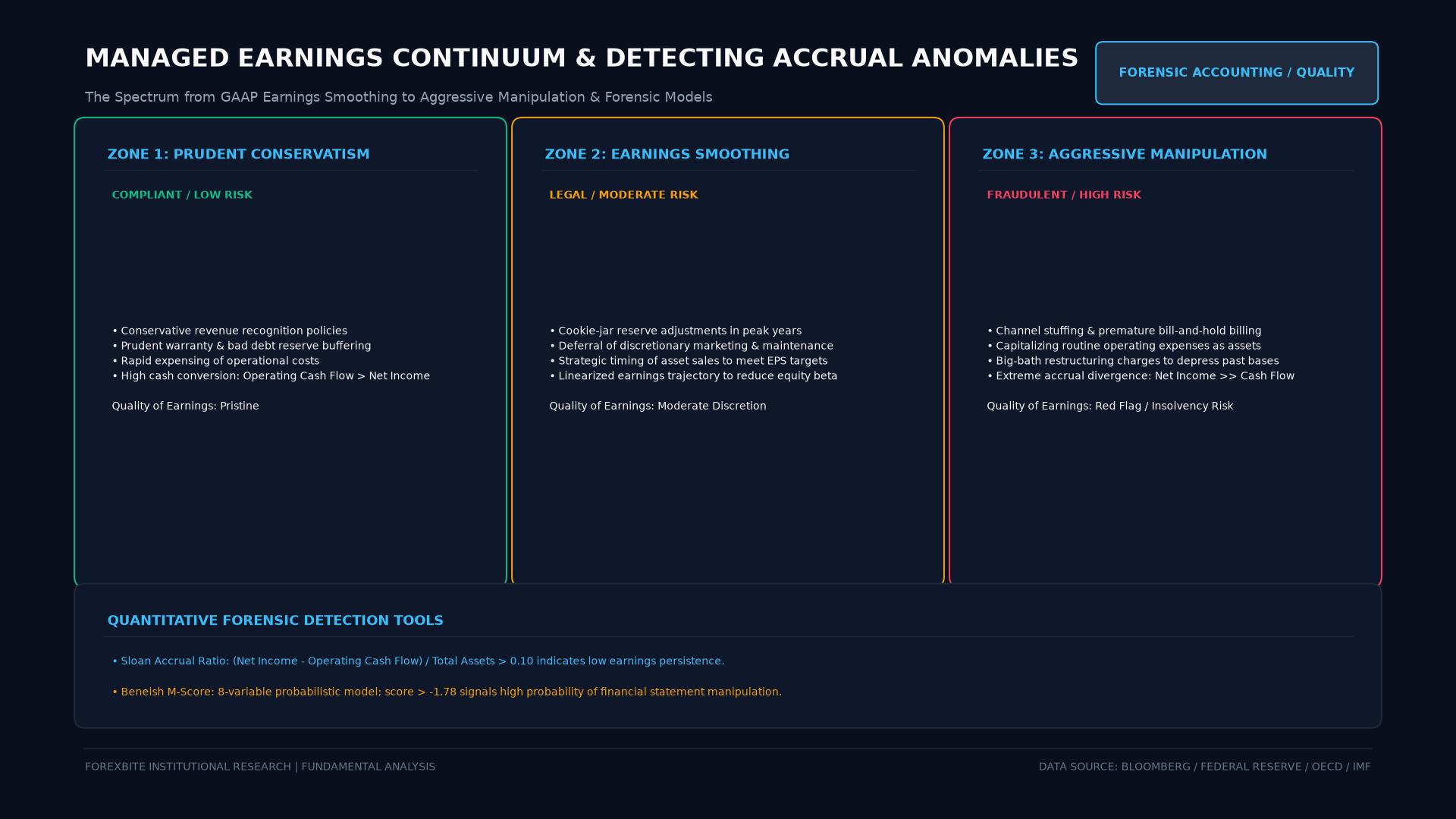 Figure: The corporate earnings management continuum from conservative GAAP compliance to aggressive accrual manipulation, accompanied by quantitative forensic models (Beneish M-Score and Sloan Accrual Ratio).
Historical Background and Arthur Levitt’s “Numbers Game”
The institutionalization of quarterly corporate earnings targets created intense pressure on executive suites. On September 28, 1998, Arthur Levitt, Chairman of the US Securities and Exchange Commission (SEC), delivered a landmark address at New York University titled “The Numbers Game”. Levitt identified five widespread techniques used by Wall Street and corporate executives to manipulate financial reports:
1. “Big Bath” Restructuring Charges
When a company experiences an unavoidable quarterly loss (or executes a change in senior leadership), management concentrates as many anticipated future expenses, asset write-downs, and severance costs as possible into that single disastrous quarter. By “clearing the decks” and taking a massive one-time charge, future quarters are artificially freed from depreciation and operating expenses, ensuring immediate earnings rebounds.
2. Creative Acquisition Accounting
During corporate mergers, acquiring firms historically allocated excessive portions of the purchase price to in-process research and development (IPR&D), expensing it immediately on the acquisition date. This reduced the recognition of goodwill and eliminated future annual amortization charges against operating income.
3. “Cookie Jar” Reserves
In unusually profitable quarters, management records inflated reserves for sales returns, loan losses, warranty claims, or legal contingencies. These accrued liabilities serve as a financial “cookie jar.” In subsequent quarters when operating revenues falter, management reverses these subjective reserves back into income, creating an illusion of steady earnings growth.
4. Abuse of Materiality (SAB 99)
Corporate controllers historical defended intentional accounting misstatements by asserting that the discrepancy was quantitatively immaterial (e.g., less than 5% of gross profit). The SEC countered this practice in 1999 by publishing Staff Accounting Bulletin No. 99 (SAB 99), establishing that qualitative factors (such as an adjustment that transforms a quarterly loss into a profit or enables executives to hit incentive bonus thresholds) make an error legally material regardless of size.
5. Premature Revenue Recognition (SAB 101/104)
Recognizing revenue before an order is manufactured, delivered, or legally accepted. Common variations include “channel stuffing” (shipping unrequested excess inventory to distributors at year-end with generous side agreements permitting returns) and “bill-and-hold” schemes.
       ARTHUR LEVITT'S FIVE FINANCIAL ILLUSIONS (1998)

1. Big Bath Charges:      Pack all write-downs into one sacrificial quarter
2. Acquisition Write-offs: Write off assets at merger to cut future depreciation
3. Cookie Jar Reserves:    Over-accrue liabilities in good years; reverse in bad years
4. Materiality Exploits:   Hide intentional misstatements behind small percentages
5. Revenue Recognition:   Book sales before delivery or satisfaction of covenants
Analytical Framework: Accrual vs Real Earnings Management
Forensic analysts divide earnings management into two operational methodologies: Accrual-Based Earnings Management (AEM) and Real Earnings Management (REM).
1. Accrual-Based Earnings Management (AEM)
Under the accrual basis of accounting, revenue is recognized when earned and expenses are recognized when incurred, regardless of physical cash flows:
$$\text{Net Income} = \text{Cash Flow from Operations (CFO)} + \text{Total Accruals}$$
Where:
- $\text{Total Accruals} = \Delta \text{Working Capital Assets} - \Delta \text{Operating Liabilities} - \text{Depreciation & Amortization}$
Total accruals consist of non-discretionary accruals ($NDA$, dictated by legitimate business sales growth) and discretionary accruals ($DA$, subjective estimates manipulated by executives):
$$\text{Total Accruals} = \text{NDA} + \text{DA}$$
When net income substantially exceeds Cash Flow from Operations over consecutive reporting periods, the quality of earnings is suspect: the discrepancy indicates that earnings are being manufactured through expanding discretionary accruals rather than cash collections.
2. Real Earnings Management (REM)
Unlike accrual manipulation, which adjusts journal entries without altering physical operations, Real Earnings Management involves altering business operations to reach short-term accounting benchmarks:
- Overproduction of Inventory: A manufacturing company ramps production far beyond market demand. Because fixed manufacturing overhead is absorbed across a larger unit volume, unit product cost falls, reducing reported Cost of Goods Sold (COGS) on current sales and temporarily inflating gross profit margins.
- Slashing Discretionary R&D and Marketing: Executives abruptly terminate long-term research programs or advertising campaigns in Q4 to eliminate operating expenses, meeting current quarterly EPS targets at the expense of long-term competitiveness.
                    ACCRUAL VS REAL MANIPULATION

Methodology     Direct Tool                Timing         Long-Term Value Impact
----------------------------------------------------------------------------------
Accrual (AEM)   Book estimates & reserves  Post-period-end Reversible paper distortion
Real (REM)      Operational cuts / excess  Intra-period    Destroys fundamental value
Quantitative Forensic Detection: The Beneish M-Score
Developed by Professor Messod Beneish in 1999, the Beneish M-Score is a mathematical model combining eight fundamental financial statement ratios to determine whether a public company has manipulated its earnings.
The composite equation is formulated as:
$$M = -4.84 + 0.920 \times \text{DSRI} + 0.528 \times \text{GMI} + 0.404 \times \text{AQI} + 0.892 \times \text{SGI} + 0.115 \times \text{DEPI} - 0.172 \times \text{SGAI} + 4.037 \times \text{TATA} + 0.0327 \times \text{LVGI}$$
Where the eight sub-indices evaluate specific warning signs:
- DSRI (Days Sales in Receivables Index): $\frac{\text{Receivables}t / \text{Sales}t}{\text{Receivables}{t-1} / \text{Sales}{t-1}}$. A surge in receivables relative to sales signals aggressive revenue acceleration or channel stuffing.
- GMI (Gross Margin Index): $\frac{\text{Gross Margin}_{t-1}}{\text{Gross Margin}_t}$. A ratio exceeding 1.0 indicates deteriorating gross margins, providing management with an incentive to engage in earnings manipulation.
- AQI (Asset Quality Index): Measures non-current assets other than property, plant, and equipment (e.g., capitalized intangible assets). An increase indicates excessive expense capitalization.
- SGI (Sales Growth Index): High sales growth companies face severe market penalties if growth decelerates, increasing management pressure to manipulate figures.
- DEPI (Depreciation Index): $\frac{\text{Depr Rate}_{t-1}}{\text{Depr Rate}_t}$. A ratio greater than 1.0 reveals that the company slowed its depreciation rate by extending asset useful lives to boost earnings.
- SGAI (Sales, General, and Administrative Expense Index): Disproportionate SG&A expansion indicates declining operational efficiency.
- TATA (Total Accruals to Total Assets): $\frac{\text{Net Income} - \text{CFO}}{\text{Total Assets}}$. High positive accruals represent synthetic paper earnings unsupported by cash.
- LVGI (Leverage Index): Rising debt-to-assets increases financial distress, heightening the risk of loan covenant breaches.
Interpretation Threshold
$$\text{If } M > -1.78 \implies \text{High Probability of Financial Statement Manipulation}$$ $$\text{If } M \le -1.78 \implies \text{Normal Reporting Probability (Low Manipulation Risk)}$$
In academic backtests, the Beneish model successfully flagged Enron’s financial statements as manipulated well before the energy giant filed for bankruptcy in 2001.
Real-World Case Study: WorldCom Capitalization of Line Costs
The collapse of telecommunications titan WorldCom in 2002 remains one of the largest corporate earnings management and accounting fraud cases in financial history.
+--------------------------------------------------------------------+
|               WORLDCOM LINE COST CAPITALIZATION FRAUD              |
+--------------------------------------------------------------------+
| 1. Economic Shock (2000-2001): Dot-com bust; corporate data usage  |
|    collapses. WorldCom faced multi-billion-dollar fixed lease fees |
|    owed to local telecom networks ("line costs").                   |
| 2. Operating Margin Crisis: Operating expenses soared past 50% of  |
|    gross revenue, threatening to trigger steep quarterly losses.   |
| 3. Executive Directive: CFO Scott Sullivan directed accounting    |
|    staff to reclassify routine monthly line costs from ordinary    |
|    operating expenses (OPEX) to long-term capital assets (CAPEX).  |
| 4. Financial Statement Distortion: Over $3.8 billion in routine    |
|    operating expenses were transferred to balance-sheet accounts   |
|    under the label "prepaid capacity".                             |
| 5. Result: Reported EBITDA and Net Income were artificially        |
|    inflated by billions, meeting Wall Street expectations.         |
| 6. Discovery & Bankruptcy: Internal auditor Cynthia Cooper         |
|    discovered the bogus entries; WorldCom filed Chapter 11 with    |
|    over $100 billion in assets, resulting in prison terms for execs.|
+--------------------------------------------------------------------+
Under standard accounting principles, lease payments for network access are routine period operating expenses that must be deducted immediately against revenue. By capitalizing $3.8 billion of these line costs as long-term capital assets, WorldCom avoided deducting them from income.
This simple journal entry transformed what was actually a substantial net loss into a reported multi-billion-dollar pre-tax profit. The fraud demonstrated how earnings management shifts into outright criminality when executives manufacture balance-sheet assets out of ordinary operational costs.
Statutory and Regulatory Reforms: The Sarbanes-Oxley Act of 2002
In direct response to Enron, WorldCom, and Sunbeam, the US Congress enacted the Sarbanes-Oxley Act of 2002 (SOX), fundamentally altering corporate governance and external audit oversight:
- SOX Section 302: Chief Executive Officers (CEOs) and Chief Financial Officers (CFOs) must personally certify the accuracy and completeness of all quarterly and annual SEC filings (Forms 10-Q and 10-K), facing criminal fines up to $5,000,000 and 20 years in federal prison for willful false certifications.
- SOX Section 404: Mandates that public companies establish, maintain, and assess an adequate Internal Control over Financial Reporting (ICFR) framework, accompanied by an independent external auditor attestation.
- Creation of the PCAOB: Established the Public Company Accounting Oversight Board to inspect and regulate independent accounting audit firms, ending self-regulation within the accounting profession.
- Clawback Provisions (SOX Section 304 & Dodd-Frank Section 954): Mandates that public corporations claw back performance-based executive compensation paid to executives if financial statements must subsequently be restated due to accounting errors or manipulation.
Frequently Asked Questions
Is earnings management always illegal?
No. Earnings management spans a broad spectrum. Discretionary decisions permitted under GAAP (such as choosing between FIFO and weighted-average inventory accounting, altering bad debt provisions within realistic ranges, or delaying discretionary research expenditures) are legal business judgments. However, when accounting entries violate GAAP standards, conceal material facts, fabricate fictitious revenues, or falsify liabilities, earnings management crosses the legal boundary into criminal securities fraud.
How can a fundamental analyst detect earnings management?
Fundamental analysts monitor specific structural discrepancies:
- Divergence Between Cash Flow and Net Income: Consistently high net income paired with stagnant or negative Cash Flow from Operations (CFO).
- Spike in Days Sales Outstanding (DSO): Accounts receivable expanding at a faster percentage rate than total revenue.
- Repeated Non-Recurring Charges: Companies that classify ongoing, routine business costs as “one-time, extraordinary restructuring charges” every year to inflate adjusted Non-GAAP EPS.
- High Beneish M-Score: An M-Score calculated above the -1.78 threshold.
What is the difference between pro-forma (Non-GAAP) earnings and managed earnings?
Non-GAAP (or pro-forma) earnings are alternative financial presentations provided by management that exclude specific items (such as stock-based compensation, goodwill impairments, or acquisition restructuring fees) from standard GAAP net income. While Non-GAAP metrics are disclosed openly and reconciled to GAAP, they can serve as an aggressive form of managed perception if management selectively excludes recurring costs to present an artificially flattering view of core operating profitability.
Ready to trade forex?
Open a free demo account with a regulated broker. Practice with virtual funds before risking real money.