Managed economy
A managed economy is an economic framework where state authorities actively direct national resources, production targets, strategic capital allocation, and market structures rather than relying exclusively on laissez-faire market clearing.
A managed economy is an economic system in which the central government, national planning agencies, and regulatory ministries exercise deliberate, systematic control over macroeconomic resources, industrial development, price mechanisms, and capital investment. In contrast to pure free-market capitalism, where supply, demand, and decentralized price discovery allocate resources, a managed economy subordinates market forces to state-directed social, industrial, or strategic priorities.
Managed economies exist along a broad institutional continuum: from total central planning (where private property is abolished and a national agency sets production quotas) to state capitalism and modern industrial policy (where private enterprise operates within strategic frameworks guided by state subsidies, sovereign wealth funds, and state-owned commercial banks).
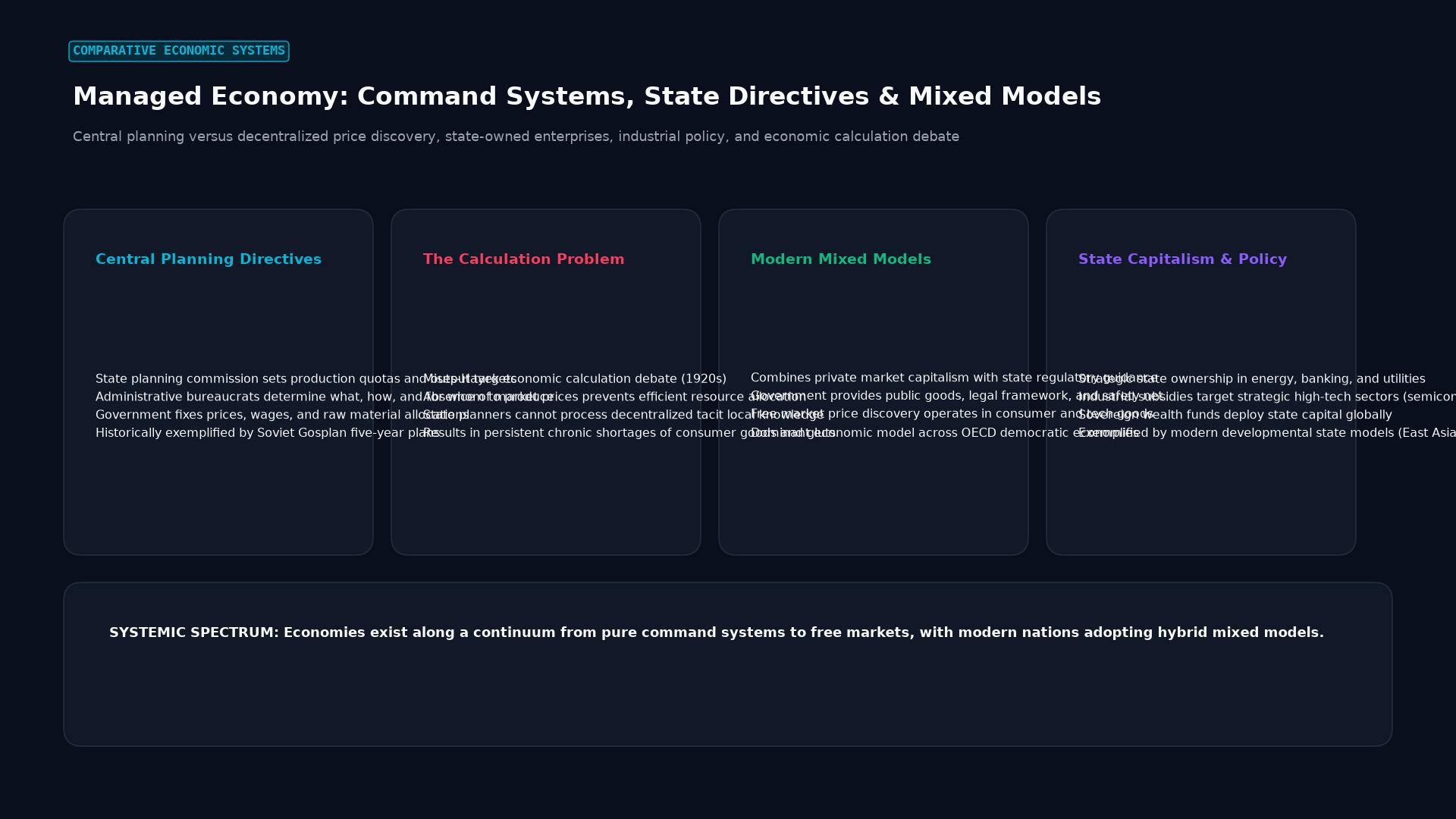 Figure: Central planning versus decentralized price discovery, state-owned enterprises, industrial policy, and economic calculation debate
Historical Taxonomies of Managed Economies
Throughout the twentieth and twenty-first centuries, nations have organized managed economies under distinct structural doctrines:
1. The Soviet Command Model (Gosplan)
The most extreme form of managed economy operated in the Soviet Union from 1928 to 1991. Through the State Planning Committee (Gosplan), the state nationalized all land, factories, and natural resources. Gosplan calculated input-output matrices across hundreds of thousands of commodities, dictating physical production quotas, agricultural deliveries, and consumer retail prices across multiple five-year plans.
Without market prices to reflect scarcity, the system generated persistent shortages of consumer goods, massive overproduction of unwanted industrial machinery, and widespread supply-chain paralysis.
2. French Dirigisme and Indicative Planning (1945–1975)
Following World War II, France instituted dirigisme to reconstruct its war-torn industrial base without abolishing private property. Led by the General Planning Commission (Commissariat Général du Plan) under Jean Monnet, France utilized “indicative planning”:
- The state established long-term production and modernization targets for key sectors (steel, electricity, transportation, telecommunications).
- The government nationalized core commercial banks (such as Crédit Lyonnais and BNP) and infrastructure providers (EDF, SNCF, Air France).
- Through the Ministry of Finance and state-controlled credit allocation, the government channeled low-interest loans to private corporations that aligned their investments with national planning priorities.
This model powered Les Trente Glorieuses (The Thirty Glorious Years), three decades of rapid French post-war economic expansion.
3. The East Asian Developmental State
Pioneered by post-war Japan under the Ministry of International Trade and Industry (MITI, now METI) and replicated by South Korea, Taiwan, and Singapore, the developmental state model paired private capitalist ownership with aggressive state export coordination:
- The state protected infant domestic industries using selective tariffs and import bans.
- Subsidized credit, tax holidays, and foreign exchange allocations were granted exclusively to industrial conglomerates (such as Japanese keiretsu or South Korean chaebols) that satisfied strict export performance benchmarks in global markets.
- National research institutes funded advanced technology adoption, transitioning these economies from agrarian low-wage producers into global leaders in electronics, semiconductors, shipbuilding, and automotive manufacturing.
4. The Socialist Market Economy of China (SASAC Model)
Initiated by Deng Xiaoping in 1978 under “Reform and Opening Up”, modern China operates a hybrid economic model. While agriculture and light consumer industries were privatized, the Chinese Communist Party retains control over the “commanding heights” of the economy through the State-owned Assets Supervision and Administration Commission (SASAC):
- SASAC oversees roughly one hundred massive central state-owned enterprises (SOEs) dominating energy, telecommunications, aviation, rail, defense, and heavy chemicals.
- The state-owned commercial banking sector (“The Big Four”: ICBC, CCB, ABC, Bank of China) provides financing for state industrial plans, including Five-Year Plans and high-speed rail networks.
- Private technology and manufacturing firms operate within broad national regulatory corridors.
       FOUR ARCHETYPES OF THE MANAGED ECONOMY

Model           Historical Example  Primary Mechanism            Ownership Mix
----------------------------------------------------------------------------------
Command         Soviet Union        Central Gosplan Quotas       100% State Public
Dirigisme       Post-War France     Indicative Credit Guidance   Mixed (State SOEs)
Developmental   Japan / South Korea Export Discipline & Subsidies Private Chaebols
State Capitalist Modern China       SASAC Strategic SOEs + Credit Party-State Hybrid
Theoretical Debates: The Socialist Calculation Problem
The economic viability of managed economies has been the subject of profound theoretical debates in economic science:
1. The Austrian Critique: Mises and Hayek
In 1920, Ludwig von Mises published Economic Calculation in the Socialist Commonwealth, arguing that rational economic calculation is impossible under a command economy. Mises demonstrated that without private ownership of the means of production, there can be no market for capital goods; without a market for capital goods, genuine market-clearing prices cannot emerge; and without market prices reflecting relative scarcity, planners cannot calculate the opportunity cost of resources.
In 1945, Friedrich Hayek expanded this critique in “The Use of Knowledge in Society”. Hayek proved that economic knowledge is fundamentally decentralized, fragmented, and tacit:
- Millions of consumers and local business owners possess real-time information regarding local conditions, preferences, and immediate bottlenecks.
- The market price system acts as a communications telecommunications network, synthesizing this dispersed information into a single scalar number (the price).
- No centralized planning bureau or algorithm can aggregate this dynamic tacit knowledge, resulting in chronic allocative inefficiency.
2. Market Failure and the Role of the State
Conversely, economists such as Paul Samuelson, Arthur Pigou, and Mariana Mazzucato emphasize that unmanaged free markets fail systematically when confronting:
- Public Goods: Clean energy infrastructure, national transport networks, and public health systems require coordinated state capital expenditure because private firms cannot exclude non-payers.
- Positive Externalities: Basic scientific research and technological innovation generate societal returns far exceeding private commercial capture. Government defense and space agencies (e.g., DARPA, NASA) directly funded the foundational technologies behind the internet, GPS, microprocessors, and touchscreen interfaces.
- Coordination Failures: In developing economies, private firms hesitate to invest in industrial plants if complementary suppliers, ports, and trained labor forces do not exist. A managed developmental state solves this “big push” problem by orchestrating simultaneous, coordinated investments across interdependent industries.
Microeconomic Distortions of Direct State Price Management
When a managed economy institutes direct price controls (such as price ceilings on food and energy, or price floors on agricultural commodities), it distorts market incentives, generating Deadweight Loss (DWL).
       DEADWEIGHT LOSS UNDER STATUTORY PRICE CEILING

Price
  ^
  |        Supply (S)
  |           \            /
P*|............\..........X............ Equilibrium Market Price
  |             \        / \
  |              \      /   \
Pc|---------------+----+-----\--------- Legal Price Ceiling
  |               |    |      \
  |               |DWL |       Demand (D)
  |               |    |
  +---------------+----+----------------->
  0              Qs   Q*      Qd       Quantity

           Shortage = (Qd - Qs)
Where:
- $P^$ and $Q^$ represent the free-market clearing price and quantity.
- $P_c$ is the statutory price ceiling imposed by the government below equilibrium.
- At $P_c$, consumers demand quantity $Q_d$, but suppliers produce only quantity $Q_s$, creating a market shortage equal to $(Q_d - Q_s)$.
The resulting economic deadweight loss is calculated geometrically:
$$\text{DWL} = \frac{1}{2} (P_{\text{shadow}} - P_c) (Q^* - Q_s)$$
Where:
- $P_{\text{shadow}}$ is the shadow reservation price consumers are willing to pay for the limited supply $Q_s$.
In historical command economies, this deadweight loss manifested as physical rationing coupons, miles-long queues outside grocery stores, and flourishing underground black markets trading at realistic market clearing rates.
Real-World Case Study: The French Nuclear Power Transition (Plan Messmer)
The execution of the French nuclear power program under the Messmer Plan represents a compelling example of effective state-managed economic coordination within a mixed market.
+--------------------------------------------------------------------+
|               THE 1974 FRENCH MESSMER NUCLEAR PLAN                 |
+--------------------------------------------------------------------+
| 1. Strategic Catalyst: The 1973 OPEC oil embargo quadrupled crude  |
|    oil prices, threatening French energy and economic sovereignty. |
| 2. Executive State Mandate: Prime Minister Pierre Messmer announced|
|    the complete decarbonization and electrification of France.      |
| 3. Centralized Coordination: State energy monopoly EDF, national   |
|    atomic agency CEA, and industrial champion Framatome unified    |
|    under a single standardized reactor design (PWR).               |
| 4. Sovereign Financing: State-guaranteed loans and national bank   |
|    credit allocated billions in low-cost capital over two decades. |
| 5. Outcome: France constructed 56 standardized nuclear reactors,    |
|    generating over 70% of national electricity, achieving the      |
|    lowest electricity production costs and carbon emissions in     |
|    Western Europe, and becoming Europe's top power exporter.       |
+--------------------------------------------------------------------+
In 1974, following the first OPEC oil crisis, French Prime Minister Pierre Messmer recognized that France had no domestic oil or natural gas reserves (“No oil, but ideas”). Rather than leaving energy generation to fragmented private utilities, the French state mobilized a coordinated national effort:
- The state-owned national utility, Électricité de France (EDF), acted as the single architect and operator.
- The government mandated a single standardized pressurized water reactor (PWR) design licensed from Westinghouse, driving massive economies of scale and cross-facility component interchangeability.
- Construction and engineering companies were guaranteed multi-decade procurement contracts.
By the 1990s, the program had deployed 56 nuclear reactors across France. The initiative delivered reliable, low-cost domestic power, insulated the national economy from subsequent global oil price shocks, and established France as the leading net electricity exporter in the European Union, demonstrating how state coordination can resolve large-scale infrastructure challenges that private markets struggle to finance.
Financial Market and Investment Implications
Global macro investors, sovereign debt analysts, and foreign exchange traders evaluate managed economies through specific analytical criteria:
- Sovereign Credit and Implicit Guarantees: State-owned enterprises (SOEs) in managed economies frequently carry implicit state guarantees, lowering their bond yields. However, when governments allow non-strategic SOEs to default (as seen with local government financing vehicles in China), institutional investors face sharp re-pricing of credit risk.
- Capital Controls and Currency Convertibility: Managed economies commonly restrict capital outflows to preserve domestic banking liquidity and protect pegged foreign exchange rates. International portfolio managers demand higher equity risk premiums to compensate for the risk of sudden capital repatriation freezes.
- Political and Regulatory Intervention Risk: Sudden state regulatory pivots (such as sudden antitrust crackdowns, unexpected tariff changes, or sector nationalizations) can erase equity market capitalization overnight, as observed in emerging market technology and private education sectors.
Frequently Asked Questions
What is the primary difference between a command economy and a mixed economy?
A command economy features total state ownership of all production assets, the abolition of private enterprise, and the replacement of price signals with administrative production quotas. A mixed economy maintains a dominant private sector where prices are determined by supply and demand, while the government intervenes via regulatory standards, progressive taxation, social safety nets, public infrastructure investments, and monetary stabilization.
Can an economy transition successfully from a managed model to a market model?
Yes, though historical outcomes vary dramatically based on the speed and sequencing of reforms. The “shock therapy” approach adopted by Russia and parts of Eastern Europe in the early 1990s (rapid price liberalization and mass voucher privatization) resulted in severe hyperinflation, industrial collapse, and the rise of oligarchic monopolies. In contrast, China and Vietnam implemented gradual, dual-track transitions: opening special economic zones and permitting private enterprise while maintaining state ownership over heavy industry and banking, preserving systemic stability.
What is modern industrial policy and is it considered a managed economy?
Modern industrial policy is a targeted form of state economic management within a capitalist economy. Rather than nationalizing private industry or dictating consumer prices, the state uses tax credits, targeted subsidies, national research grants, and public procurement to channel private capital toward strategic technologies (such as semiconductors under the US CHIPS Act or electric vehicle batteries under the European Green Deal). While it departs from strict free-market neutrality, it operates within an open market framework.
Ready to trade forex?
Open a free demo account with a regulated broker. Practice with virtual funds before risking real money.