Initial Margin
Initial margin is the mandatory upfront collateral deposit required by a broker or exchange to open a leveraged financial position, serving as a good-faith performance bond against potential market losses.
What Is Initial Margin?
Initial margin is the minimum amount of capital a trader must have available in their trading account to open a new leveraged position in foreign exchange, futures, or contracts for difference (CFDs). Rather than acting as a fee, purchase cost, or down payment on an asset, initial margin functions as a collateral performance bond.
When a trader executes a leveraged trade, the broker does not deduct the initial margin from the account balance. Instead, the broker temporarily “locks” or segregates that portion of account equity into a designated Used Margin reserve. This locked collateral remains untouchable for opening other positions until the active trade is closed, protecting both the brokerage and the trader from catastrophic default.
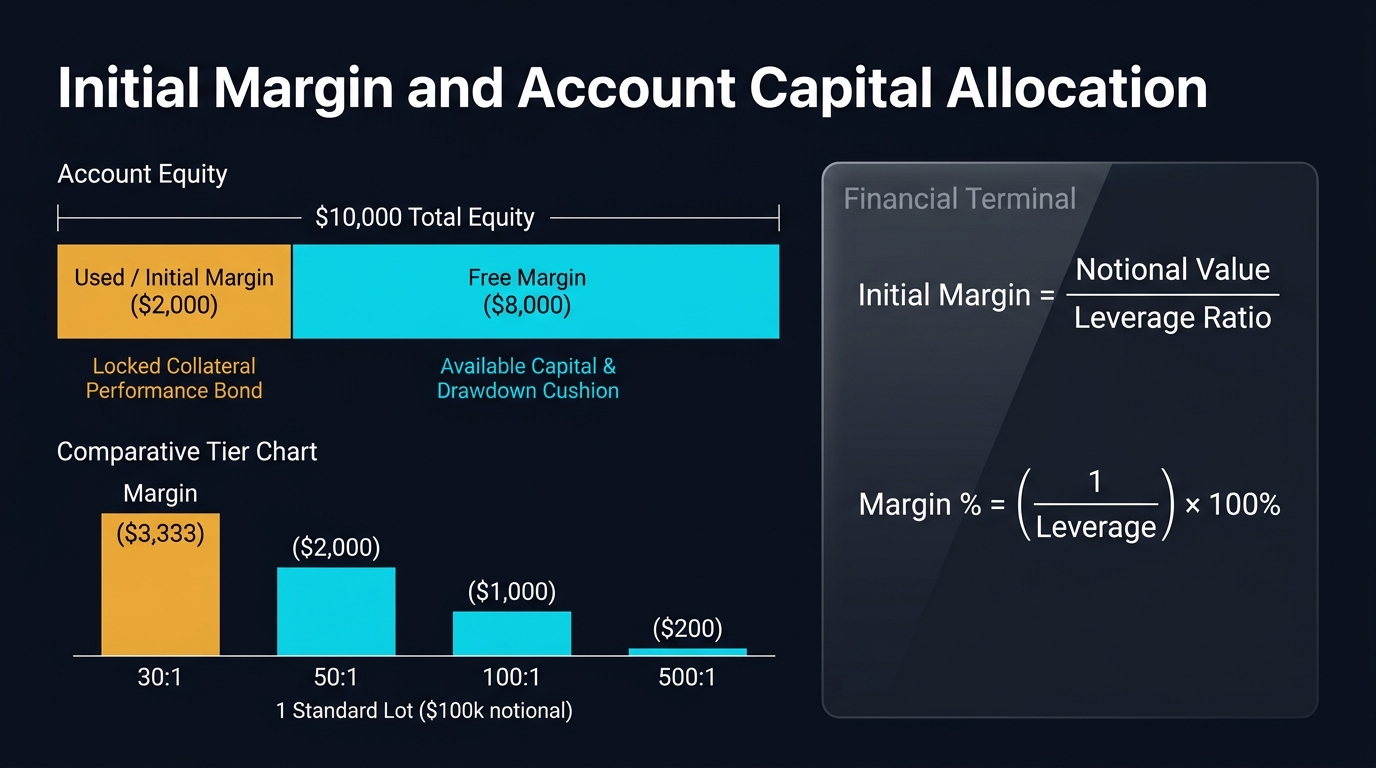
+-------------------------------------------------------------------------+
|                        ACCOUNT CAPITAL ALLOCATION                       |
|                                                                         |
|  [TOTAL ACCOUNT EQUITY: $10,000]                                        |
|  ---------------------------------------------------------------------  |
|  [Used / Initial Margin: $2,000]  |  [Free Margin: $8,000]              |
|  - Locked as collateral bond      |  - Available to open new trades     |
|  - Required to support position   |  - Absorbs floating market losses   |
+-------------------------------------------------------------------------+
How Initial Margin Is Calculated
Initial margin is calculated directly from the total notional value of the trade and the leverage ratio provided by the broker:
$$\text{Initial Margin} = \frac{\text{Notional Position Value}}{\text{Leverage Ratio}}$$
Alternatively, regulators express margin requirements as a percentage:
$$\text{Initial Margin} = \text{Notional Position Value} \times \text{Margin Percentage Requirement}$$
Where:
- $\text{Margin Percentage} = \frac{1}{\text{Leverage Ratio}} \times 100%$
Initial Margin for 1 Standard Lot ($100,000 USD) Across Leverage Tiers
| Leverage Ratio | Margin Percentage | Initial Margin Required (1 Standard Lot) |
|---|---|---|
| 30:1 (ESMA / ASIC Cap) | 3.33% | $3,333.33 USD |
| 50:1 (US CFTC / NFA Cap) | 2.00% | $2,000.00 USD |
| 100:1 (International) | 1.00% | $1,000.00 USD |
| 500:1 (High Leverage) | 0.20% | $200.00 USD |
Numerical Example with Base Currency Conversion
Suppose a trader opens a 1.0 standard lot position on EUR/USD when the exchange rate is 1.0850, utilizing a broker offering 50:1 leverage (2.0% margin requirement):
- Contract Notional Value: €100,000 EUR × 1.0850 = $108,500 USD
- Initial Margin Required: $$\text{Initial Margin} = \frac{$108,500}{50} = \mathbf{$2,170 \text{ USD}}$$
The broker immediately locks $2,170 USD of the trader’s equity to maintain the position.
Initial Margin vs. Maintenance Margin vs. Free Margin
To avoid margin calls and liquidations, traders must distinguish between these critical margin terms:
- Initial Margin: The capital required to enter the trade.
- Maintenance Margin: The minimum equity threshold required to keep the position open as floating losses accumulate. In many retail forex brokerages, initial and maintenance margins are identical, while in futures exchanges, maintenance margin is typically 75% to 85% of initial margin.
- Free Margin: The unencumbered capital remaining in the account ($\text{Equity} - \text{Used Margin}$). Free margin acts as a financial shock absorber; if floating losses consume all free margin, the account triggers a margin call.
- Margin Level Percentage: The ratio of equity to used margin: $$\text{Margin Level} = \left(\frac{\text{Equity}}{\text{Used Margin}}\right) \times 100%$$
Margin Level Thresholds in Retail Forex:
- Above 100%: Account is healthy; free margin remains positive.
- At 100%:    Margin Call Warning; zero free margin left to open trades.
- At 50%:     STOP-OUT LEVEL; broker forcefully liquidates positions.
Global Regulatory Margin Frameworks
Following retail trader losses during systemic flash crashes (such as the 2015 Swiss Franc unpegging), global regulatory authorities instituted strict caps on maximum allowable retail leverage:
| Jurisdiction | Regulatory Body | Major FX Leverage Cap | Initial Margin Requirement |
|---|---|---|---|
| United States | CFTC / NFA | 50:1 | 2.0% on major currencies |
| European Union | ESMA | 30:1 | 3.33% on major pairs (20:1 / 5% on crosses) |
| United Kingdom | FCA | 30:1 | 3.33% on major pairs |
| Australia | ASIC | 30:1 | 3.33% on major pairs |
These mandatory initial margin rules prevent retail traders from wiping out accounts on minor intraday market noise.
Common Retail Mistakes with Initial Margin
- Exhausting Free Margin (Max-Bidding): Committing 80% or 90% of account equity to initial margin locks down capital. A minor 20-pip adverse price move can cause equity to breach the stop-out threshold, triggering immediate automated liquidation.
- Confusing Balance with Equity: Account balance records closed trades; Equity reflects live, unrealized floating profit and loss. Initial margin is locked against Equity, meaning floating drawdowns directly erode the margin cushion.
Key Takeaways
- Initial margin is the mandatory upfront collateral required to open a leveraged trade.
- Margin is not a transaction fee; it is temporarily locked capital returned when the position closes.
- Higher leverage lowers initial margin requirements, but dramatically magnifies percentage-based risk.
- Free margin equals total equity minus used initial margin and absorbs floating losses.
- Leading regulatory authorities (ESMA, CFTC, FCA, ASIC) cap retail leverage between 30:1 and 50:1 to protect consumer capital.
Frequently Asked Questions
What happens to my initial margin when I close a trade?
When you close a position, the locked initial margin is immediately released back into your account’s Free Margin pool, adjusted for any realized profits or losses incurred on the trade.
Why do brokers increase initial margin requirements before elections or major news?
Prior to high-volatility binary events—such as national elections, referendums, or emergency central bank meetings—brokers often raise initial margin requirements (e.g., from 1% to 5%) to reduce account leverage across client books, preventing accounts from falling into negative balances during illiquid price gaps.
What is the difference between initial margin and variation margin?
Initial margin is the collateral deposited upfront to initiate the position. Variation margin is the daily cash payment credited or debited to reflect mark-to-market price changes over the life of the trade.
Ready to trade forex?
Open a free demo account with a regulated broker. Practice with virtual funds before risking real money.