Maturity
Maturity—or maturity date—is the definitive final calendar date on which a financial obligation, debt security, or derivative contract terminates, requiring full repayment of principal capital or physical/cash settlement.
What Is Maturity?
In global finance and investment banking, maturity (or the maturity date) is the contractually designated endpoint of a financial instrument’s life cycle. On this date, the contractual relationship between debtor and creditor, or between derivative counterparties, is legally concluded:
- For debt securities (such as sovereign bonds, municipal notes, corporate debentures, and certificates of deposit), maturity marks the date when the issuer is legally obligated to return the full nominal principal (face value) to investors and cease coupon interest payments.
- For derivatives and foreign exchange contracts (such as currency forwards, cross-currency swaps, and options), maturity represents the final settlement date on which the underlying exchange of cash or physical currencies takes place, or the moment when the derivative contract permanently expires.
The time remaining between today and the maturity date is known as the tenor or term-to-maturity. Across modern capital markets, assets with different maturities trade at different interest rate yields, forming the foundational macroeconomic structure known as the Yield Curve.
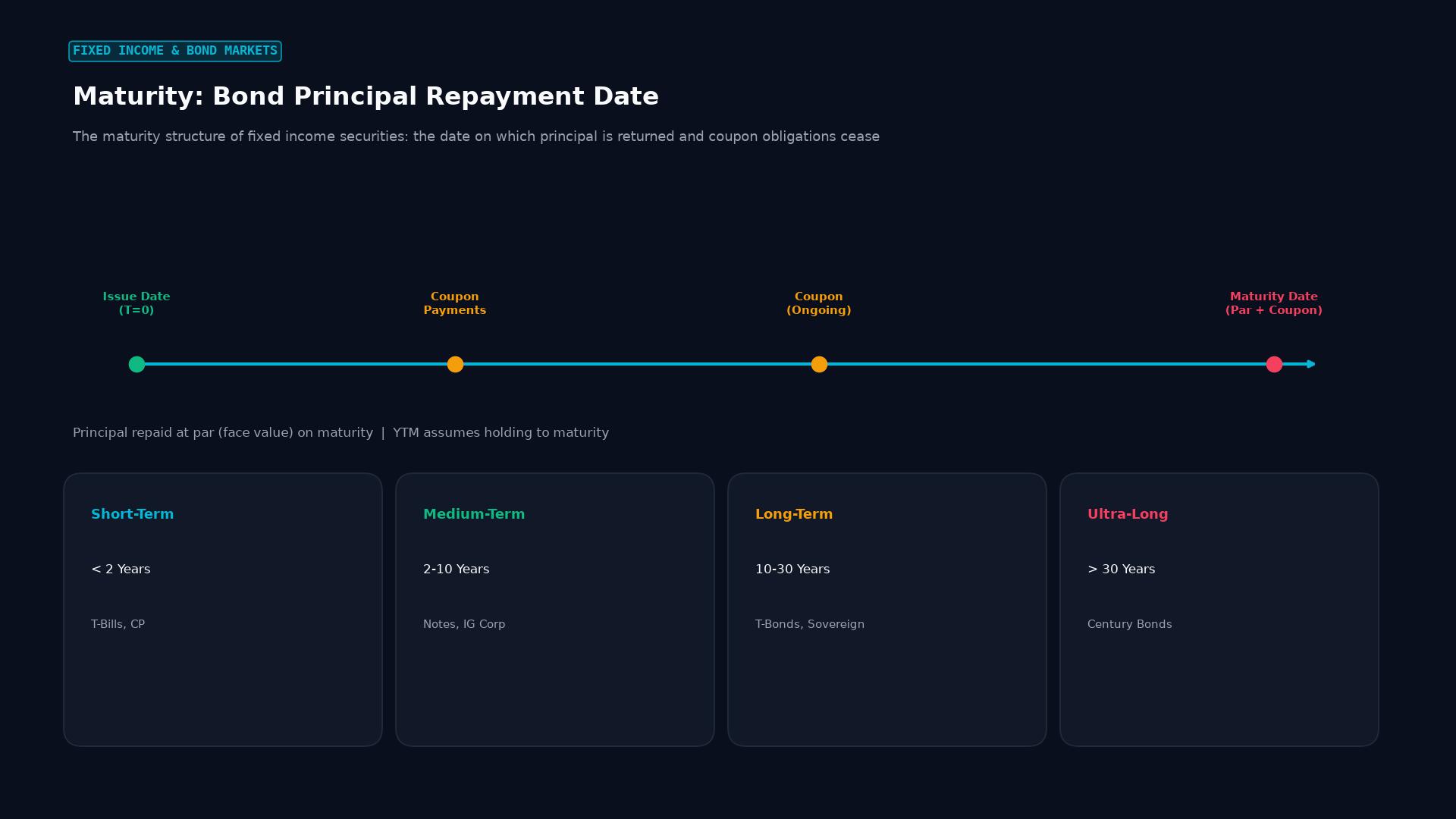 Figure: The maturity structure of fixed income securities: the date on which principal is returned and coupon obligations cease
Key Takeaways
- Contractual Termination: Maturity terminates all ongoing contractual obligations and triggers the final repayment of principal debt or settlement of derivative positions.
- Tenor vs. Maturity: Maturity is a fixed historical calendar date (e.g., December 15, 2034). Tenor is the dynamic duration of time remaining until that date arrives (e.g., 8 years remaining).
- The Duration Principle: As a bond’s maturity extends further into the future, its price sensitivity to interest rate fluctuations (Macaulay Duration) increases exponentially.
- Foreign Exchange Tenors: In the interbank OTC foreign exchange market, forwards and swaps are quoted in standard maturity tenors: Overnight (O/N), Tom-Next (T/N), 1-Week (1W), 1-Month (1M), 3-Month (3M), 6-Month (6M), and 1-Year (1Y).
- Yield Curve Inversion: When short-term maturities yield higher interest rates than long-term maturities, the yield curve inverts, serving as one of the most reliable historical leading indicators of an impending macroeconomic recession.
Comparative Taxonomy: Financial Instruments by Maturity Tier
| Maturity Horizon | Typical Financial Instruments | Price Volatility Risk | Reinvestment Risk | Primary Investor Objective |
|---|---|---|---|---|
| Ultra-Short (Overnight to 1 Year) | Treasury Bills, Commercial Paper, FX Swaps, CDs | Minimal (Near-zero duration) | High (Must roll over constantly) | Cash preservation, liquidity management |
| Intermediate (2 to 10 Years) | Treasury Notes, Corporate Bonds, Medium-Term Swaps | Moderate (Predictable duration) | Moderate | Core institutional fixed-income income |
| Long-Term (10 to 30+ Years) | 30-Year Sovereign Bonds, Infrastructure Debt | Extreme (Very high duration) | Low (Yield locked for decades) | Pension funds, liability-driven investing (LDI) |
| Perpetual (No Maturity) | Consols, Perpetual Preferred Shares, AT1 Bonds | Maximum (No principal repayment guarantee) | Zero | Permanent equity-like capital for banks |
The Mathematics of Maturity and Interest Rate Sensitivity
The relationship between an asset’s maturity and its price sensitivity to shifts in benchmark interest rates is measured via Modified Duration:
$$\text{Modified Duration} = \frac{\text{Macaulay Duration}}{1 + \frac{y}{k}}$$
Where $y$ is the yield to maturity and $k$ is the compounding frequency per year.
$$% \Delta P \approx - \text{Modified Duration} \times \Delta y$$
Numerical Example of Maturity Risk:
Consider two sovereign bonds, both trading at a 4.0% yield ($y = 0.04$):
- Bond A (Short Maturity - 2 Years): Modified Duration = 1.9 years.
- Bond B (Long Maturity - 30 Years): Modified Duration = 17.5 years.
If the central bank unexpectedly raises interest rates by 100 basis points (+1.0%):
- Price Change for Bond A: $-1.9 \times 1.0% = \mathbf{-1.9%}$ (Minor drop).
- Price Change for Bond B: $-17.5 \times 1.0% = \mathbf{-17.5%}$ (Severe capital loss).
This demonstrates why long maturities carry massive capital risk when macroeconomic interest rate regimes shift upward.
Real-World Case Study: Inverted Yield Curve and the 2022–2024 Macro Cycle
Historically, a normal yield curve slopes upward: investors demand a higher yield to lock up capital for 10 or 30 years compared to 3 months.
- The Inversion: In July 2022, the U.S. 2-Year Treasury yield rose above the 10-Year Treasury yield, causing a severe 2Y/10Y Yield Curve Inversion that deepened to over -100 basis points in 2023.
- The Mechanism: The Federal Reserve aggressively hiked short-term borrowing costs to fight inflation, pushing short-maturity yields to 5.5%. However, investors expected long-term economic deceleration, anchoring 30-year bond yields near 4.0%.
- Forex Market Reaction: The high yield on short-term U.S. maturities sparked a historic surge in global capital flows into U.S. Dollar money market funds, propelling the U.S. Dollar Index (DXY) to multi-decade highs against the Japanese Yen, Euro, and British Pound.
Critical Risks Associated with Contract Maturity
- Reinvestment Risk: Holding short-maturity assets protects against bond price drops, but when those assets mature, the investor must reinvest principal into new instruments. If central banks have slashed rates in the interim, subsequent income yields will be drastically lower.
- Roll Risk in Derivatives: Corporate treasuries that hedge long-term multi-year foreign currency exposures using short-term 3-month forward maturities must constantly “roll” contracts at maturity, exposing the firm to shifting interest rate differentials and wider forward points.
Frequently Asked Questions (FAQ)
What happens on the maturity date of a bond?
On the maturity date, the bond issuer repays the final scheduled coupon interest payment plus 100% of the bond’s original par (face) value to the bondholder, extinguishing the debt.
Can an option be exercised after its maturity date?
No. An option’s maturity date (expiration date) represents the absolute final deadline for exercise. Once the official expiration hour passes, an unexercised contract lapses permanently and ceases to exist.
What is the difference between maturity and expiration?
While commonly used as synonyms, “maturity” is the standard term in debt and fixed-income markets referring to principal repayment, while “expiration” is the standard term in derivatives (options and futures) referring to the final cutoff date for exercising contract rights.
Ready to trade forex?
Open a free demo account with a regulated broker. Practice with virtual funds before risking real money.