Minimum Price Contract
A minimum price contract (MPC) is a specialized forward procurement agreement used in agricultural, energy, and commodity markets that guarantees a producer a fixed price floor for future delivery while preserving the ability to participate in market rallies.
What Is a Minimum Price Contract (MPC)?
A minimum price contract (MPC) is a structured physical forward contract widely utilized across the agricultural commodities, energy, and international trade sectors. Executed between a primary producer (such as a grain farmer or oil drilling operator) and a commercial merchant, grain elevator, or industrial processor, the MPC establishes a guaranteed minimum price floor for the future physical delivery of a commodity.
Crucially, unlike a standard fixed-price forward contract—which locks the producer into a rigid price and forfeits all upside if market prices soar—a minimum price contract grants the producer full participation in subsequent price rallies. Structurally, the merchant creates an MPC by embedding a synthetic exchange-traded put option into the physical procurement agreement. The merchant hedges the floor guarantee by purchasing a put option on a derivatives exchange (such as the Chicago Board of Trade, CBOT), deducting the option premium and basis from the contract’s baseline floor.
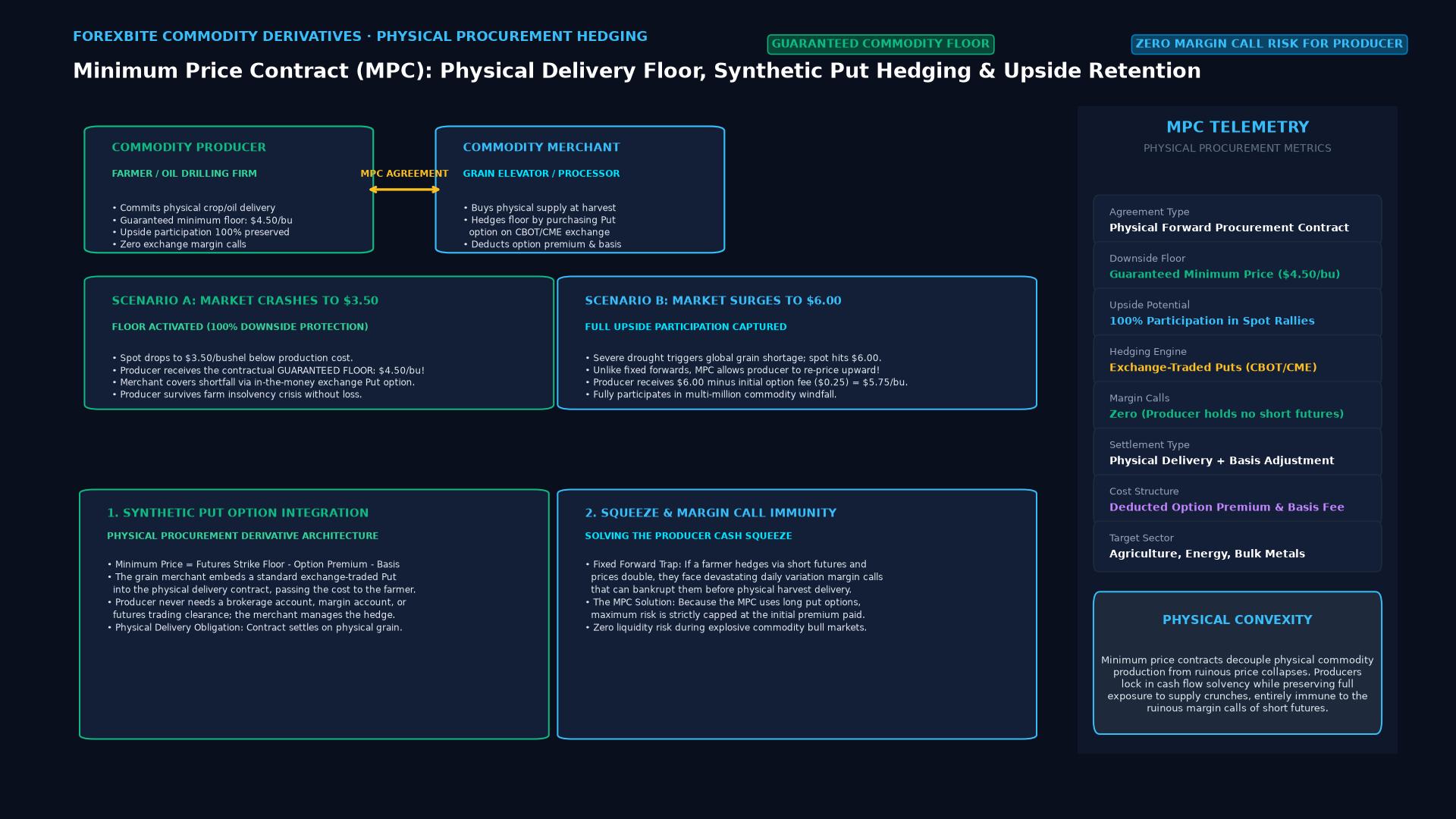 Figure: Structural mechanics of a Minimum Price Contract (MPC) combining physical delivery with exchange-traded put options to guarantee a cash floor while preserving market rally upside.
Key Takeaways
- Asymmetric Payoff Structure: Guarantees absolute downside protection at a predefined price floor while maintaining full upside profit potential if market prices advance.
- Synthetic Put Option Integration: The commercial buyer hedges the MPC by purchasing an exchange-traded put option on futures exchanges (such as CME or ICE), passing the option premium cost through to the producer as a contractual deduction.
- Protection Against Involuntary Short Squeezes: Because the producer is not selling futures contracts directly, they never face unexpected margin calls or variation margin liquidity crises during violent commodity rallies.
- Physical Delivery Commitment: Unlike pure financial options, an MPC is an agreement tied to the physical delivery of actual physical commodities (bushels of corn, barrels of oil, metric tons of wheat).
- Basis Risk Component: The guaranteed minimum price typically reflects the futures price floor adjusted for local basis (the difference between the local cash price and the exchange futures quote).
Comparative Taxonomy: Commodity Marketing Contracts
| Contract Type | Downside Floor Protection? | Upside Rally Participation? | Margin Calls for Producer? | Premium Cost Deducted? |
|---|---|---|---|---|
| Minimum Price Contract (MPC) | Yes (Guaranteed floor) | Yes (Rally participation) | Zero (Merchant holds hedges) | Yes (Option cost embedded) |
| Cash Forward Contract | Yes (Locks exact price) | No (Zero upside) | Zero | None |
| Hedge-to-Arrive (HTA) | No (Futures locked, basis floating) | Yes (Basis upside only) | Zero | None |
| Direct Futures Hedge | Yes (Locks futures level) | No (Offsetting losses on rally) | High (Must fund margin calls) | None |
| Direct Put Option Purchase | Yes (Strike floor) | Yes (Uncapped) | Zero (Capped at premium) | Paid directly upfront to broker |
Mathematical Payoff Formulation
The final cash price received by a producer under a Minimum Price Contract upon physical delivery is expressed as:
$$P_{\text{Final}} = \max\left( K_{\text{Floor}}, ; P_{\text{Futures}} - \text{Option Premium} \right) \pm \text{Basis}$$
Where:
- $K_{\text{Floor}}$ is the contracted minimum futures price floor: $$K_{\text{Floor}} = \text{Put Strike Price} - \text{Option Premium}$$
- $P_{\text{Futures}}$ is the prevailing exchange futures price when the producer elects to lock in their final price.
- $\text{Basis}$ is the local cash differential ($P_{\text{Cash Local}} - P_{\text{Futures}}$).
Numerical Agricultural Scenario:
In May, a soybean farmer anticipates harvesting 50,000 bushels in October. November Soybean Futures trade at $12.50 per bushel.
- Contract Execution: The local grain elevator offers a Minimum Price Contract based on the November $12.50 Put Option, which carries an exchange premium of $0.45 per bushel, plus a $0.05 elevator administrative fee.
- Floor Calculation: The guaranteed futures floor is established at: $$$12.50 - ($0.45 + $0.05) = \mathbf{$12.00 \text{ per bushel}}$$
- Scenario A (Severe Drought Crushes Crop, Futures Surge to $15.00):
- The farmer exercises the upside clause in September.
- The farmer receives $$15.00 - $0.50 = \mathbf{$14.50 \text{ per bushel}}$ (capturing an extra $2.50/bu over the floor).
- Scenario B (Global Bumper Harvest, Futures Collapse to $9.50):
- The farmer falls back on the contract floor.
- The farmer is paid the full guaranteed $12.00 per bushel, completely shielded from the $3.00 market crash.
Strategic Advantages Over Direct Producer Hedging
For independent agricultural producers and mid-sized commodity enterprises, executing an MPC with an elevator is often vastly superior to opening a personal commodity brokerage account:
- Zero Margin Call Risk: In 2022, when fertilizer and crop prices exploded, farmers who directly shorted futures to hedge their crops faced massive, multi-million-dollar cash margin calls from brokers before harvest, driving many to near-bankruptcy. Under an MPC, the commercial elevator finances all margin calls with its bank credit lines.
- Simplicity: The farmer avoids managing complex options Greek models, trading accounts, and exchange clearing statements.
Pitfalls and Contractual Traps
- Basis Risk Uncertainty: Many MPCs guarantee only the futures price component, leaving the local cash basis unpriced until delivery. If local elevators suffer terminal storage bottlenecks at harvest, basis can collapse from -$0.20 to -$1.00, eroding net realized revenue despite the futures floor.
- Deadline Clauses: An MPC always contains an expiration deadline (typically 30 days prior to contract maturity) by which the producer must declare whether they are setting the final price or accepting the floor. Failing to notify the merchant can result in automatic settlement at disadvantageous baseline rates.
Frequently Asked Questions (FAQ)
Can minimum price contracts be used in foreign exchange?
Yes. In corporate forex risk management, structured forward contracts known as Participating Forwards or Capped Forwards function identically to an MPC: a corporate importer or exporter establishes a worst-case exchange rate floor while retaining 50% to 100% participation in favorable currency movements.
Does a producer have to pay cash upfront for an MPC?
Generally no. The cost of purchasing the underlying put option and the elevator’s administrative fee are not paid out-of-pocket; instead, they are deducted directly from the contract’s baseline floor price or subtracted from the final crop settlement check.
What happens if the producer cannot deliver the physical commodity?
Because an MPC is a binding physical procurement contract, failure to deliver the agreed commodity (due to hail, drought, or operational failure) constitutes a contract breach. The producer is legally obligated to buy out the contract or settle the cash difference between the contract price and the prevailing market replacement price.
Ready to trade forex?
Open a free demo account with a regulated broker. Practice with virtual funds before risking real money.