MISE
MISE stands primarily for Mean Integrated Squared Error in quantitative finance and statistical modeling, measuring the accuracy of probability density estimators. In macroeconomic policy, it historically designates the Italian Ministry of Economic Development.
The acronym MISE possesses two distinct meanings within institutional finance, quantitative modeling, and international macroeconomic policy:
- In Quantitative Finance and Statistical Modeling: MISE stands for Mean Integrated Squared Error. It is the primary mathematical loss function used by quantitative analysts and financial econometricians to measure the accuracy and performance of non-parametric probability density estimators, particularly Kernel Density Estimation (KDE) applied to asset return distributions and options-implied volatility surfaces.
- In Macroeconomics and European Industrial Policy: MISE designates the Ministero dello Sviluppo Economico (Ministry of Economic Development), the executive department of the Italian government responsible for national industrial policy, energy security, foreign direct investment screening (“Golden Power”), and state restructuring of distressed commercial enterprises.
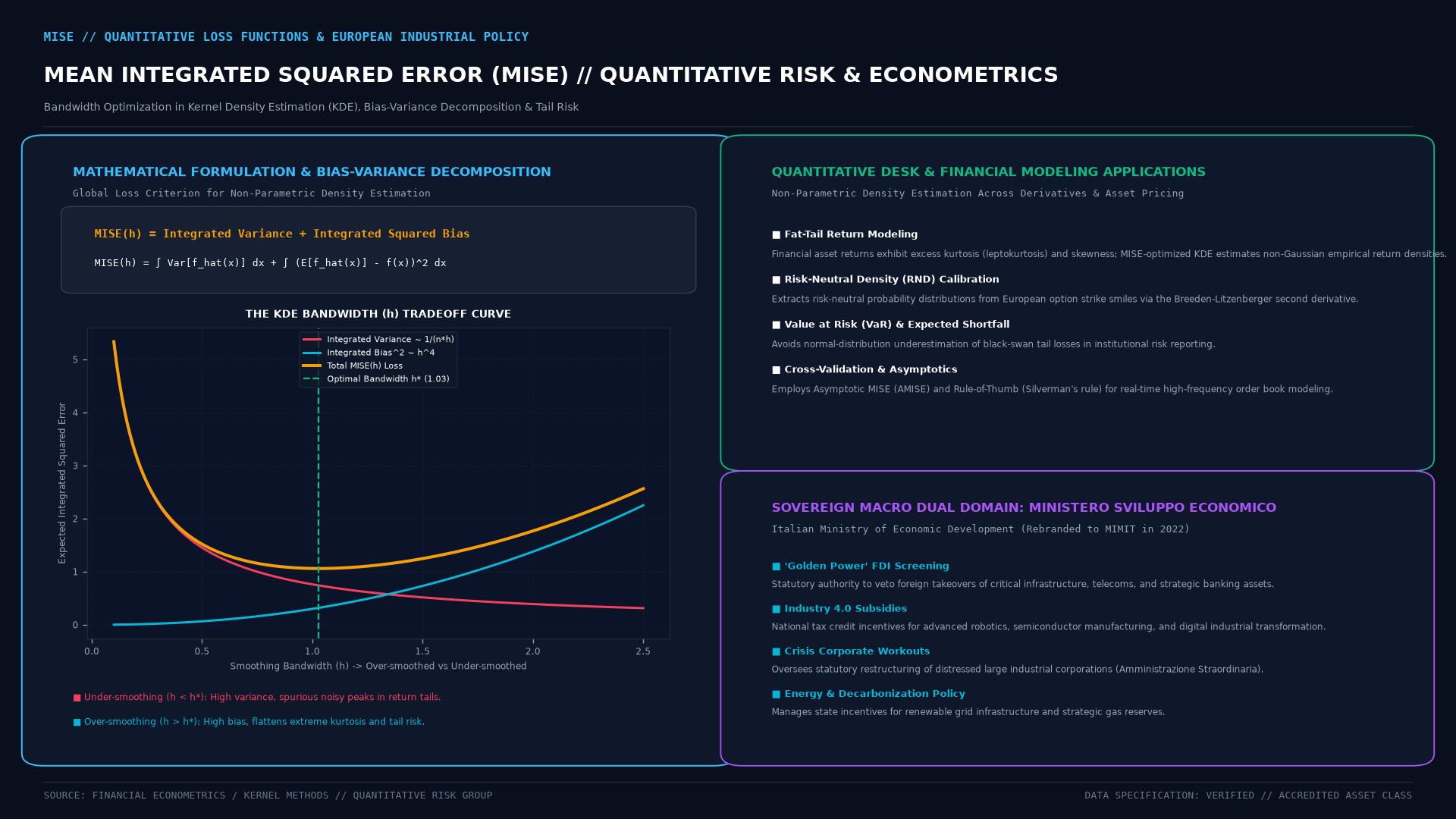 Figure: Mathematical formulation and bias-variance decomposition of Mean Integrated Squared Error (MISE) in Kernel Density Estimation (KDE), illustrating optimal bandwidth selection ($h^$) for fat-tail asset return modeling and options risk-neutral density estimation, alongside the dual sovereign domain of the Italian Ministry of Economic Development (MISE).*
Primary Domain: Mean Integrated Squared Error in Quantitative Trading
In quantitative asset management, risk modeling, and algorithmic derivatives pricing, analysts must model the true probability distribution ($f$) of asset returns without relying on overly simplistic assumptions of normal Gaussian distributions. Financial market returns display fat tails (leptokurtosis) and negative skewness that standard parametric models fail to capture.
To construct empirical return distributions from historical tick or daily price data, quantitative desks utilize Kernel Density Estimation (KDE). The fundamental challenge in KDE is selecting the optimal smoothing parameter, or bandwidth ($h$). Mean Integrated Squared Error (MISE) serves as the definitive global criterion for calibrating this bandwidth.
1. Mathematical Formulation and Decomposition
Let $X_1, X_2, \dots, X_n$ be an independent and identically distributed sample of financial asset log-returns drawn from an unknown density function $f$. The kernel density estimator $\hat{f}_h(x)$ is defined as:
$$\hat{f}h(x) = \frac{1}{n h} \sum{i=1}^{n} K\left( \frac{x - X_i}{h} \right)$$
Where:
- $K(\cdot)$ is a standardized kernel function (such as a Gaussian or Epanechnikov kernel) satisfying $\int K(u) du = 1$.
- $h > 0$ is the smoothing bandwidth.
The Mean Integrated Squared Error measures the expected total squared discrepancy between the estimated density $\hat{f}_h(x)$ and the true underlying density $f(x)$ integrated across the entire real support domain:
$$\text{MISE}(h) = E\left[ \int_{-\infty}^{\infty} \Big(\hat{f}_h(x) - f(x)\Big)^2 dx \right]$$
Applying Fubini’s theorem and expanding the expectation, MISE decomposes into the sum of Integrated Variance and Integrated Squared Bias:
$$\text{MISE}(h) = \int_{-\infty}^{\infty} \text{Var}\Big(\hat{f}h(x)\Big) dx + \int{-\infty}^{\infty} \text{Bias}^2\Big(\hat{f}_h(x)\Big) dx$$
                 THE MISE BIAS-VARIANCE TRADEOFF

Loss / Error
   ^
   |        \                                 /  Total MISE Error Curve
   |         \         Optimal Bandwidth (h*) /
   |          \              |               /
   |           \             v              /
   |            \          +---+           /   Integrated Squared Bias
   |             \________/     \_________/    (Increases with large h)
   |              \                     /
   |               \                   /
   | Integrated     \                 /
   | Variance        \               /
   | (Spikes with     \             /
   |  tiny h)          \           /
   +--------------------+---------+---------------------------->
   0                  h* (Optimal)                  Bandwidth (h)
2. The Bandwidth Selection Dilemma
The decomposition illustrates the core tradeoff in quantitative financial modeling:
- Under-smoothing (Tiny $h$): If the bandwidth $h$ is too small, the estimator conforms too closely to individual historical sample points. The bias is near zero, but the integrated variance explodes, producing an erratic, noisy density estimate.
- Over-smoothing (Large $h$): If the bandwidth $h$ is too wide, the estimator smooths out critical distributional features. The variance is minimal, but the integrated squared bias surges, masking multi-modal distributions, volatility clustering, and fat tail risks.
3. Asymptotic MISE (AMISE) and Optimal Bandwidth ($h^*$)
Using Taylor series expansions under standard smoothness assumptions, the Asymptotic Mean Integrated Squared Error (AMISE) is formulated as:
$$\text{AMISE}(h) = \frac{R(K)}{n h} + \frac{1}{4} h^4 \mu_2(K)^2 R(f’’)$$
Where:
- $R(K) = \int K(u)^2 du$ is the roughness of the kernel.
- $\mu_2(K) = \int u^2 K(u) du$ is the second moment of the kernel.
- $R(f’‘) = \int \Big(f’’(x)\Big)^2 dx$ reflects the roughness (curvature) of the true density’s second derivative.
Differentiating $\text{AMISE}(h)$ with respect to $h$ and setting the result equal to zero yields the theoretical optimal bandwidth ($h^*$):
$$h^* = \left( \frac{R(K)}{n \mu_2(K)^2 R(f’’)} \right)^{\frac{1}{5}}$$
Under Silverman’s Rule of Thumb, assuming a Gaussian reference distribution with standard deviation $\hat{\sigma}$, the optimal bandwidth simplifies to:
$$h_{\text{Silverman}} = 1.06 \hat{\sigma} n^{-\frac{1}{5}} \approx 0.9 \min\left(\hat{\sigma}, \frac{\text{IQR}}{1.34}\right) n^{-\frac{1}{5}}$$
Where $\text{IQR}$ is the sample Interquartile Range, providing resistance against financial market outlier anomalies.
Secondary Domain: Ministero dello Sviluppo Economico (MISE)
In European macroeconomic governance and Italian corporate finance, MISE designated the Ministero dello Sviluppo Economico (Ministry of Economic Development). In late 2022, under the Meloni administration, the ministry was reorganized and officially rebranded as MIMIT (Ministero delle Imprese e del Made in Italy), though international investors, credit agencies, and legal statutes frequently reference its historical MISE moniker.
Core Strategic Mandates of MISE / MIMIT
- The “Golden Power” National Security Review: Under Law Decree 21/2012 and subsequent amendments, MISE coordinates the Italian state’s “Golden Power” veto authority. The government holds statutory rights to block, condition, or veto foreign acquisitions of strategic Italian corporations operating in defense, energy, telecommunications (5G networks), transportation, banking, and artificial intelligence.
- Industrial Subsidies and Transition 4.0: MISE manages billions of euros in corporate tax credits, research grants, and capital subsidies under the national Piano Transizione 4.0 (funded partly via the EU Recovery and Resilience Facility, RRF), incentivizing Italian manufacturing enterprises to automate production lines and adopt green technologies.
- Extraordinary Administration of Distressed Enterprises (Amministrazione Straordinaria): Under the Marzano Law, when large Italian industrial conglomerates with over five hundred employees face insolvency (such as steel giant Acciaierie d’Italia/Ilva, airline Alitalia, or dairy conglomerate Parmalat), MISE places the company into extraordinary administration. The ministry appoints extraordinary commissioners to preserve operating assets, protect employment, and restructure debt outside standard judicial bankruptcy liquidation.
       CORE REGULATORY POWERS OF MISE / MIMIT

+---------------------------------------------------------------+
| Golden Power Screening: Blocks hostile foreign takeovers      |
+---------------------------------------------------------------+
| Industrial Subsidies: Distributes Transition 4.0 tax credits  |
+---------------------------------------------------------------+
| Crisis Workouts: Oversees Marzano Law corporate insolvencies  |
+---------------------------------------------------------------+
| Energy Oversight: Regulates national wholesale gas & grid PPA |
+---------------------------------------------------------------+
Real-World Case Study: Quantitative Option Smile Fitting Using MISE
Consider a quantitative options trading fund, Chronos Volatility Arbitrage, modeling the risk-neutral density ($q(S_T)$) of the S&P 500 index derived from cross-sectional European option market prices under the Breeden-Litzenberger theorem:
$$q(K) = e^{r T} \left. \frac{\partial^2 C}{\partial K^2} \right|_{K=S_T}$$
Where $C(K, T)$ represents call option prices across strike prices $K$.
+--------------------------------------------------------------------+
|               CHRONOS TRADING: MISE BANDWIDTH AUDIT                |
+--------------------------------------------------------------------+
| 1. Objective: Extract empirical risk-neutral probability density   |
|    from 450 discrete SPX out-of-the-money put and call quotes.     |
| 2. Raw Volatility Surface: Market quotes exhibit discrete bid-ask  |
|    spreads, liquidity gaps, and high-strike quote noise.           |
| 3. Bandwidth Calibration:                                          |
|    - Trial A (h = 0.005): Estimator under-smooths; second derivative|
|      fluctuates violently, generating negative probabilities       |
|      (butterfly arbitrage violation).                              |
|    - Trial B (h = 0.080): Estimator over-smooths; eliminates the   |
|      skew, severely underpricing out-of-the-money downside puts.   |
| 4. Optimization Engine: Desk minimizes Asymptotic MISE (AMISE)     |
|    using cross-validation algorithms, identifying h* = 0.022.      |
| 5. Outcome: The MISE-minimized density captures true downside crash|
|    tail kurtosis without violating no-arbitrage boundary conditions|
|    permitting profitable execution of out-of-the-money put spreads.|
+--------------------------------------------------------------------+
By utilizing MISE as the objective minimization function, the quantitative trading desk balanced the trade-off between noisy raw quotation noise and structural distribution distortion, preventing model arbitrage losses.
Frequently Asked Questions
What is the primary difference between MSE and MISE?
Mean Squared Error (MSE) measures the expected squared error of a point estimator at a single specific location ($x$), evaluating local accuracy: $\text{MSE}\Big(\hat{f}(x)\Big) = E\Big[(\hat{f}(x) - f(x))^2\Big]$. Mean Integrated Squared Error (MISE) integrates this local MSE across the entire continuous support domain of the probability distribution, evaluating the global, aggregate fidelity of the entire estimated function.
Why is MISE essential for financial Value at Risk (VaR) calculations?
Traditional parametric Value at Risk models assume asset returns follow a normal bell curve, which underestimates the frequency and severity of market crashes (fat tails). Non-parametric Kernel Density Estimation models the real historical shape of returns directly from empirical data. Minimizing MISE guarantees that the tails of the distribution are estimated with the highest possible statistical accuracy, preventing risk managers from underestimating capital requirements during systemic shocks.
How does Italy’s “Golden Power” law administered by MISE impact international M&A?
Under Golden Power regulations coordinated by MISE/MIMIT, non-Italian corporate acquirers cannot close M&A transactions involving strategic Italian targets without submitting a formal pre-closing notification to the Prime Minister’s Office and MISE. The government conducts an inter-ministerial review and can prohibit the acquisition or impose legally binding conditions (such as maintaining domestic production facilities, preserving IP inside Italy, or mandating cybersecurity standards), even for transactions structured under international law.
Ready to trade forex?
Open a free demo account with a regulated broker. Practice with virtual funds before risking real money.