Monetary Easing
Monetary easing is a central bank policy designed to stimulate economic activity and combat deflationary forces by expanding the money supply, lowering benchmark interest rates, and reducing the cost of credit across financial markets.
Monetary easing is an expansionary macroeconomic policy implemented by central banks to boost economic activity, stimulate employment, and prevent deflationary stagnation. When economic growth stalls, unemployment rises, or private sector borrowing contracts, a central bank intervenes by loosening credit conditions.
By making money cheaper to borrow and more abundant in the banking system, monetary easing encourages businesses to invest in capital projects and motivates consumers to finance major purchases. In foreign exchange markets, central bank easing decisions are major catalysts, often driving multi-month structural currency trends.
Conventional vs. Unconventional Monetary Easing
Central banks possess two primary toolkits for executing monetary easing:
1. Conventional Easing Tools
- Policy Rate Cuts: The central bank lowers its target benchmark interest rate (such as the Federal Reserve’s Federal Funds Rate or the ECB’s Deposit Facility Rate). This immediately lowers the overnight lending rate among commercial banks, cascading into cheaper auto loans, mortgages, and corporate credit lines.
- Lowering Reserve Requirements: By reducing the percentage of deposits that commercial banks must hold in reserve vaults, central banks free up additional capital for bank lending.
- Discount Window Operations: Central banks provide short-term liquidity loans directly to commercial banks at preferential borrowing rates to ensure smooth banking system liquidity.
2. Unconventional Easing Tools
When benchmark interest rates reach the “Zero Lower Bound” (0%) and cannot be lowered further conventionally, central banks deploy unconventional measures:
- Quantitative Easing (QE): The central bank creates new digital central bank reserves to buy massive tranches of government bonds and mortgage-backed securities from private banks. This injects liquidity directly into the financial system and compresses long-term yields.
- Forward Guidance: Official policy statements and communications pledging to maintain ultra-low interest rates for an extended period, anchoring market expectations.
- Negative Interest Rate Policy (NIRP): Adopted historically by the Bank of Japan (BoJ) and Swiss National Bank (SNB), charging commercial banks a fee to park excess reserves, aggressively incentivizing them to lend capital into the real economy.
The Transmission Mechanism to the Real Economy
Monetary easing influences economic activity through several interconnected channels:
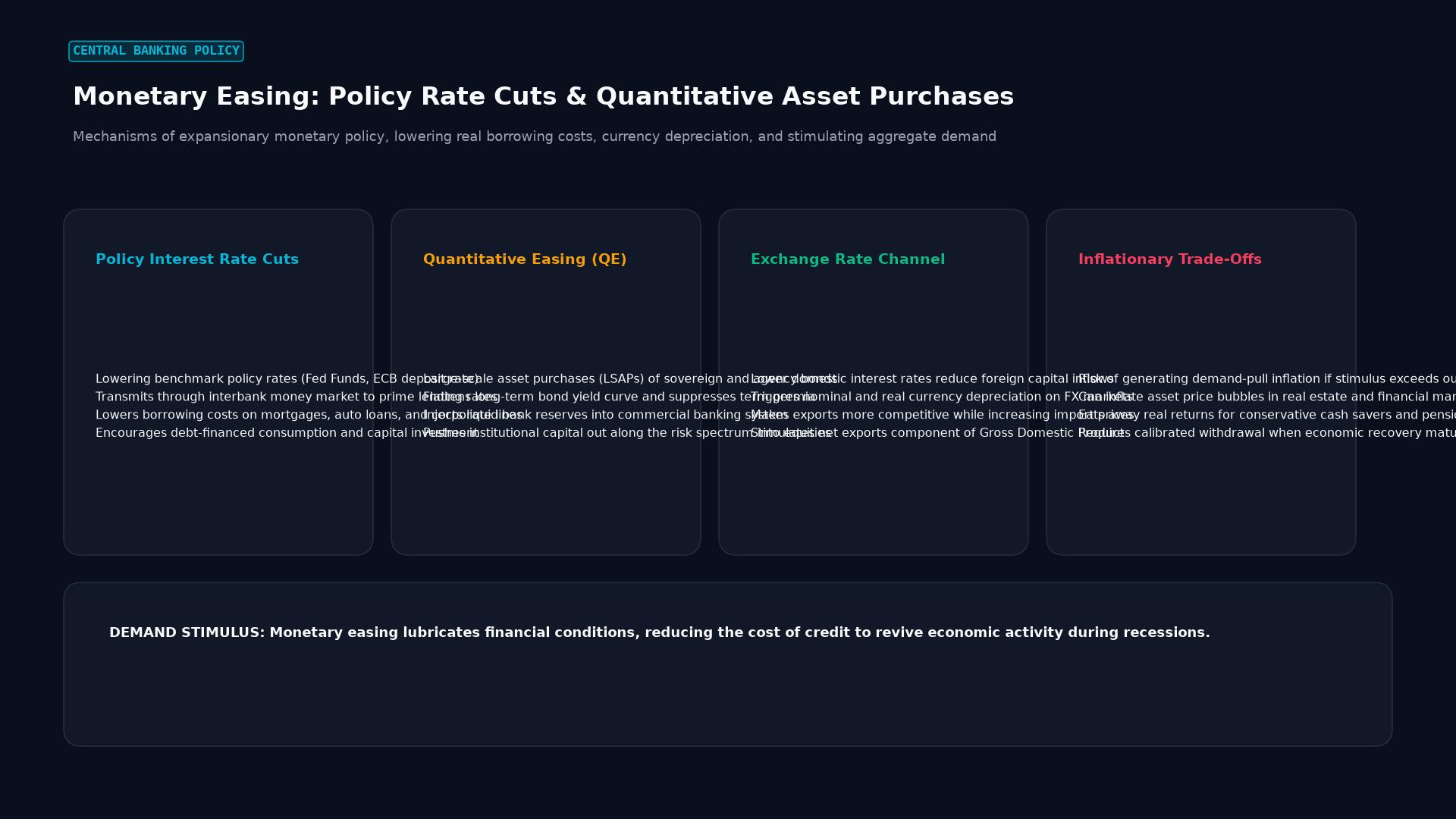 Figure: Mechanisms of expansionary monetary policy, lowering real borrowing costs, currency depreciation, and stimulating aggregate demand
- Credit Channel: Cheaper loans lower debt servicing burdens for corporations and households, spurring consumer demand and capital expenditures.
- Wealth Effect: With cash and bond yields depressed, investors rotate capital into stocks and real estate. Rising asset portfolios make consumers feel wealthier, encouraging spending.
- Exchange Rate Channel: Falling yields diminish foreign demand for domestic bonds and money-market instruments, causing the domestic currency to depreciate. A weaker currency makes the nation’s exports cheaper abroad while boosting domestic inflation through higher import prices.
Impact of Monetary Easing on Forex Markets
In the foreign exchange market, currencies function as shares in their national economies. When a central bank embarks on monetary easing while peer central banks remain neutral or hawkish, the easing currency almost invariably depreciates:
- Yield Disadvantage: Capital flows toward currencies offering higher real yields. When a central bank cuts interest rates, international fund managers liquidate local assets to seek higher carry elsewhere.
- Carry Trade Funding: Easing currencies often become preferred “funding currencies” in carry trades. Investors borrow cheap capital in the easing currency and convert it into high-yielding emerging market currencies.
- Currency Debasement Concerns: Aggressive balance sheet expansion through QE increases the broad money supply ($M2$), diminishing the purchasing power of the currency relative to hard commodities like gold and oil.
Practical Example: Federal Reserve Easing in 2020 and EUR/USD
The global economic shock of March 2020 provides a textbook case study in aggressive monetary easing:
- The Emergency Action: Facing severe market dislocation, the U.S. Federal Reserve slashed its benchmark funds rate by 150 basis points to a target range of 0.00%–0.25% and announced open-ended Quantitative Easing, expanding its balance sheet by over $3 trillion within a few months.
- Initial Safe-Haven Surge: In the initial panic, the U.S. Dollar Index (DXY) spiked above 103.00 as global institutions scrambled for dollar cash liquidity.
- The Sustained Bearish Trend: Once monetary easing flooded the banking system with unprecedented dollar liquidity and reduced real U.S. yields into deep negative territory, the dollar entered a prolonged bear market.
- EUR/USD Trajectory: EUR/USD rallied relentlessly from a low of 1.0635 in March 2020 to reach a high above 1.2340 by early January 2021—a move of more than 1,700 pips driven by the Fed’s aggressive easing posture relative to European monetary policy.
Risks and Side Effects of Prolonged Easing
While monetary easing revives economies during recessions, extended periods of ultra-easy money carry severe long-term risks:
- Runaway Inflation: Expanding liquidity beyond an economy’s productive capacity inevitably leads to persistent consumer price inflation.
- Speculative Asset Bubbles: Near-zero borrowing costs encourage excessive risk-taking, creating unsustainable bubbles in real estate, corporate debt, and speculative equities.
- Zombie Companies: Artificially low rates allow unproductive, heavily indebted businesses to survive on cheap debt rather than restructuring, dragging down long-term economic productivity.
Key Takeaways
- Stimulative Policy: Monetary easing expands the money supply and lowers borrowing costs to fight recessions and deflation.
- Tools of the Trade: Employs benchmark rate cuts, lower reserve requirements, Quantitative Easing, and forward guidance.
- Currency Headwinds: A central bank cutting rates creates downward pressure on its currency as international yield-seeking capital exits.
- Asset Inflation: Easing tends to boost equities, commodities, and real estate by pushing investors out of low-yielding cash into risk assets.
- Inflationary Rebound: Excessive or prolonged easing risks overheating the economy and triggering sharp inflationary spikes that eventually force central banks into aggressive tightening.
Frequently Asked Questions
What is the difference between monetary easing and quantitative easing (QE)?
Monetary easing is the overarching policy objective of loosening monetary conditions. Quantitative easing is a specific, unconventional tool within monetary easing where a central bank purchases long-term financial assets on the open market to inject fresh reserves into the commercial banking system.
How does monetary easing affect retail forex traders?
Monetary easing creates high-conviction macro trend trades. Retail traders typically look to sell the currency of a central bank entering an easing cycle against currencies whose central banks are either hiking rates or holding them steady, capturing both directional trend pips and favorable interest rate differentials.
What is quantitative tightening (QT)?
Quantitative tightening is the exact opposite of monetary easing. In QT, a central bank reduces the size of its balance sheet by letting mature bonds roll off without reinvestment or by actively selling securities, draining liquidity from the financial system to cool down inflation.
Ready to trade forex?
Open a free demo account with a regulated broker. Practice with virtual funds before risking real money.