Naked Put
A naked put—or uncovered put—is an aggressive options trading strategy where a trader sells a put option on margin without holding an offsetting short position or cash reserve, assuming substantial downside tail risk in exchange for upfront premium income.
What Is a Naked Put?
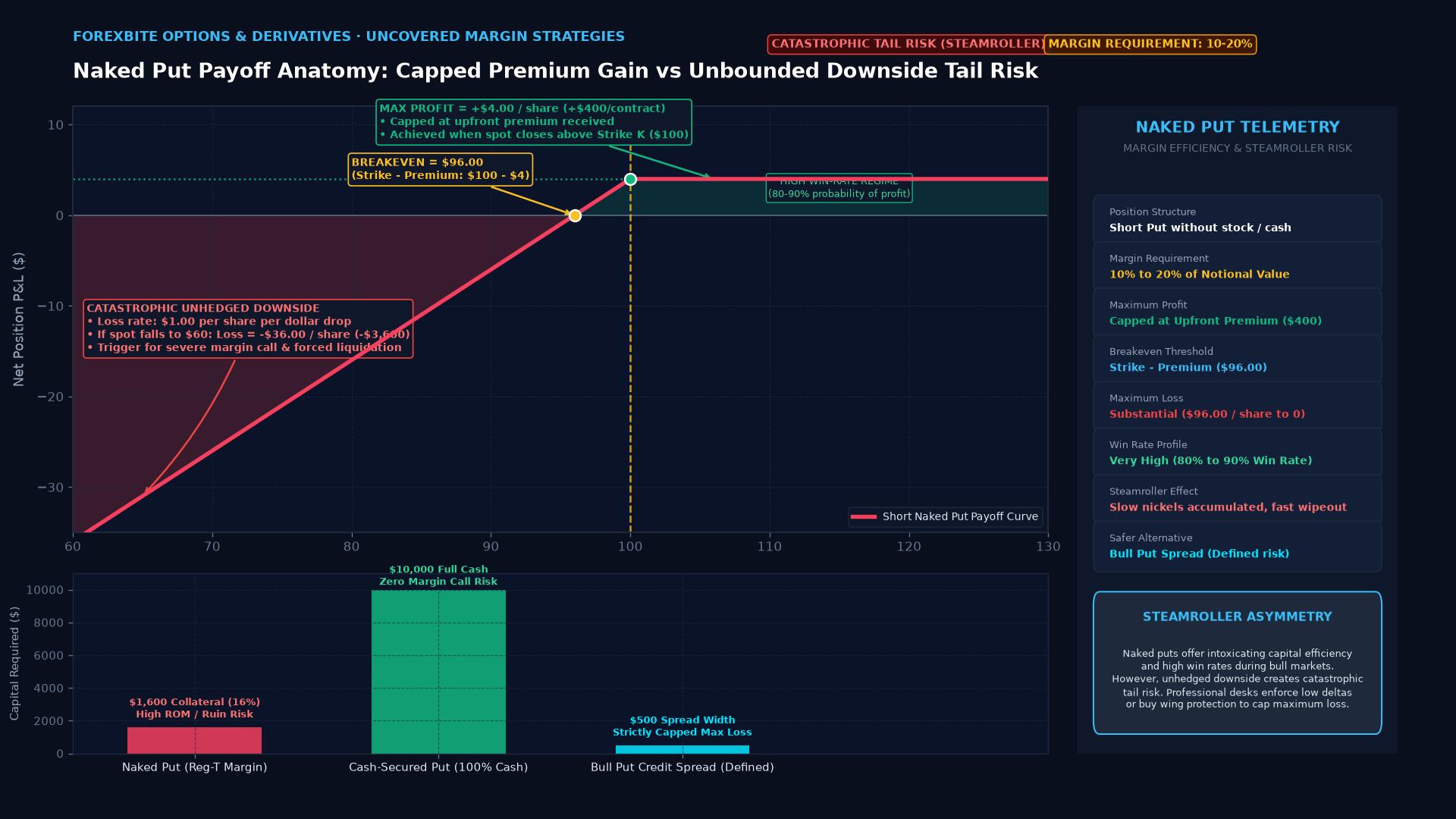
A naked put (also referred to as an uncovered put or short put) is a high-risk, bullish-to-neutral derivative strategy in which an options trader writes (sells) a put option contract without holding a corresponding short position in the underlying asset and without setting aside 100% of the cash collateral required to purchase the underlying asset if assigned (unlike a conservative cash-secured put).
Because the trade is executed entirely on broker margin, the seller must post only a fractional collateral deposit (typically 10% to 20% of the notional assignment value). In exchange for assuming the contractual obligation to purchase the underlying asset at the agreed strike price ($K$) upon expiration, the seller collects the upfront option premium directly into their account cash balance.
If the underlying asset stays above the strike price, the option expires worthless (lapses), allowing the writer to keep 100% of the premium as profit. However, if the underlying asset suffers a steep, unexpected market crash, the naked put seller faces catastrophic financial losses, as they are legally forced to purchase plunging assets at the inflated strike price.
Key Takeaways
- Asymmetric Risk Profile: Upside profit is strictly capped at the upfront option premium received; downside risk is massive, theoretically extending down to zero asset price.
- Margin-Driven Leverage: Traded on fractional margin borrowing; a trader with $10,000 in capital can sell puts on $100,000+ in underlying notional value, generating immense capital efficiency or catastrophic ruin.
- The “Steamroller” Analogy: Naked put sellers boast extraordinarily high win rates (often 80% to 95%) during calm bull markets, but a single black-swan gap can wipe out years of accumulated profits in hours.
- Naked Put vs. Cash-Secured Put: A cash-secured put holds 100% cash in reserve and cannot trigger a margin call. A naked put relies on margin credit, exposing the trader to forced liquidation if equity collapses.
- High Options Approval Tier: Due to severe risk of negative account balances, regulated brokers mandate their highest options trading clearance (Level 4 or 5) before allowing naked put execution.
Comparative Taxonomy: Put Selling Strategies
| Option Strategy | Capital Required | Downside Risk Profile | Margin Call Vulnerability? | Broker Approval Tier |
|---|---|---|---|---|
| Naked Put (Uncovered) | Fractional Margin (10%–20%) | Catastrophic (To zero asset price) | Extremely High | Highest Level (Level 4 / 5) |
| Cash-Secured Put (CSP) | 100% Cash (Strike $\times$ 100) | Capped at net stock purchase price | Zero (100% pre-funded) | Basic Tier (Level 1 / 2) |
| Bull Put Credit Spread | Defined Margin (Spread width) | Strictly Capped (Defined risk) | Zero (Long put protects) | Standard Spread Tier (Level 3) |
| Covered Call | Long 100 shares of underlying | Substantial (Stock can drop to $0) | Zero | Basic Tier (Level 1) |
The Mathematics of the Naked Put
The payoff structure of a short naked put option at expiration is defined by:
$$\text{Payoff} = \text{Premium Received} - \max\left( K - S_T, ; 0 \right)$$
$$\text{Break-Even Price} = K - \text{Premium}$$
$$\text{Maximum Possible Loss} = (K - \text{Premium}) \times \text{Contract Multiplier}$$
Numerical Execution Example:
A trader sells an uncovered put on an equity index ETF trading at $450.00:
- Strike Price ($K$): $430.00 (Out-of-the-money)
- Tenor: 30 Days
- Option Premium Received: $5.00 per share ($500 cash credited per 100-share contract).
- Broker Margin Requirement: 20% of notional = $\frac{$43,000}{5} = \mathbf{$8,600}$ collateral.
- Break-Even Price: $$430.00 - $5.00 = \mathbf{$425.00}$.
Expiration Scenarios:
- Mild Bull / Neutral ($S_T \ge 430.00$): Spot closes at $440.00. The option lapses worthless. The seller retains the full +$500 profit (+5.8% return on margin).
- Black Swan Crash ($S_T = 330.00$): A surprise geopolitical crisis collapses the market to $330.00.
- The contract is assigned at $430.00.
- Gross Loss = $($430.00 - $330.00) \times 100 = $10,000$.
- Net Loss after retaining premium = $$10,000 - $500 = \mathbf{-$9,500}$.
- The loss completely wipes out the trader’s $8,600 margin deposit and creates a negative account deficit requiring immediate repayment.
Real-World Case Study: The “Volmageddon” Crash of February 2018
On February 5, 2018—a day known on Wall Street as “Volmageddon”:
- The Context: Institutional hedge funds and thousands of retail traders had spent years profitably selling out-of-the-money options and volatility products (such as XIV), collecting consistent daily premium yield while the CBOE VIX traded near historic lows of 10.
- The Spike: A sudden late-afternoon selloff in the S&P 500 caused the VIX to spike by an unprecedented 115% in a single trading session.
- The Implied Volatility Explosion: Because option premiums are exponentially sensitive to implied volatility (Vega), out-of-the-money put options suddenly exploded in price by 1,000% to 5,000%.
- The Liquidation Cascade: Naked put sellers faced astronomical margin calls that their account equity could not support. Clearing brokers forcibly bought back the short puts at peak panic quotes to eliminate risk, bankrupting several prominent hedge funds (such as LJM Preservation and Growth Fund, which lost 80% of its capital in two days) and wiping out millions in retail accounts.
Risk Rules for Trading Naked Puts
- Never Over-Leverage Margin: Just because a broker allows you to sell 20 naked put contracts with your margin does not mean you should; size positions as if you might actually be assigned the physical shares.
- Convert to Credit Spreads (Defined Risk): Professional traders frequently buy a deep out-of-the-money put below the sold put strike. This transforms a naked put into a Bull Put Spread, capping maximum theoretical loss and preventing catastrophic liquidation during black swan crashes.
- Enforce Delta Thresholds: Sell puts with low deltas (e.g., 0.10 to 0.15 Delta), ensuring an 85% to 90% statistical probability of expiring worthless under standard lognormal distribution assumptions.
Frequently Asked Questions (FAQ)
What happens if a naked put is assigned?
If the option expires in-the-money, the clearing house assigns the contract to you. You are legally required to purchase 100 shares of the underlying asset per contract at the strike price. If your account lacks sufficient cash, your broker will either issue a margin call or immediately liquidate the purchased shares on the open market, debiting the loss from your account.
Why do traders sell naked puts instead of cash-secured puts?
Capital efficiency. A cash-secured put requires locking up 100% of the cash notional (e.g., $50,000 cash for a $500 strike), generating a modest annualized return on cash. A naked put requires posting only $5,000 to $10,000 in margin collateral, allowing the trader to deploy the remaining cash elsewhere or generate significantly higher return on margin (ROM).
What is the maximum profit on a naked put?
The maximum profit is strictly limited to the total upfront option premium collected when writing the contract. It is impossible to make more than the initial premium, regardless of how high the underlying asset price rallies.
Ready to trade forex?
Open a free demo account with a regulated broker. Practice with virtual funds before risking real money.