Narrow Market
A narrow market—also referred to as a thin or shallow market—is a trading environment characterized by low transaction volume, scarce market participants, wide bid-ask spreads, and heightened vulnerability to volatile price spikes from modest order flow.
What Is a Narrow Market?
A narrow market (frequently described by traders as a thin market, shallow market, or light trading environment) is a financial condition wherein the volume of buying and selling interest is significantly depressed relative to normal operating conditions. In a narrow market, order books lack depth: there are very few resting limit orders at each price tier, and the total number of active institutional market participants is sharply curtailed.
In foreign exchange (Forex), narrow market conditions can arise structurally (such as in exotic currency pairs with low global trade turnover) or cyclically (such as during major international holidays like Christmas and New Year’s, or during the daily transition between the New York close and the Asian market open).
Because resting limit orders are sparse, the balance of power between buyers and sellers is fragile. A single commercial buy or sell order that would barely cause a ripple in a deeply liquid market can trigger sudden, violent price dislocations, severe execution slippage, and erratic flash crashes in a narrow market.
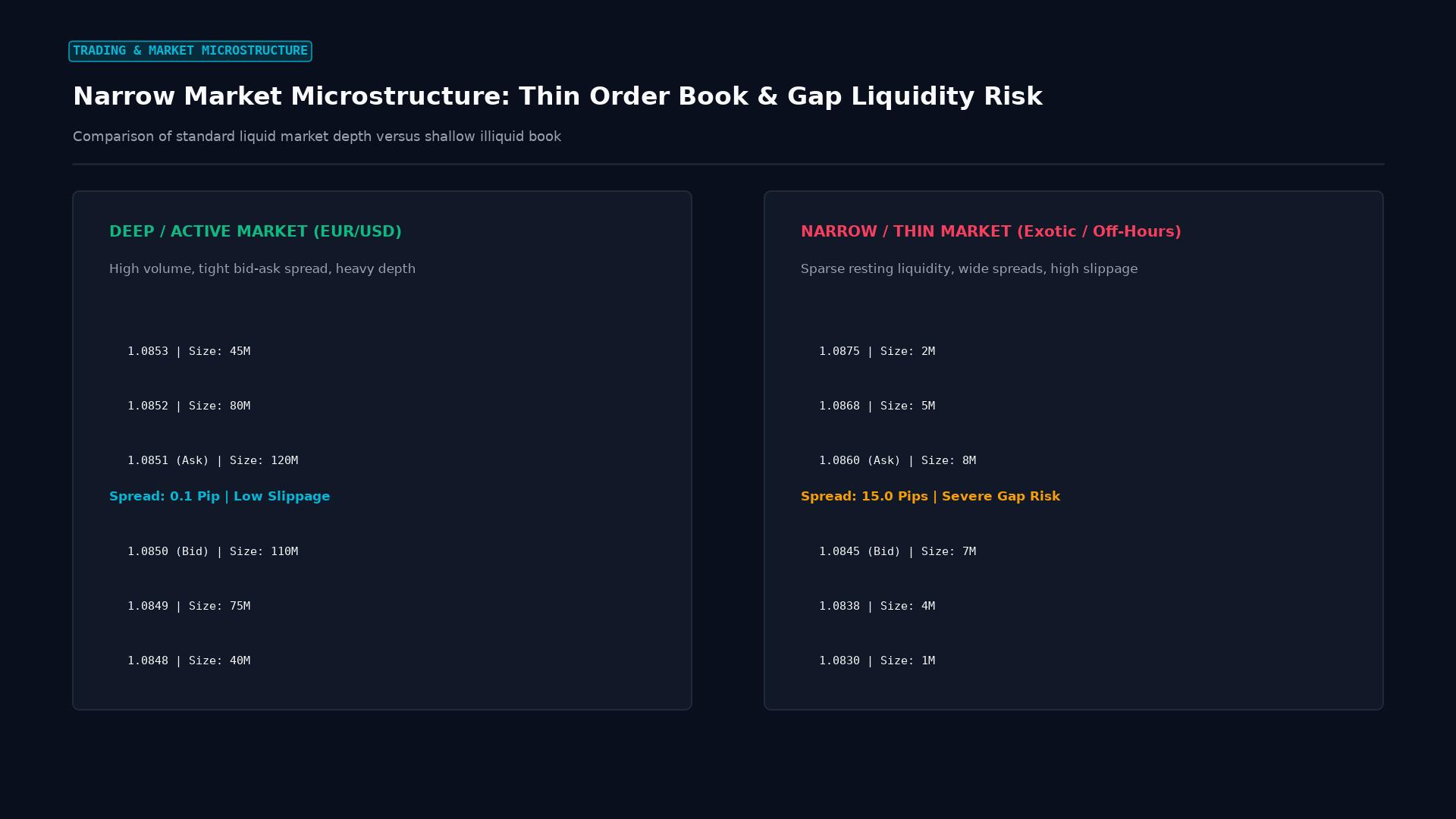 Figure: Order book comparison: deep liquid market with tight spreads vs narrow illiquid market with sparse resting depth and high slippage risk.
Key Takeaways
- Sparse Order Book Depth: Resting bid and ask limit orders are minimal, meaning small transactional volumes easily consume available liquidity tiers.
- Inflated Bid-Ask Spreads: Because liquidity providers take on heightened inventory risk when counterparties are scarce, they widen bid-ask spreads significantly to protect profit margins.
- Severe Execution Slippage: Market orders and triggered stop-losses experience substantial negative slippage, as orders sweep across multiple price levels to find matching liquidity.
- Susceptibility to Manipulation: Narrow markets are vulnerable to aggressive institutional “stop hunts,” where large market participants intentionally push prices through obvious support/resistance levels to trigger retail stops.
- Predictable Seasonal Occurrences: Narrow market conditions predictably materialize during the Christmas-to-New-Year holiday corridor, late Friday afternoons, and during the daily 5:00 PM EST interbank rollover cut.
Comparative Taxonomy: Narrow vs. Broad (Deep) Markets
| Operational Dimension | Narrow Market (Thin / Illiquid) | Broad Market (Deep / Liquid) |
|---|---|---|
| Trading Volume | Low to depressed | High to massive |
| Bid-Ask Spreads | Wide and erratic (e.g., 5 to 50+ pips) | Razor-thin (e.g., 0.1 to 0.5 pips) |
| Price Impact (Kyle’s $\lambda$) | Extreme (Small orders dislocate price) | Negligible (Large block trades absorbed smoothly) |
| Technical Reliability | Poor (Prone to false breakout wicks) | High (Respects key structural levels) |
| Slippage Severity | Frequent and substantial | Rare under normal conditions |
| Typical Occurrence | Holidays, Asian night lull, exotic pairs | London-New York session overlap in G10 majors |
Market Microstructure Mechanics: The Price Impact Function
In market microstructure theory, the relationship between order size ($Q$) and price dislocation ($\Delta P$) is dictated by the depth of the limit order book:
$$\Delta P = \lambda_{\text{market}} \cdot Q + \eta$$
Where $\lambda_{\text{market}}$ (Kyle’s Lambda) measures market illiquidity:
- In a Broad, Liquid Market, $\lambda \approx 0$. A $10,000,000 order produces an imperceptible price shift: $$\Delta P = 0.00001 \times 10,000,000 = 0.1 \text{ pips}$$
- In a Narrow Market, $\lambda$ expands exponentially. The exact same $10,000,000 order sweeps through resting liquidity: $$\Delta P = 0.00500 \times 10,000,000 = \mathbf{50.0 \text{ pips}}$$
This mathematical sensitivity explains why algorithmic high-frequency market makers automatically shut down or widen quoting bands whenever tick volume drops below predetermined thresholds.
Real-World Case Study: The Japanese Yen “Flash Crash” (January 3, 2019)
The classic danger of trading in a narrow market occurred on the morning of January 3, 2019:
- The Narrow Setup: Japanese financial markets were closed for the extended Golden Week / New Year’s bank holidays. It was 07:30 AM Tokyo time (5:30 PM New York time)—the absolute thinnest, most illiquid “twilight hour” of global foreign exchange trading.
- The Catalyst: Apple Inc. issued an unexpected earnings guidance downgrade, triggering minor safe-haven flows toward the Japanese Yen.
- The Cascade: In a normal London session, this headline would have prompted a modest 30-pip dip. However, in the ultra-narrow holiday market, automated algorithmic trading programs began hitting bids across sparse order books.
- The Flash Crash: Within seven minutes:
- USD/JPY plunged over 400 pips from 108.80 to 104.70.
- AUD/JPY collapsed by over 7% (500+ pips) down to 70.00.
- The Aftermath: Retail margin accounts holding long cross-yen trades were forcibly stopped out across catastrophic slippage levels before prices rebounded almost entirely within an hour, illustrating the lethal risk of operating with leverage inside a narrow market.
Tactical Rules for Navigating Narrow Markets
- Widen Protective Stop-Losses or Stay Flat: In thin holiday conditions, standard 15-pip stops are virtually guaranteed to be triggered by erratic random wicks. Either widen stop distances and reduce position sizes proportionally, or close all positions and step away from the market.
- Avoid Executing Aggressive Market Orders: Always utilize Limit Orders with strictly defined limit prices to prevent receiving catastrophic execution fills through an empty order book.
- Beware of False Breakouts: Breakouts of key support and resistance levels that occur on low volume in a narrow market fail over 70% of the time, typically resolving as “liquidity grab” traps that quickly reverse.
Frequently Asked Questions (FAQ)
Is it safe to trade forex during the Christmas and New Year holidays?
Most professional institutional desks strongly advise against trading between December 22nd and January 3rd. Institutional bank desks operate with skeleton crews, volume evaporates, and the market becomes “narrow,” creating unpredictable price wicks and inflated broker spreads.
What is the difference between a narrow market and a quiet market?
A “quiet market” is a calm, low-volatility consolidation channel where prices move slowly within a narrow range because participants are awaiting a catalyst. A “narrow market” refers specifically to an absence of underlying order book volume and depth, meaning that even a quiet market can suddenly turn into an explosive, volatile flash crash with a single order.
Why do broker spreads widen so much in a narrow market?
Retail brokers receive their price feeds from institutional liquidity providers. In a narrow market, liquidity providers face immense difficulty finding matching buyers or sellers to lay off risk. To protect themselves from holding unwanted inventory during erratic price swings, they widen their quoted spreads.
Ready to trade forex?
Open a free demo account with a regulated broker. Practice with virtual funds before risking real money.