Not Held Basis Order
A Not Held Basis Order—or Not Held Order (NH)—is an institutional order that grants a broker full discretion over execution price and timing, legally absolving the broker of liability for missed market opportunities while working the order.
What Is a Not Held Basis Order?
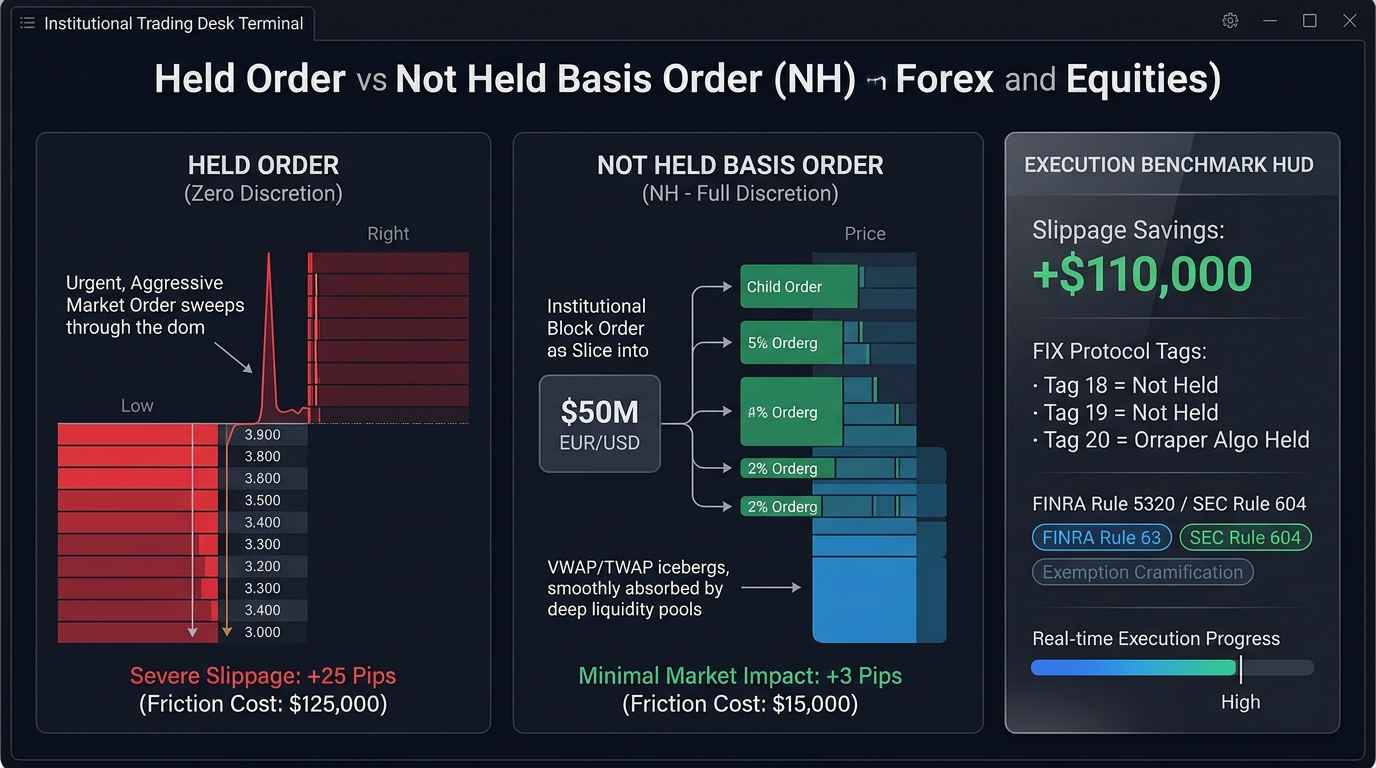
In institutional equity trading, derivatives dealing, and wholesale foreign exchange execution, a Not Held Basis Order (commonly designated as a Not Held Order, abbreviated as NH on order tickets) is a specialized trading instruction that confers full execution discretion upon the broker or trading desk. When a client submits an order on a “not held” basis, they explicitly release the broker from the legal and financial obligation to execute immediately at prevailing market prices.
The terminology originates from exchange floor practice: under a standard “Held Order,” a broker is legally held responsible for executing the client’s order instantly; if the market trades at the specified price and the broker fails to execute, the broker must reimburse the client for the missed trade from their own pocket. In contrast, with a Not Held Order, the broker is not held liable for price fluctuations or missed executions while using their professional judgment, algorithmic slicing tools, or market-reading acumen to work a large block order over time.
Key Takeaways
- Broker Discretionary Authority: Grants the executing broker the flexibility to determine when, how, and at what price to execute portions of a large block order throughout the trading day.
- Exemption from Liability: The client waives the right to claim financial damages if the market moves away and the order remains partially or wholly unfilled.
- The Block Trading Tool: Crucial for pension funds, mutual funds, and sovereign wealth entities needing to execute massive positions (e.g., $100M+ in foreign exchange or 500,000 shares in equities) without causing severe price dislocations.
- Exemption from Display Rules: Under regulatory standards (such as FINRA Rule 5320 and SEC Rule 604), Not Held orders are exempt from mandatory immediate limit order display rules, allowing brokers to conceal institutional intentions from high-frequency front-runners.
- Contrast with Held Orders: All standard retail orders (market orders, stop-losses, retail limit orders) are strictly Held Orders, requiring instantaneous, non-discretionary broker processing.
Comparative Taxonomy: Execution Order Types
| Order Directive | Broker Discretion | Legal Liability for Delay | Typical User | Market Impact Profile |
|---|---|---|---|---|
| Not Held Order (NH) | Complete Discretion (Price & Timing) | Zero (Client waives liability) | Institutional asset managers, sovereign funds | Minimal (Worked algorithmically) |
| Held Order | Zero Discretion (Must execute instantly) | Strict Liability on broker | Retail traders, standard wealth accounts | High on large block orders |
| Market Order | Zero (Immediate fill at best quote) | Strictly held to execute | Retail and day traders | High negative slippage risk |
| Limit Order | Zero (Executes only at price or better) | Strictly held if price is traded | Retail and algorithmic systems | Zero market impact until filled |
The Economics of Block Execution: The “Working” Order
When an institutional fund manager needs to accumulate $100,000,000 USD/JPY, submitting a simple Market Order is suicidal: it would instantly consume all resting offers in the interbank order book, moving the exchange rate by 30 to 50 pips against the fund.
Instead, the fund manager routes the order to an institutional execution desk marked “Buy $100M USD/JPY – Not Held”:
- Algorithmic Discretion: The dealer deploys specialized algorithmic execution schedules, such as Volume-Weighted Average Price (VWAP) or Time-Weighted Average Price (TWAP).
- Opportunistic Accumulation: The dealer waits for intraday retracements, stepping into the market as a passive buyer when foreign export orders arrive, absorbing liquidity quietly without alerting the broader market.
- The Trade-Off: If a sudden geopolitical crisis erupts during the day and USD/JPY surges 200 pips before the broker finishes buying, the client cannot sue the broker for failing to buy immediately. The client accepted timing risk in exchange for minimizing execution impact.
Real-World Case Study: Pension Fund Rebalancing Execution
A multi-billion-dollar sovereign pension fund conducts quarterly asset rebalancing, requiring the liquidation of a €200,000,000 EUR/GBP position.
-
Option A: Executing via Standard Held Market Orders:
- The trading desk dumps the €200M notional in five large chunks onto the London Stock Exchange and interbank matching engines.
- Institutional market makers detect the massive one-way flow; bids pull back immediately.
- The fund incurs an average execution slippage of 18 pips, resulting in an unrecoverable transaction loss of £360,000 GBP.
-
Option B: Executing via a Not Held Basis Order:
- The fund manager assigns the execution to a specialized agency broker marked: “Sell €200M EUR/GBP, Not Held, benchmark to London 4:00 PM Fix.”
- The agency broker works the order over a four-hour window, pairing client sells with incoming European corporate import flow and utilizing dark liquidity pools.
- The order completes with an average execution price within 0.8 pips of the daily volume-weighted benchmark, saving the pension fund over £300,000 in transaction drag.
Regulatory Compliance and Information Safeguards
- Institutional Designation: In modern regulated markets (such as under the SEC and FINRA in the U.S. or the FCA in the UK), brokers cannot treat an order as “Not Held” by default. The client must either provide explicit written authorization on the order ticket or maintain a signed institutional master execution agreement authorizing discretionary handling.
- Audit Trails: Regulators require brokerages to record detailed electronic audit logs showing the algorithmic child-orders and human decisions made while working a Not Held order to verify that the broker did not favor proprietary non-client house accounts over the worked client block.
Frequently Asked Questions (FAQ)
Can a retail trader place a Not Held order on MetaTrader?
No. Retail trading platforms like MetaTrader 4 and 5 operate exclusively under non-discretionary, automated Held Order mechanics. Not Held orders are utilized exclusively in institutional finance between hedge funds, pension funds, and professional broker-dealer execution desks.
What does “working an order” mean?
“Working an order” is the process where a professional broker breaks a massive block order into hundreds or thousands of smaller algorithmic sub-orders, executing them gradually throughout the trading session to achieve the best average price while concealing the total order size from the market.
What is the primary difference between a Limit Order and a Not Held Order?
A Limit Order restricts the broker to a rigid, mathematical price boundary (must execute at the limit price or better, with zero discretion). A Not Held Order grants the broker qualitative leeway to buy above or below current prices, delay execution, or wait for better market conditions based on professional judgment.
Ready to trade forex?
Open a free demo account with a regulated broker. Practice with virtual funds before risking real money.