Off-Balance Sheet
Off-balance sheet (OBS) refers to assets, liabilities, financing commitments, or derivative exposures that are not recorded directly on a company's or bank's formal balance sheet statement, but represent contractual obligations or potential claims that impact financial risk.
What Is Off-Balance Sheet (OBS)?
In financial accounting and institutional banking, off-balance sheet (OBS) items refer to economic resources, contingent obligations, and financing vehicles that are not recognized directly on a reporting entity’s statement of financial position (balance sheet). Under both International Financial Reporting Standards (IFRS) and US GAAP, certain contractual agreements do not qualify as recognized assets or liabilities at inception, despite generating significant economic exposures and cash flow commitments.
Historically, corporations and commercial banks utilized off-balance sheet mechanisms to manage debt-to-equity ratios, reduce reported leverage, and minimize regulatory capital charges under Basel Accords. While legitimate corporate finance uses OBS structures for risk mitigation and asset-backed securitization, aggressive off-balance sheet accounting has also been at the epicenter of major financial crises, including the 2001 collapse of Enron and the 2007–2008 subprime mortgage banking panic.
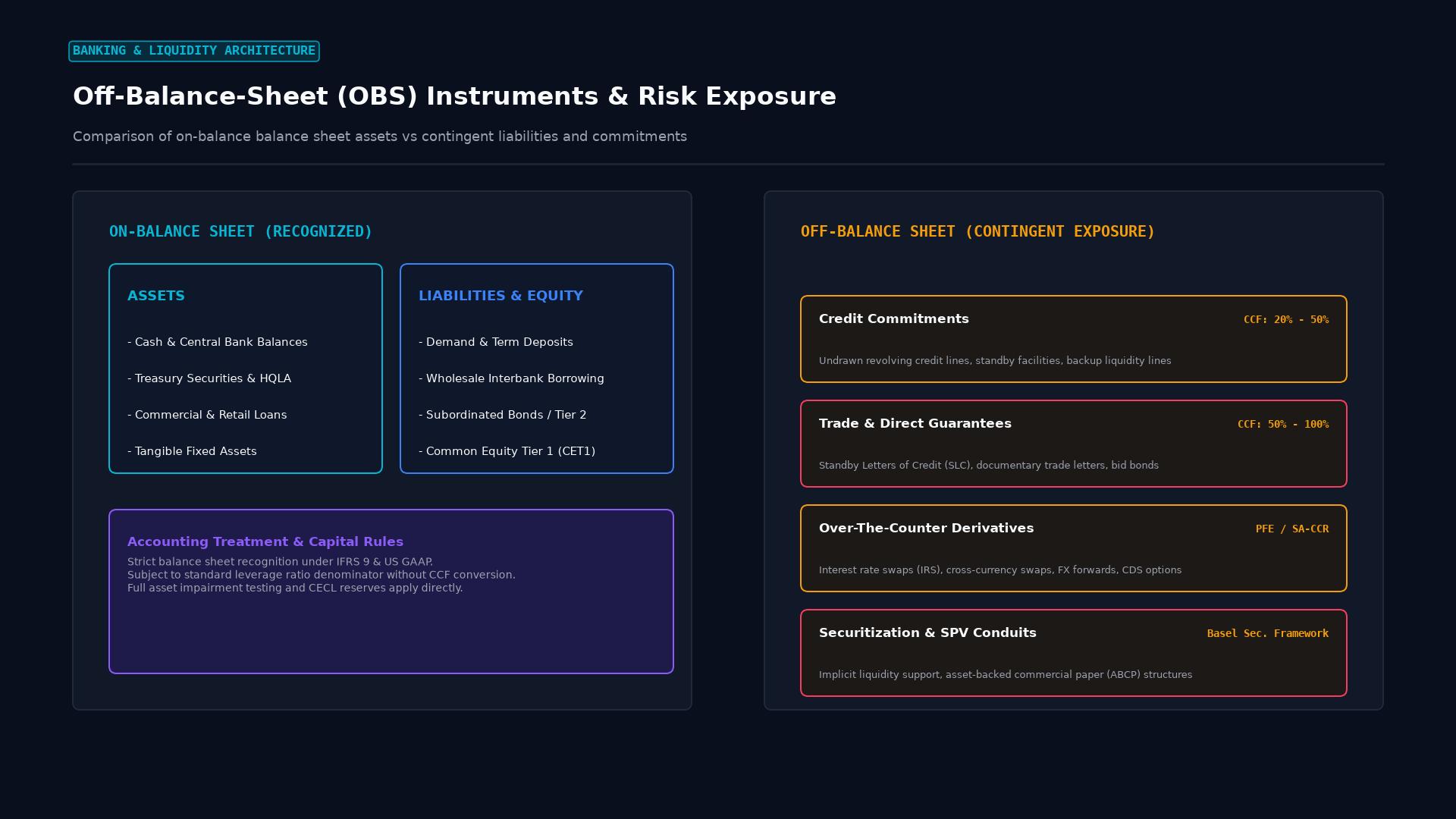 Figure: Comparison of on-balance sheet assets and liabilities with off-balance sheet commitments, letters of credit, derivative swaps, and credit conversion factors.
Primary Forms of Off-Balance Sheet Activities
Financial institutions and corporate treasuries structure off-balance sheet items across three broad categories:
1. Financial Derivatives and Hedging Contracts
In corporate treasuries and interbank dealing desks, derivative contracts—such as interest rate swaps (IRS), forward foreign exchange contracts, and credit default swaps (CDS)—carry enormous notional amounts that never appear on the balance sheet. Instead, only the fair value (mark-to-market net replacement value) is recognized as a derivative asset or liability:
- A multinational corporation entering a $100,000,000 forward contract to hedge EUR/USD currency risk does not record $100M of assets or debt; it records $0 at inception and subsequently recognizes only floating unrealized gains or losses.
2. Letters of Credit and Credit Guarantees
In trade finance, banks issue standby letters of credit (SBLCs) and performance bonds on behalf of importers and exporters. The issuing bank guarantees payment to a third party only if the corporate borrower defaults. Because this obligation is contingent on an uncertain future event, it resides off-balance sheet in accounting disclosures until a claim is triggered.
3. Special Purpose Entities (SPEs / SPVs)
In asset securitization, a sponsor bank transfers pools of residential mortgages, auto loans, or credit card receivables to an independent legal trust known as a Special Purpose Vehicle (SPV). The SPV finances the asset purchase by issuing asset-backed securities (ABS) or collateralized loan obligations (CLOs) to capital market investors. If structured to satisfy legal isolation and derecognition criteria, the underlying debt and assets are removed from the sponsoring bank’s balance sheet.
Regulatory Framework: Basel III and Accounting Reforms
Following major market disruptions, accounting standard-setters and central bank regulators implemented sweeping rules to bring transparency to off-balance sheet leverage:
| Accounting Standard / Rule | Regulatory Focus | Impact on OBS Items |
|---|---|---|
| IFRS 16 / ASC 842 | Operating Leases | Ended off-balance sheet operating leases. Requires lessees to recognize a “Right-of-Use Asset” and corresponding lease liability on the balance sheet. |
| Basel III Leverage Ratio | Bank Capital Adequacy | Imposed a non-risk-weighted leverage ratio (minimum 3%) that includes off-balance sheet exposures converted via Credit Conversion Factors (CCFs). |
| Credit Conversion Factor (CCF) | OBS Exposure Measurement | Assigns percentages (20% to 100%) to off-balance sheet commitments (e.g., undrawn credit lines) to calculate risk-weighted assets (RWA). |
| FIN 46(R) / ASC 810 | Variable Interest Entities (VIE) | Mandates consolidation of SPVs/VIEs onto the parent company balance sheet if the parent holds the power to direct economic activities and absorbs risks. |
The Risks: Lehman Brothers and Repo 105
The dangerous potential of off-balance sheet maneuvers was highlighted in the 2008 bankruptcy of investment bank Lehman Brothers.
Lehman utilized an internal accounting procedure known as Repo 105:
- At the end of financial reporting quarters, Lehman entered short-term repurchase (repo) agreements, transferring $50 billion in liquid securities to counterparties in exchange for cash.
- Because the securities were valued at 105% of the cash received, Lehman classified the transactions under UK accounting rules as “sales” rather than collateralized borrowings.
- Lehman used the cash proceeds to pay down short-term liabilities, temporarily shrinking its balance sheet and reducing its net leverage ratio from 32x to 27x in regulatory disclosures.
- Days after quarterly filings closed, Lehman borrowed money to repurchase the securities, returning the debt to the firm.
       LEHMAN'S REPO 105 QUARTER-END BALANCE SHEET DE-LEVERAGING

 [Day 88: Quarter-End Approaches]
 Lehman Balance Sheet: $50B Securities + High Leverage (32:1)
             |
             v [Execute Repo 105 "Sale" in London]
 Counterparty transfers $47.6B Cash <---> Lehman transfers $50B Bonds (OBS)
             |
             v [Pay Down Short-Term Debt]
 Reported Leverage Drops to 27:1 (Quarterly Filing Published to Investors)
             |
             v [Day 93: New Quarter Begins]
 Lehman borrows $47.6B to buy back $50B bonds ---> Leverage jumps back to 32:1
When the mortgage market seized in September 2008, the true extent of Lehman’s off-balance sheet liabilities and interconnected derivative exposures accelerated the largest bankruptcy in financial history.
Frequently Asked Questions
Why do companies use off-balance sheet financing?
Legitimate purposes include risk management (hedging currency or interest rate swings through derivatives), sharing project risk through joint ventures, and maintaining flexible liquidity via standby credit facilities. It allows companies to secure operational assets without overburdening their balance sheet with direct debt.
Where can investors find off-balance sheet liabilities in annual reports?
Investors must examine the Notes to the Financial Statements (specifically sections titled Commitments and Contingencies, Derivatives and Hedging Activities, and Variable Interest Entities). These footnotes detail contractual lease obligations, undrawn debt facilities, derivative gross notional values, and legal claims.
How does Basel III treat off-balance sheet bank exposures?
Under Basel III regulations, banks cannot ignore off-balance sheet items when calculating regulatory capital. Regulators apply Credit Conversion Factors (CCFs) ranging from 20% (for unconditionally cancellable credit facilities) to 100% (for direct credit substitutes like standby letters of credit) to translate OBS commitments into equivalent on-balance sheet risk-weighted assets.
Ready to trade forex?
Open a free demo account with a regulated broker. Practice with virtual funds before risking real money.